
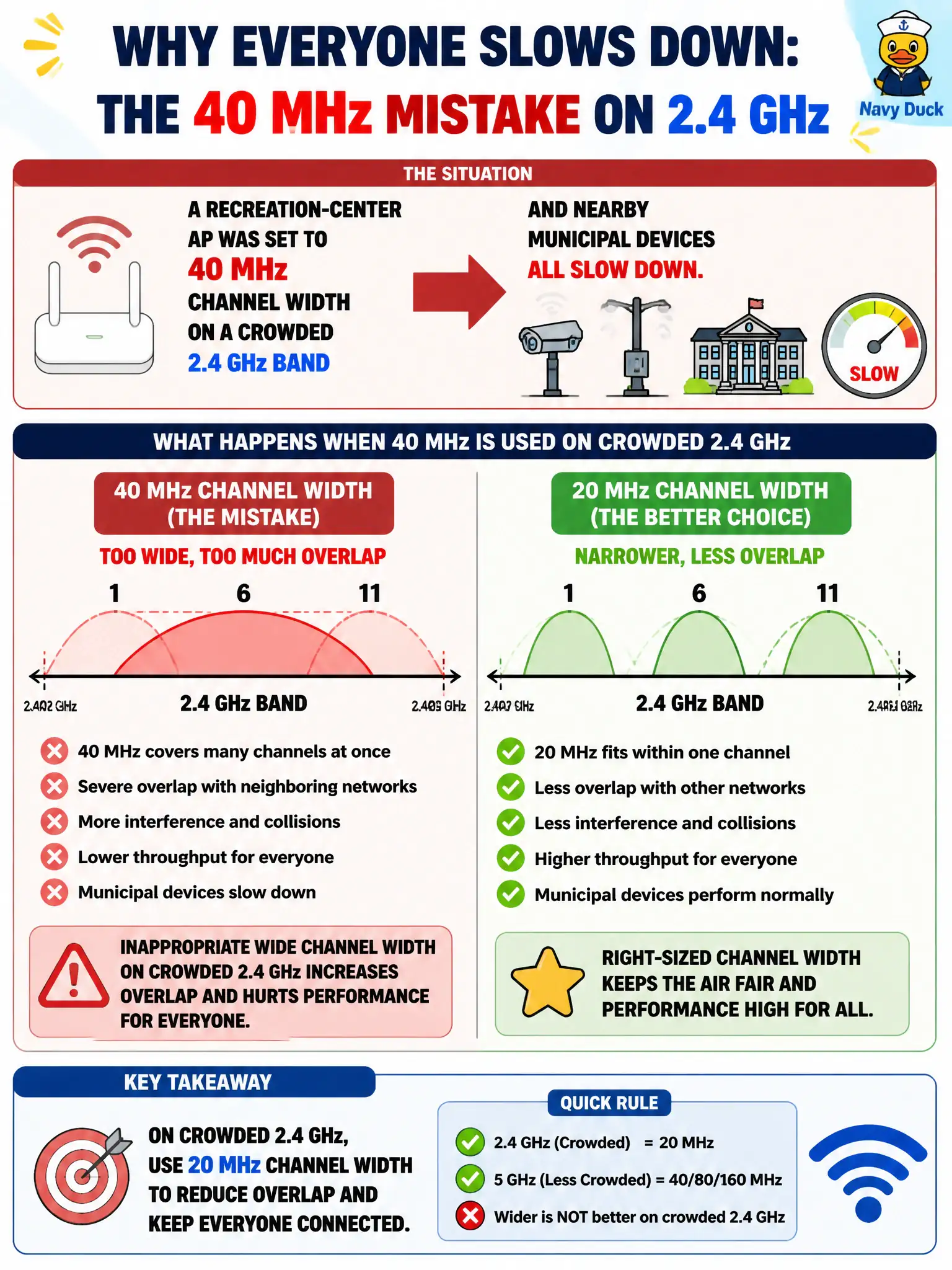
A recreation-center AP was set to 40 MHz channel width on a crowded 2.4 GHz band, and nearby municipal devices all slow down. What configuration mistake best explains the impact?
Select an answer to reveal the explanation.
Short Explanation
Forty megahertz on busy 2.4 GHz is like parking a wide truck across two narrow lanes—everyone scrapes paint. Stick to the narrower width the design calls for in that crowded band. Performance comes back when you stop hogging spectrum.
Full Explanation
A recreation-center AP set to 40 MHz channel width on a crowded 2.4 GHz band that slows nearby municipal devices is explained by inappropriate wide channel width on crowded 2.4 GHz increasing overlap and hurting performance for everyone. 2.4 GHz has few non-overlapping channels; 40 MHz consumes scarce spectrum and raises interference risk. Design docs usually keep 2.4 GHz narrow in dense civic spaces.
Forty megahertz on 2.4 GHz always increasing airtime fairness automatically fails because width does not automatically improve fairness and often worsens congestion. Crowded 2.4 GHz requiring 40 MHz before any SSID can beacon fails by concept: SSIDs beacon on 20 MHz routinely. Channel width only affecting wired PoE class negotiation fails: width is an RF parameter, not PoE classification.
Exam caveat: wide channels on crowded 2.4 GHz are a classic performance misconfiguration.
Operational check: set the recreation AP’s 2.4 GHz width to the design value (typically 20 MHz); retest neighboring device performance; leave 5 GHz widths to design separately; document the mistake for future installs. Audit other recreation 2.4 GHz APs for accidental 40 MHz bonds after this incident so one venue’s mistake does not remain a pattern across parks and community centers.