
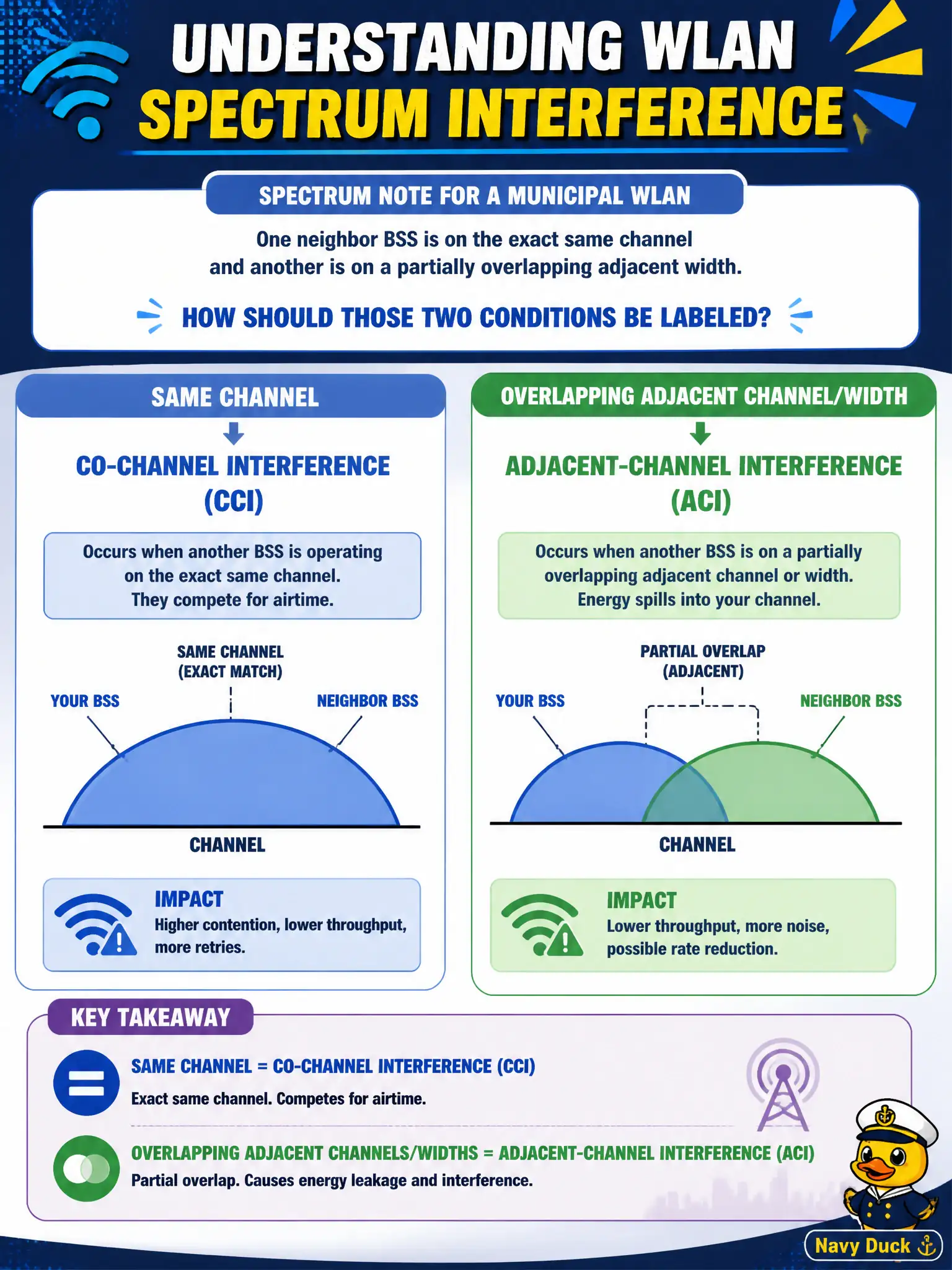
A spectrum note for a municipal WLAN shows one neighbor BSS on the exact same channel and another on a partially overlapping adjacent width. How should those two conditions be labeled?
Select an answer to reveal the explanation.
Short Explanation
Same channel equals CCI—shared walkie-talkie. Overlapping neighbor channels equal ACI—bleed from the next station. Put the right sticker on each so the fix matches the fault.
Full Explanation
A spectrum note showing one neighbor BSS on the exact same channel and another on a partially overlapping adjacent width should be labeled: same channel is co-channel interference (CCI); overlapping adjacent channels/widths are adjacent-channel interference (ACI). Accurate labeling drives different corrective actions—channel reuse planning versus width/separation changes. Municipal RF notes must use the correct terms.
Calling same channel always ACI and partial overlap always CCI swaps the definitions and will drive the wrong fix. Labeling both as identical captive-portal noise fails by concept: portals are not spectrum interference types. Ignoring same-channel neighbors while only adjacent widths matter for CWTS fails because CCI is foundational curriculum.
Exam caveat: memorize CCI vs ACI cleanly; exam items love swapped labels.
Operational check: annotate the spectrum note with CCI for identical channels and ACI for partial overlaps; propose channel/width changes per design separately for each; verify utilization/retries improve after corrections. Keep a one-page RF glossary in the municipal NOC runbook defining CCI versus ACI with examples so ticket notes drive the correct channel versus width remediation.