
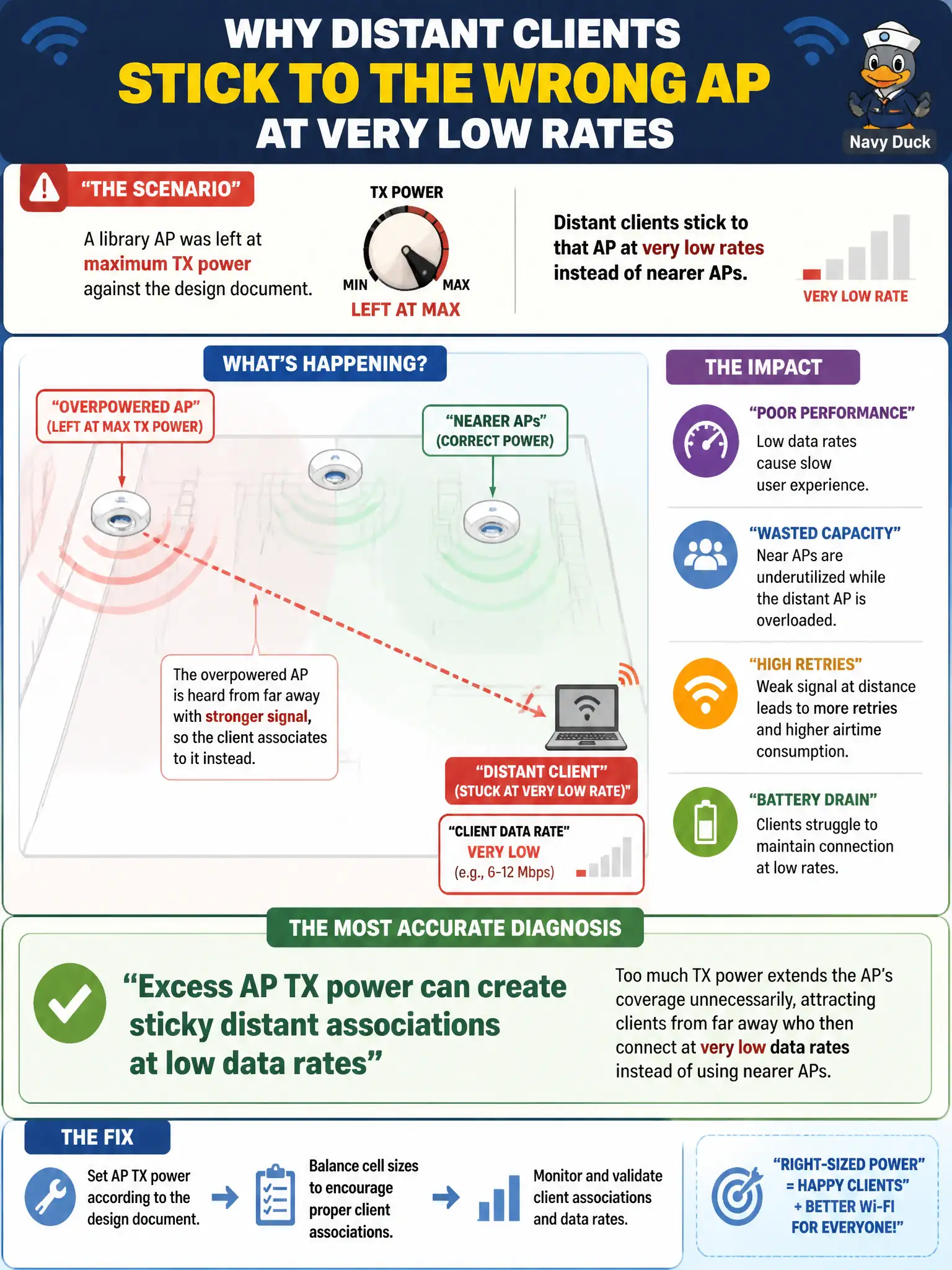
A library AP was left at maximum TX power against the design document. Distant clients stick to that AP at very low rates instead of nearer APs. What is the most accurate diagnosis?
Select an answer to reveal the explanation.
Short Explanation
Blasting the AP too loud makes faraway laptops cling to a weak, slow link like a distant AM station. The design's lower power would have nudged them to a closer AP. Turn power back to the design value.
Full Explanation
A library AP left at maximum TX power against the design document, with distant clients sticking to that AP at very low rates instead of nearer APs, is accurately diagnosed as excess AP TX power creating sticky distant associations at low data rates. Loud APs are heard far away; clients cling while uplink/downlink imbalance and low MCS hurt performance. Technicians restore design power rather than celebrating maximum TX.
Maximum TX power always forcing WPA3 SAE and cannot affect rates fails because TX power does not force SAE and does affect cell size and rates. Excess TX power required by CWTS whenever sticky clients appear fails by concept: CWTS follows design power, and excess power often causes stickiness. Sticky low-rate clients proving the SSID must convert to open authentication fails: security downgrade does not fix cell-edge stickiness.
Exam caveat: max power ≠ max performance. Sticky low-rate clients are a known excess-TX symptom.
Operational check: set AP TX power back to design levels; verify nearer APs become attractive; walk-test that distant clients roam or associate more appropriately; record before/after rates. Revisit library cell edges after power normalization to ensure nearer APs advertise usable SNR and that sticky distant associations at legacy rates no longer dominate the reading rooms.