
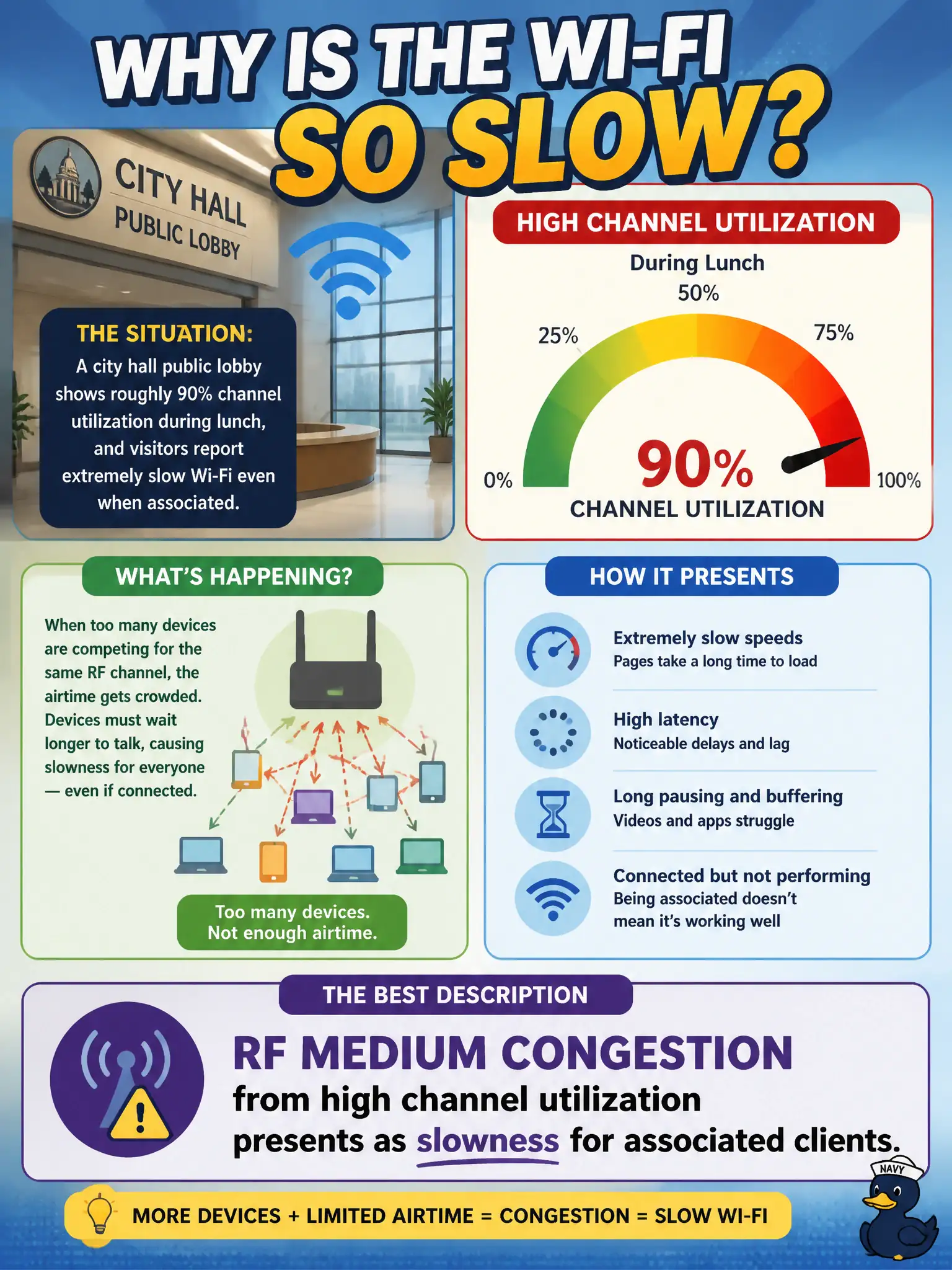
A city hall public lobby shows roughly 90% channel utilization during lunch, and visitors report extremely slow Wi-Fi even when associated. What best describes the performance situation?
Select an answer to reveal the explanation.
Short Explanation
A packed radio channel is like a one-lane bridge at rush hour—everyone is 'on the road' but barely moving. High utilization means the medium is congested, so apps crawl. Look at airtime and density, not just whether the SSID appears.
Full Explanation
A city-hall public lobby at roughly 90% channel utilization during lunch with extremely slow Wi-Fi for associated visitors describes RF medium congestion from high channel utilization presenting as slowness for associated clients. Utilization measures how busy the channel is; association can succeed while airtime is scarce. Lunch crowds are classic civic congestion windows.
High utilization always meaning every client has invalid PSK material fails because associated clients already authenticated. Ninety percent utilization proving ACI cannot exist fails by concept: high utilization and ACI are not mutually exclusive. Lobby slowness only solvable by disabling all beacon frames fails and would break discovery rather than cure congestion.
Exam caveat: high utilization ⇒ congestion performance problem even when clients remain associated.
Operational check: measure channel utilization at lunch; reduce load (capacity, channel plan per design, rate limits, encourage 5/6 GHz if available); retest visitor throughput; do not rotate PSKs as a congestion cure. Consider lunch-hour capacity actions allowed by design—additional 5 GHz SSIDs/APs, client band guidance, or rate limits on guest—so 90% utilization is treated as capacity, not as a password problem.