
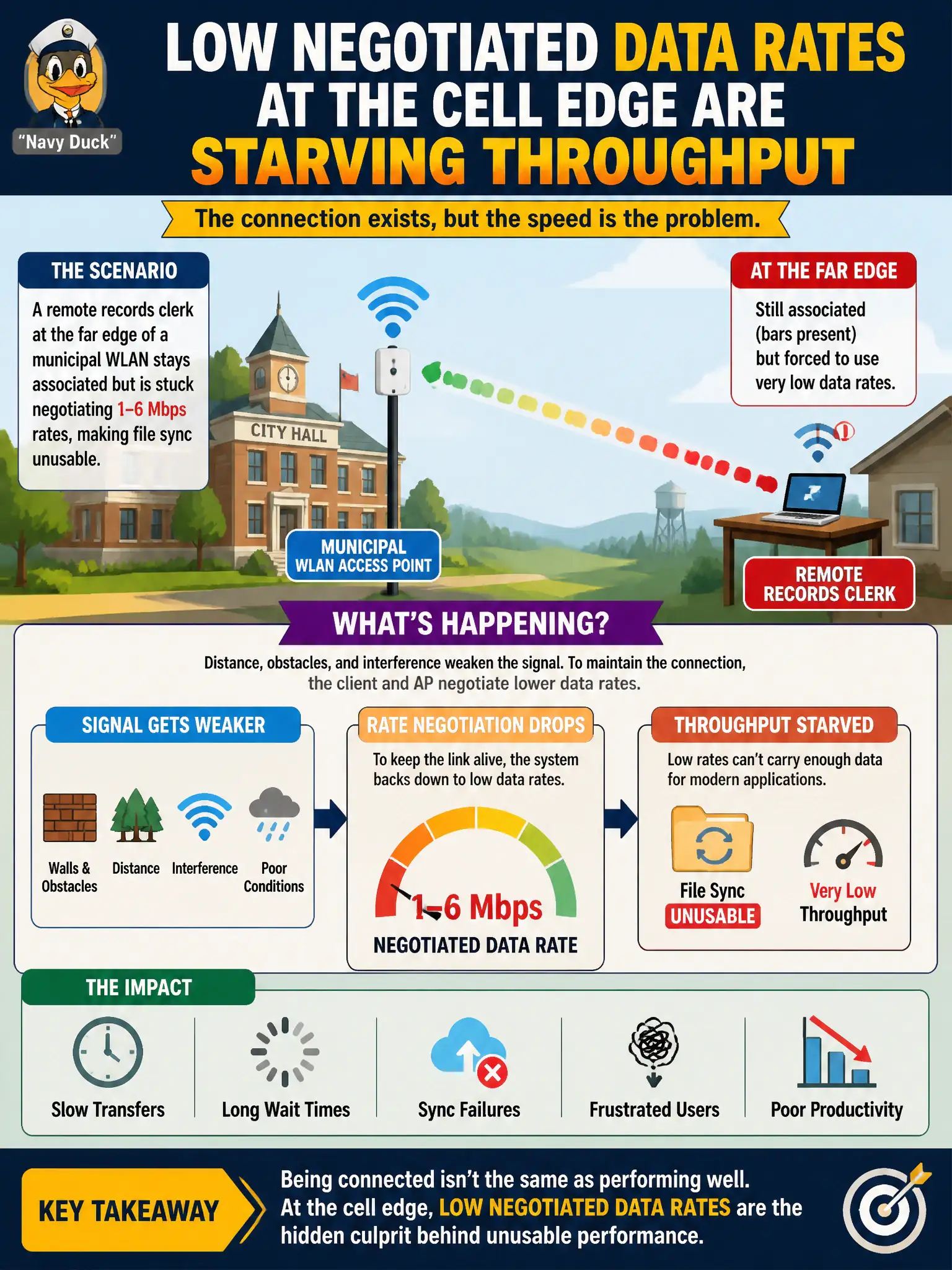
A remote records clerk at the far edge of a municipal WLAN stays associated but is stuck negotiating 1–6 Mbps rates, making file sync unusable. What performance issue is primarily indicated?
Select an answer to reveal the explanation.
Short Explanation
Hanging onto the AP from the cheap seats at walking speed rates will not fill a file sync. Low data rates chew airtime and kill throughput even if you are 'connected.' Move closer, improve coverage, or stop living on the ragged edge.
Full Explanation
A remote records clerk at the far edge of a municipal WLAN who stays associated but stuck negotiating 1–6 Mbps rates, making file sync unusable, primarily indicates low negotiated data rates at the cell edge starving throughput. Association can persist at miserable PHY rates; performance still fails. Technicians recognize rate starvation as a performance class distinct from total disconnect.
Enterprise RADIUS cannot authorize any rate above 6 Mbps by standard fails because RADIUS authorization is not a PHY rate cap at 6 Mbps by IEEE mandate. Hidden-node RTS/CTS must be disabled to unlock higher PHY rates fails by concept and may worsen hidden-node conditions if misapplied as a universal cure. Band steering always capping edge clients at legacy 1 Mbps only invents a false steering rule.
Exam caveat: associated at cell edge ≠ healthy performance. Look at negotiated rates, not only association state.
Operational check: read the client’s negotiated rate/MCS and RSSI/SNR at the desk; improve coverage or relocate closer per process; retest file sync after rates rise; avoid blaming RADIUS for PHY rate floors. If the records clerk must remain at the cell edge, escalate for an additional AP or approved repeater/coverage fix rather than accepting chronic 1–6 Mbps sync failure as normal.