
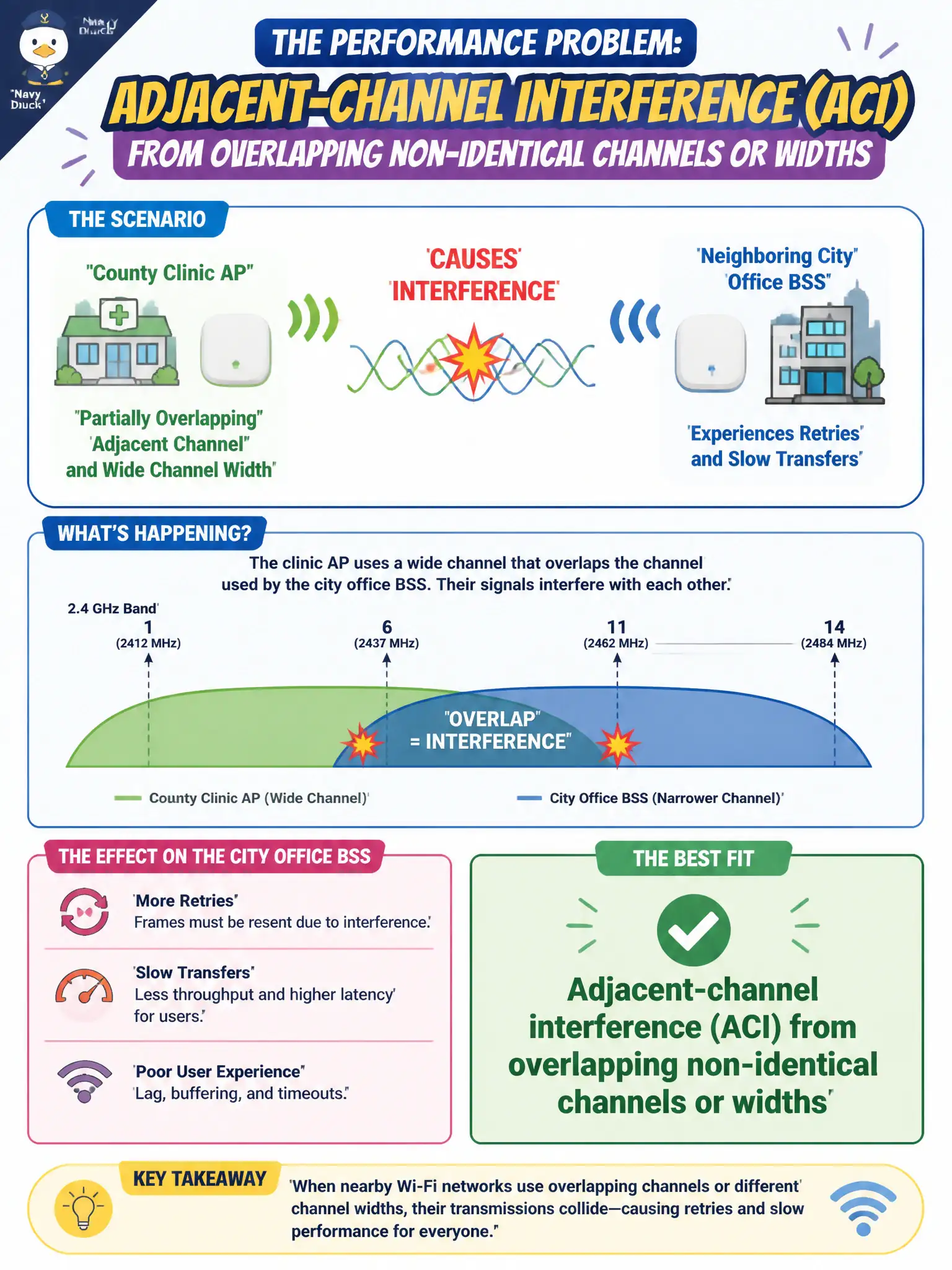
A county clinic AP on a partially overlapping adjacent channel and wide channel width causes retries and slow transfers for a neighboring city office BSS. What performance problem fits best?
Select an answer to reveal the explanation.
Short Explanation
Overlapping adjacent channels are like two radio DJs bleeding into each other's stations. It is not the same-channel line-up; it is messy partial overlap—ACI. Narrow or separate the widths so the neighbors stop stepping on each other.
Full Explanation
A county clinic AP on a partially overlapping adjacent channel and wide channel width causing retries and slow transfers for a neighboring city office BSS fits adjacent-channel interference (ACI) from overlapping non-identical channels or widths. Partial spectral overlap creates harmful energy without being pure same-channel contention. Mitigations differ from CCI: adjust separation, width, or channel choice per design.
Perfect channel isolation that improves both BSSs simultaneously fails as a description of the problem—the scenario is harmful overlap, not perfect isolation. Mandatory WEP reuse mandated by overlapping channel numbers fails by concept: channel overlap does not require WEP. Sticky-client roaming that only occurs when SSIDs are identical fails because ACI is a spectrum/performance issue, not a roam-stickiness definition.
Exam caveat: ACI = overlapping non-identical channels/widths; CCI = identical channel contention. CWTS expects accurate labels.
Operational check: map channel numbers and widths of clinic and office APs; reduce width or choose non-overlapping channels per design; measure retry rates before/after; leave security suites alone unless separately broken.