
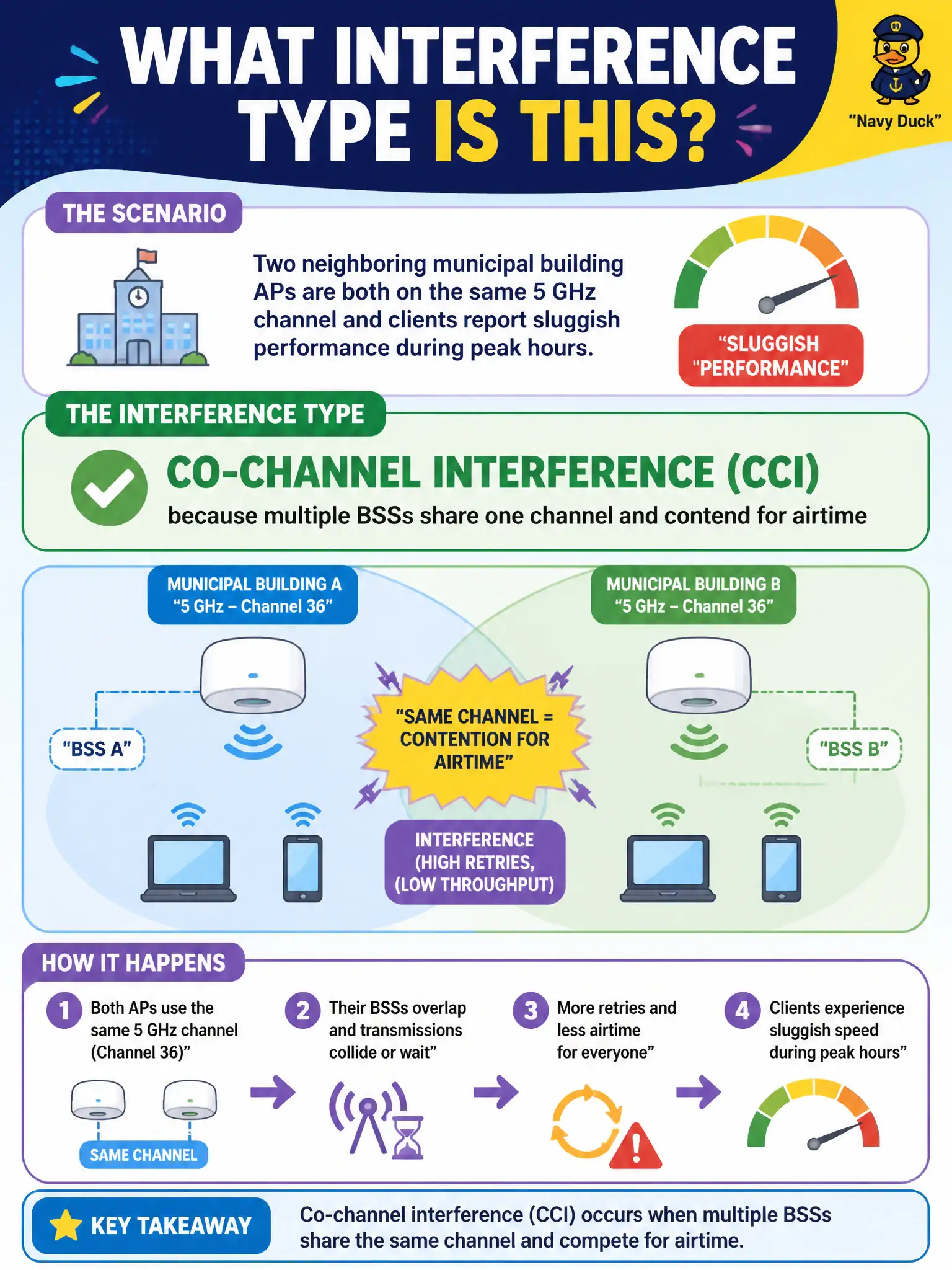
Two neighboring municipal building APs are both on the same 5 GHz channel and clients report sluggish performance during peak hours. What interference type should the tech identify?
Select an answer to reveal the explanation.
Short Explanation
Same channel, two talkers—everyone waits their turn on one shared walkie-talkie frequency. That is co-channel interference, not a password problem. Plan or correct channels so neighbors are not fighting for the same airtime.
Full Explanation
Two neighboring municipal building APs both on the same 5 GHz channel with sluggish peak-hour performance should be identified as co-channel interference (CCI): multiple BSSs share one channel and contend for airtime. Same-channel neighbors take turns on a shared medium, reducing effective capacity for city clients. Correct labeling drives channel-reuse planning rather than chasing unrelated AAA symptoms.
Adjacent-channel interference only, because same-channel neighbors never contend, fails because same-channel neighbors are the definitional CCI case and they do contend. A captive-portal certificate mismatch that mimics RF contention fails by concept: cert mismatches affect auth, not shared-channel airtime math. A PoE classification error that halves MCS on every associated client fails without PoE evidence and mislabels a classic CCI pattern.
Exam caveat: same channel + contention symptoms ⇒ CCI. Adjacent overlap is ACI—do not swap the labels.
Operational check: confirm both APs’ operating channels; if identical and clients are slow at peak, plan non-overlapping channels per design; retest throughput after separation; document CCI in the municipal RF notes. Coordinate channel plans across neighboring municipal buildings that share exterior walls so CCI is not reintroduced by independent teams picking the same “clean” 5 GHz channel.