
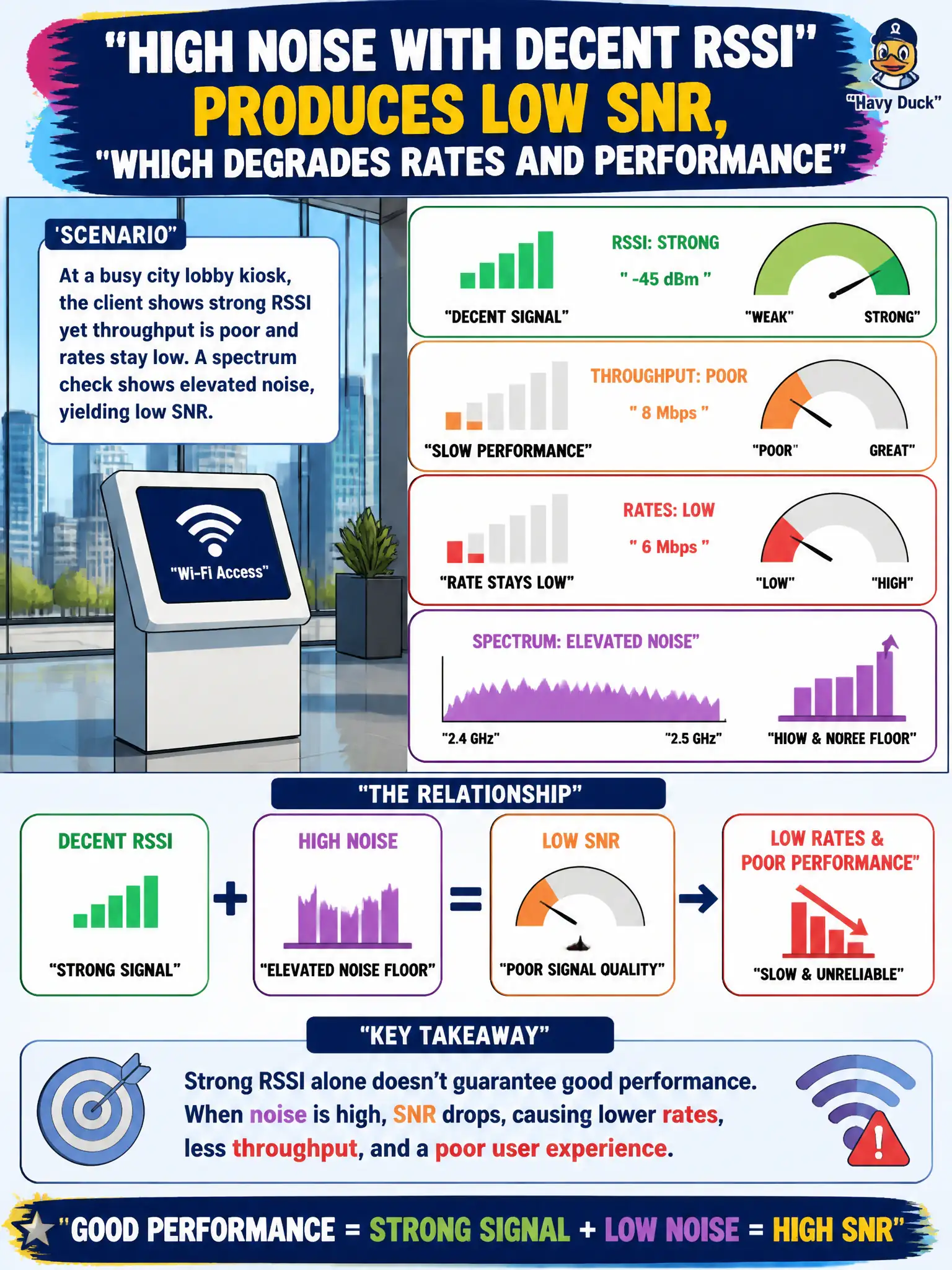
At a busy city lobby kiosk, the client shows strong RSSI yet throughput is poor and rates stay low. A spectrum check shows elevated noise, yielding low SNR. What performance issue does this illustrate?
Select an answer to reveal the explanation.
Short Explanation
Loud signal next to a louder noisy room still gives you a muddy conversation. RSSI can look fine while noise crushes SNR, and rates tumble. Chase the noise, not just the bars.
Full Explanation
At a busy city lobby kiosk showing strong RSSI yet poor throughput and low rates, with spectrum showing elevated noise and low SNR, the performance issue is high noise with decent RSSI producing low SNR, which degrades rates and performance. RSSI alone is not quality; SNR captures how signal sits above the noise floor. Civic kiosks in RF-noisy lobbies often look “full bars” while remaining slow.
RSSI alone guaranteeing maximum MCS regardless of noise floor fails because MCS depends on usable SNR, not raw received strength in isolation. Low RSSI with perfect SNR always meaning a driver signing failure fails by concept and mismatches the stated strong-RSSI/low-SNR evidence. Captive-portal redirect volume as the only cause of low data rates fails because spectrum evidence points to noise, not portal traffic alone.
Exam caveat: distinguish RSSI from SNR. CWTS performance items punish “bars look fine so RF is fine” thinking.
Operational check: record RSSI and noise/SNR at the kiosk; identify non-Wi-Fi or Wi-Fi noise sources; mitigate (move kiosk, change channel per design, reduce interferers); retest rates after SNR improves. For lobby kiosks, schedule spectrum checks during peak citizen hours rather than empty mornings so noise-driven SNR loss is measured when it actually harms throughput.