
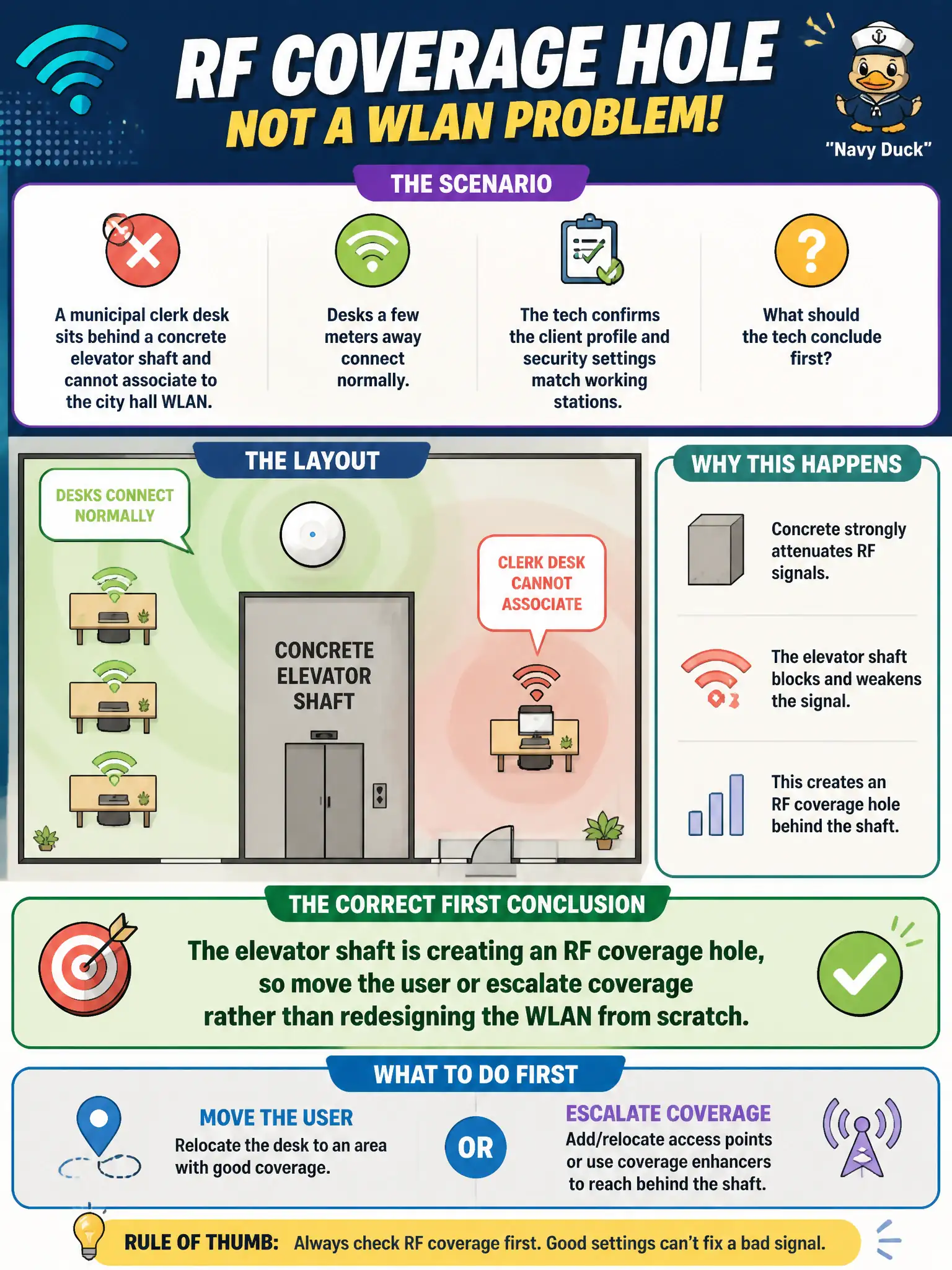
A municipal clerk desk sits behind a concrete elevator shaft and cannot associate to the city hall WLAN, while desks a few meters away connect normally. The tech confirms the client profile and security settings match working stations. What should the tech conclude first?
Select an answer to reveal the explanation.
Short Explanation
Think of the elevator shaft like a thick concrete wall blocking a flashlight beam. The profile works a few desks over, so the radio path—not the password—is the smoking gun. Move the clerk or escalate a coverage fix instead of reinventing the whole design.
Full Explanation
When a municipal clerk desk behind a concrete elevator shaft cannot associate while desks a few meters away connect normally, and the tech confirms the client profile and security settings match working stations, the first conclusion is an RF coverage hole created by the shaft—move the user or escalate coverage rather than redesigning the WLAN from scratch. Matched configs on nearby working stations rule out a global SSID or authentication outage. CWTS technicians document obstruction-driven dead zones and escalate design-level fixes; full predictive redesign is outside technician scope.
Rotating the RADIUS shared secret on the controller before any RF check fails because identical working peers prove AAA is functioning for this SSID. Claiming the SSID passphrase length is too short for WPA3-Personal fails by concept when Enterprise/profile settings already match working desks and the symptom tracks location behind concrete. Requiring a PoE injector for a battery laptop fails because client laptops are not AP PoE endpoints, and power injection does not create RF through an elevator shaft.
Exam caveat: same config works nearby + fails behind dense obstruction ⇒ RF coverage hole first. Do not jump to RADIUS or PoE rituals.
Operational check: compare RSSI/SNR at the clerk desk versus a working desk with the same profile; photograph/note the elevator obstruction; relocate the user temporarily if possible; open a coverage remediation ticket with evidence rather than changing city-wide security settings.