
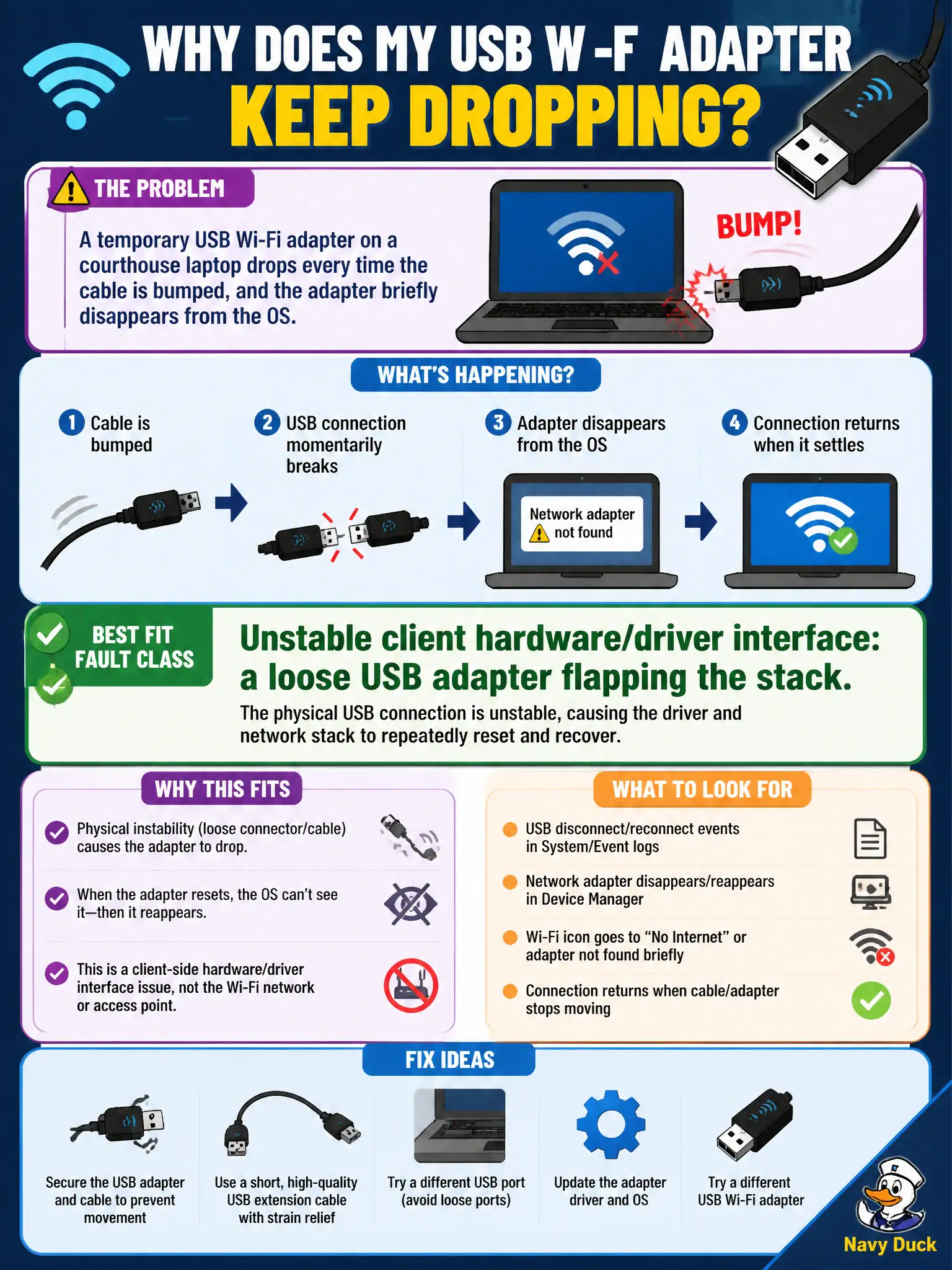
A temporary USB Wi-Fi adapter on a courthouse laptop drops every time the cable is bumped, and the adapter briefly disappears from the OS. Which fault class fits best?
Select an answer to reveal the explanation.
Short Explanation
Bump the dongle, Wi-Fi dies—that is a loose USB/hardware-interface problem, not secret ACI that hates secure cables. Reseat or replace the flaky adapter.
Full Explanation
A temporary USB Wi-Fi adapter on a courthouse laptop that drops every time the cable is bumped, with the adapter briefly disappearing from the OS, fits unstable client hardware/driver interface: a loose USB adapter flapping the stack. Mechanical disconnection removes the NIC from the OS view and kills sessions. Classify physical/client-interface instability before inventing RF conspiracy theories.
Correct WPA3-Enterprise with intentional sticky-client roaming storms fails because bumping a USB cable is not a roam-feature design choice. ACI that only occurs when USB cables are mechanically secure fails by concept: secure cables would not create the disappearance symptom described. Hidden SSID policy that ejects adapters when touched fails because SSID hiding does not eject hardware on physical bumps.
Exam caveat: correlate symptom timing with physical disturbance. Hardware flap is a connectivity fault class of its own.
Operational check: reseat or replace the USB adapter; prefer a secure port or internal NIC; reproduce without cable motion; if stable, close as client hardware interface; avoid unnecessary AP channel changes. Prefer locking USB NICs with captive screws or moving critical courthouse users to internal adapters so mobility testing is not contaminated by intermittent hardware disappearance.