
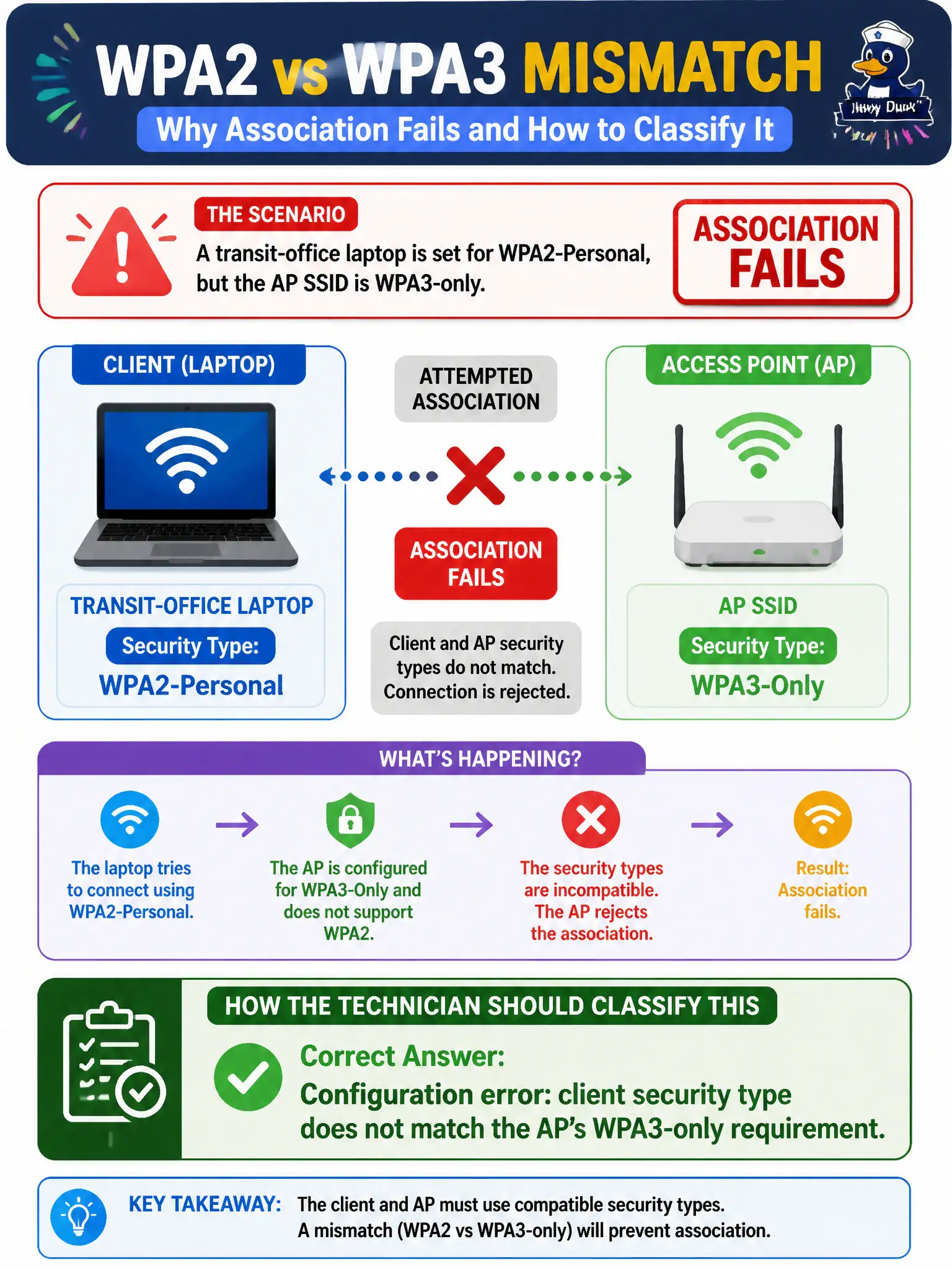
A transit-office laptop is set for WPA2-Personal, but the AP SSID is WPA3-only. Association fails. How should the technician classify this?
Select an answer to reveal the explanation.
Short Explanation
Client speaking WPA2-Personal while the AP only speaks WPA3 is a settings mismatch—classic config error. RSSI will not invent a compatible handshake.
Full Explanation
A transit-office laptop set for WPA2-Personal against an AP SSID that is WPA3-only fails association due to a configuration error: client security type does not match the AP’s WPA3-only requirement. AKM/security-mode mismatch prevents the handshake from completing even when the passphrase string might otherwise be known. Technicians classify this as settings alignment, not as an RF mystery.
Pure RF issue because security mismatch only appears as low RSSI fails because security mismatch presents as authentication/association failure, not as a fabricated low-signal story. Successful OWE negotiation that somehow still blocks Personal clients fails by concept: OWE is a different open-encryption path, not an explanation for WPA2-vs-WPA3 Personal mismatch. Normal behavior when CCMP/AES is correctly aligned on both sides fails because the modes are not aligned—WPA2-Personal versus WPA3-only is the break.
Exam caveat: match security modes on both ends. CWTS items frequently mix WPA2/WPA3 Personal mismatches with RF distractors.
Operational check: inspect laptop WLAN profile security type; set it to WPA3-Personal if the AP is WPA3-only (or adjust AP to transition mode per design); retry association; confirm peers with matching mode succeed.