
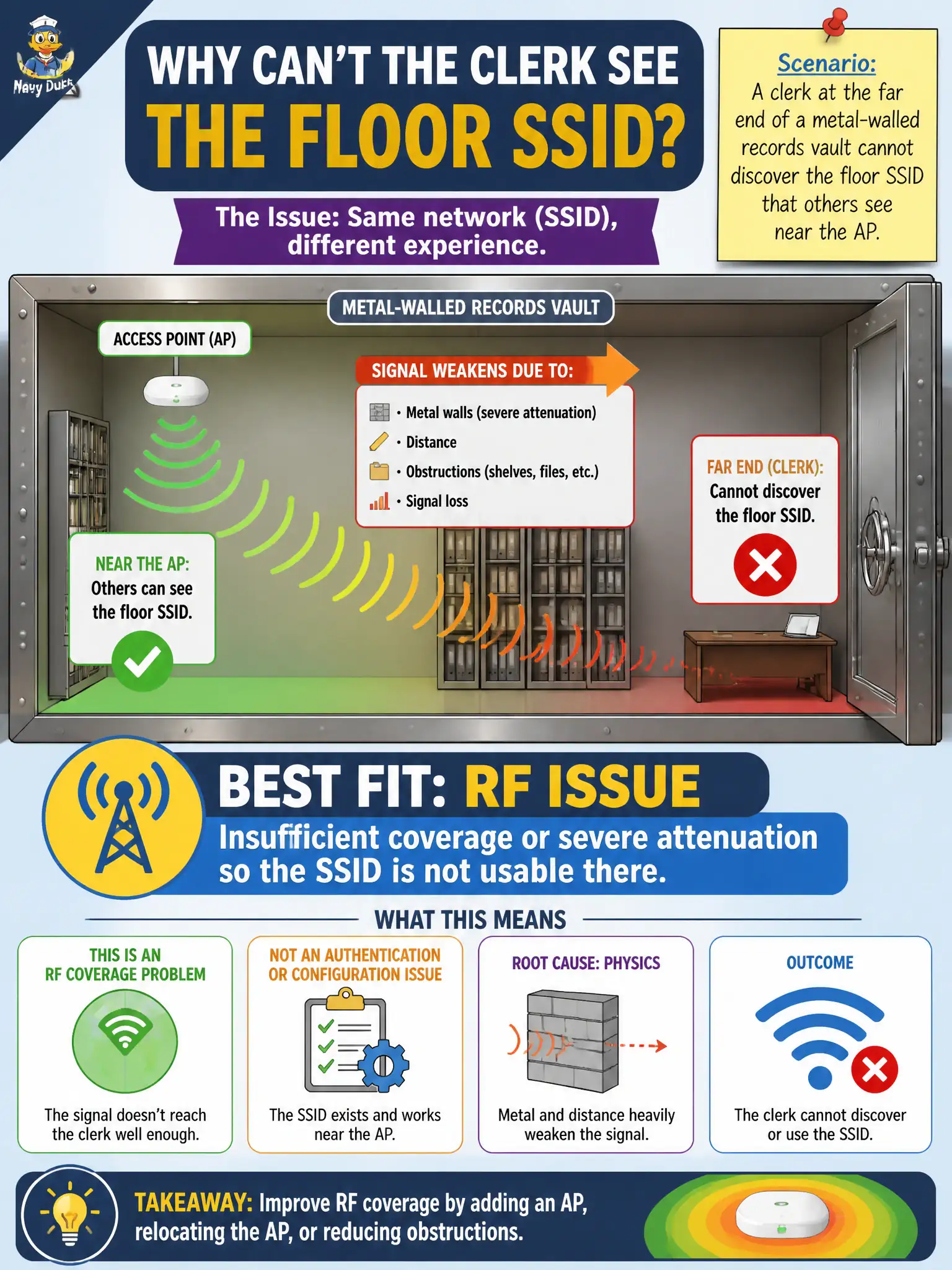
A clerk at the far end of a metal-walled records vault cannot discover the floor SSID that others see near the AP. Which fault class best fits?
Select an answer to reveal the explanation.
Short Explanation
Metal vault, far from the AP, SSID never shows up—that is an RF coverage problem, not a password typo. Walls and distance eat the signal before association ever starts.
Full Explanation
A clerk at the far end of a metal-walled records vault who cannot discover the floor SSID that others see near the AP is experiencing an RF issue: insufficient coverage or severe attenuation so the SSID is not usable there. Metal and distance absorb and reflect energy; if beacons are not heard at usable levels, discovery fails even with perfect passwords. CWTS connectivity classification separates RF visibility problems from authentication and driver faults.
Correct passphrase typed into an Enterprise profile by mistake fails as the primary class because the SSID is not discovered at all—authentication has not started. Successful 802.1X with a VLAN DHCP scope that is merely slow fails by concept: successful 802.1X implies the BSS was heard and joined. Driver signed correctly with airplane mode clearly off fails because those healthy client states do not create metal-vault coverage.
Exam caveat: “SSID never appears” in a harsh RF environment is coverage/attenuation until proven otherwise—not a password problem.
Operational check: measure RSSI/SNR at the vault desk versus near the AP with a known-good client; if the vault is a dead zone, relocate the user or escalate for coverage remediation per municipal process; do not reset RADIUS first.