
Replacing an omnidirectional AP antenna with a higher-gain directional antenna for a municipal warehouse aisle changes coverage. What tradeoff should the technician expect from higher passive gain?
Select an answer to reveal the explanation.
Short Explanation
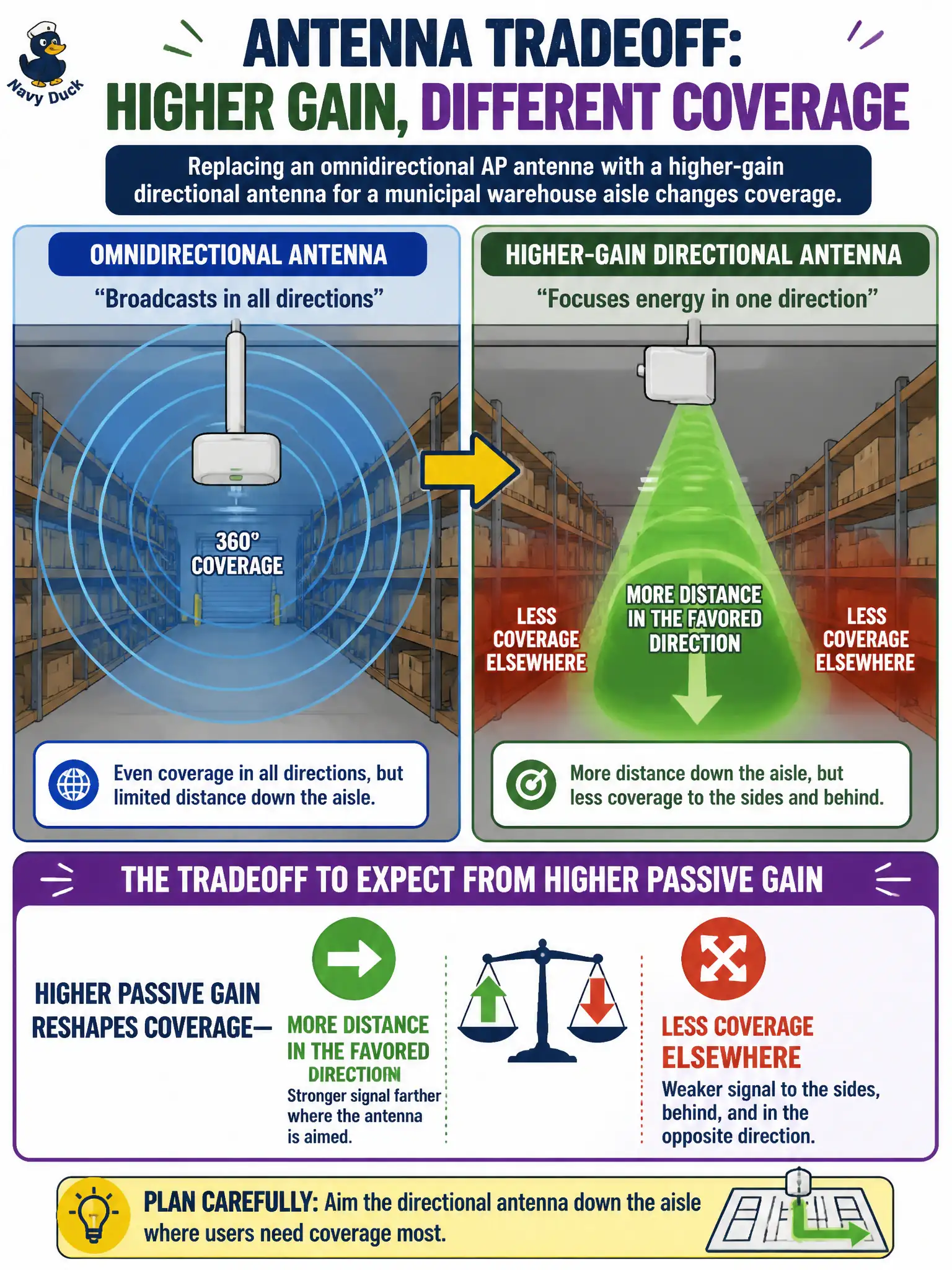
Crank the gain with a directional and you trade the donut for a flashlight beam. Farther down the aisle, quieter off to the sides — that is the deal. It is pattern surgery, not free power everywhere or a new router personality.
Full Explanation
Replacing an omnidirectional AP antenna with a higher-gain directional antenna for a municipal warehouse aisle changes the coverage pattern: higher passive gain reshapes coverage—more distance in the favored direction and less coverage elsewhere. Passive gain concentrates energy; it does not create free power in every direction. Aisle-focused antennas help forklifts and scanners down the lane while starving side racks and cross-aisles if those zones still need service. Civic technicians must expect that tradeoff and validate both the favored and the neglected directions against the warehouse design.
Claiming higher passive gain always increases usable signal equally in every direction with no dead zones fails by concept: directivity is the point of a directional antenna and necessarily reduces coverage off-axis. Saying directional antennas remove free-space path loss so distance no longer matters fails because FSPL still applies along the boresight; gain only improves the link budget, it does not delete physics. Claiming passive gain upgrades convert the AP into a Layer 3 router automatically invents an unrelated networking function antennas do not provide.
Exam caveat: gain is pattern surgery—aisle focusing can create side-rack holes; survey both axes after an omni-to-directional swap.
Operational check: aim the directional per the warehouse design down the target aisle; measure end-of-aisle RSSI/SNR and cross-aisle or side-rack levels; adjust orientation or retain additional coverage for neglected zones; document the pattern tradeoff in the antenna change record.