
A hallway patch antenna is specified for a clinic corridor. What does passive antenna gain mean in that design?
Select an answer to reveal the explanation.
Short Explanation
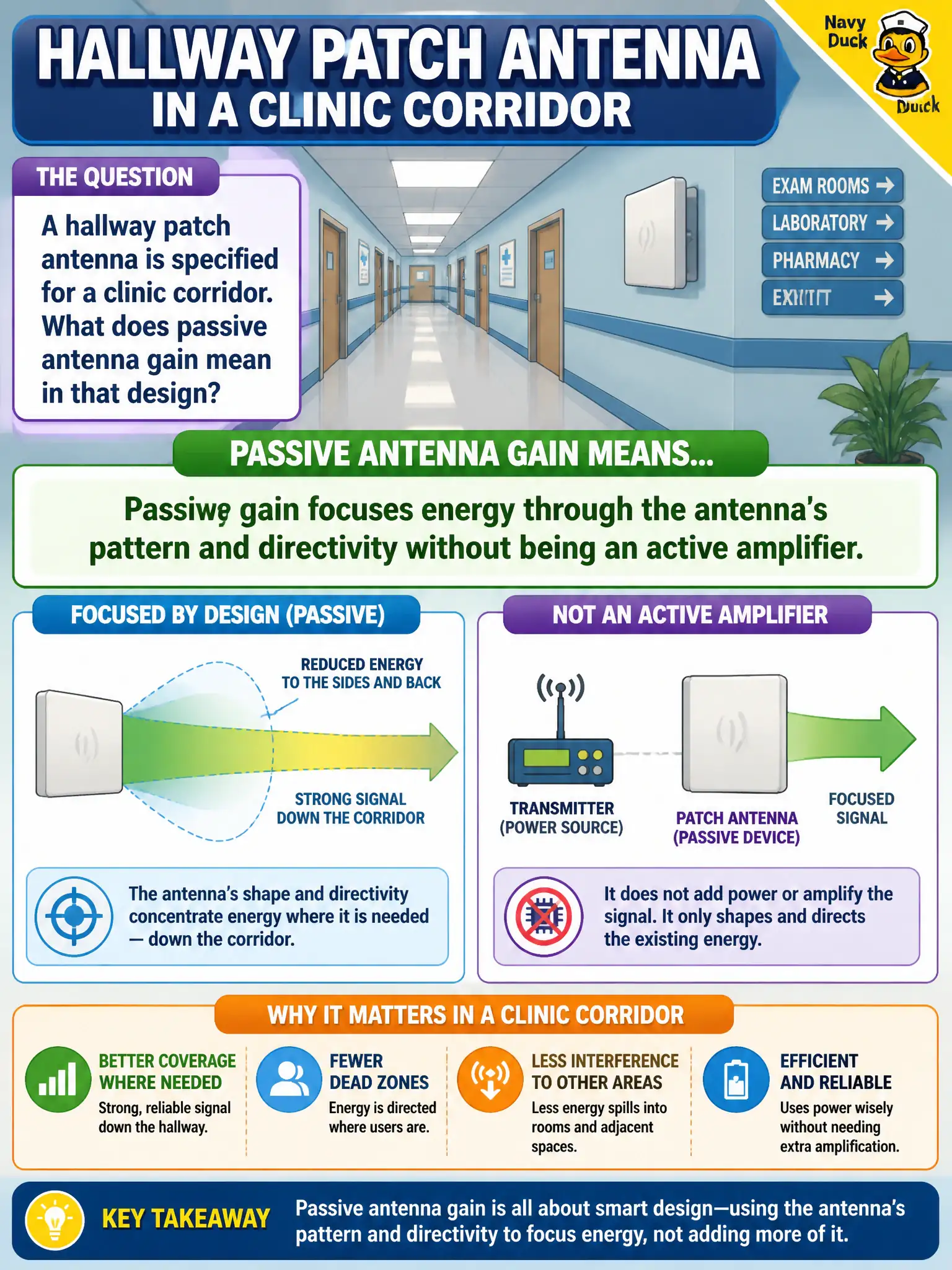
A patch does not drink PoE to yell louder — it shapes the shout down the hallway. Passive gain is focus, not a tiny booster amp hiding in the plastic. Pattern tradeoffs are the whole point of that corridor antenna.
Full Explanation
Passive antenna gain for a clinic hallway patch focuses energy through the antenna’s pattern and directivity without being an active amplifier drawing PoE for RF gain. It does not increase isotropic power equally in every direction with no pattern change, and it is not merely a controller software setting with no physical antenna. Exam caveat: passive gain still affects EIRP in the beam—honor clinic regulatory and design limits. Operational check: aim the patch along the corridor, verify coverage down the hall and reduced spill into adjacent wings, and confirm connectors are tight. Document passive directivity—not active amplification—in the clinic antenna schedule. In municipal WLAN operations, record the rationale in the work order so future on-call staff know which concept applied and which failure modes the rejected options would create for city services. Re-validate after the next maintenance window that the same control still holds under the AP firmware and client mix used by the civic network team. Keep civic notes tied to the approved design document and absolute measurements where RF levels matter. Keep civic notes tied to the approved design document and absolute measurements where RF levels matter.