
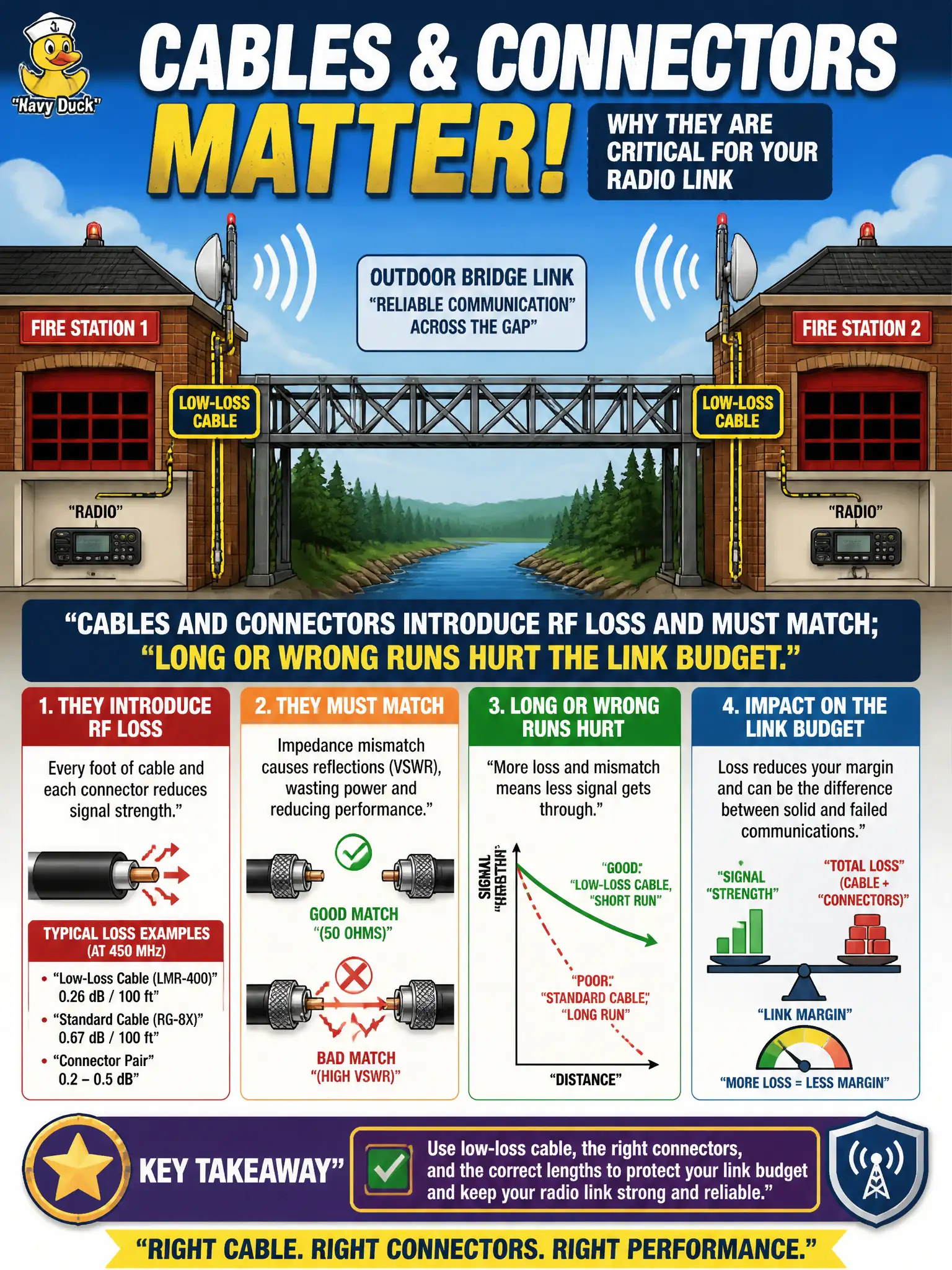
An outdoor bridge between two fire-station buildings needs low-loss cable and correct connectors between the radio and antenna. Why do cables and connectors matter?
Select an answer to reveal the explanation.
Short Explanation
Every extra foot of lossy coax and every mismatched connector nibbles the link budget like trail mix. Match the parts, keep runs sane, and the antenna actually gets the power the radio sent. Cables are RF path, not just PoE spaghetti.
Full Explanation
An outdoor bridge between two fire-station buildings depends on low-loss cable and correct connectors between the radio and antenna because cables and connectors introduce RF loss and must match the designed interface; long or wrong runs hurt the link budget. Every dB of cable and connector loss reduces power delivered to the antenna and shrinks fade margin on the PTP hop. Municipal outdoor installs therefore specify cable type, length, and connector family (including weatherproofing) so the radiated link still meets the design. Treating the RF jumpers as afterthoughts is a common cause of mysterious outdoor underperformance.
Claiming cables only carry PoE and never affect RF power delivered to the antenna fails when the path is an RF feed between radio and antenna—those conductors carry RF, and loss matters. Saying any connector type can be forced together without changing loss or reliability fails by concept: mismatched or poorly mated connectors raise loss, reflections, and failure risk outdoors. Claiming connector choice only changes the SSID name advertised by the bridge invents a false relationship; connectors do not rewrite BSS identifiers.
Exam caveat: account for cable and connector loss in EIRP and fade-margin math on municipal PTP links—ignore loss and the paper link budget lies.
Operational check: install the specified low-loss cable length and correct connector types per the fire-station bridge kit; weather-seal outdoor joints; verify continuity and VSWR/link metrics if available; confirm the far-end RSSI/SNR meets design; record cable length and loss assumptions in the install package.