
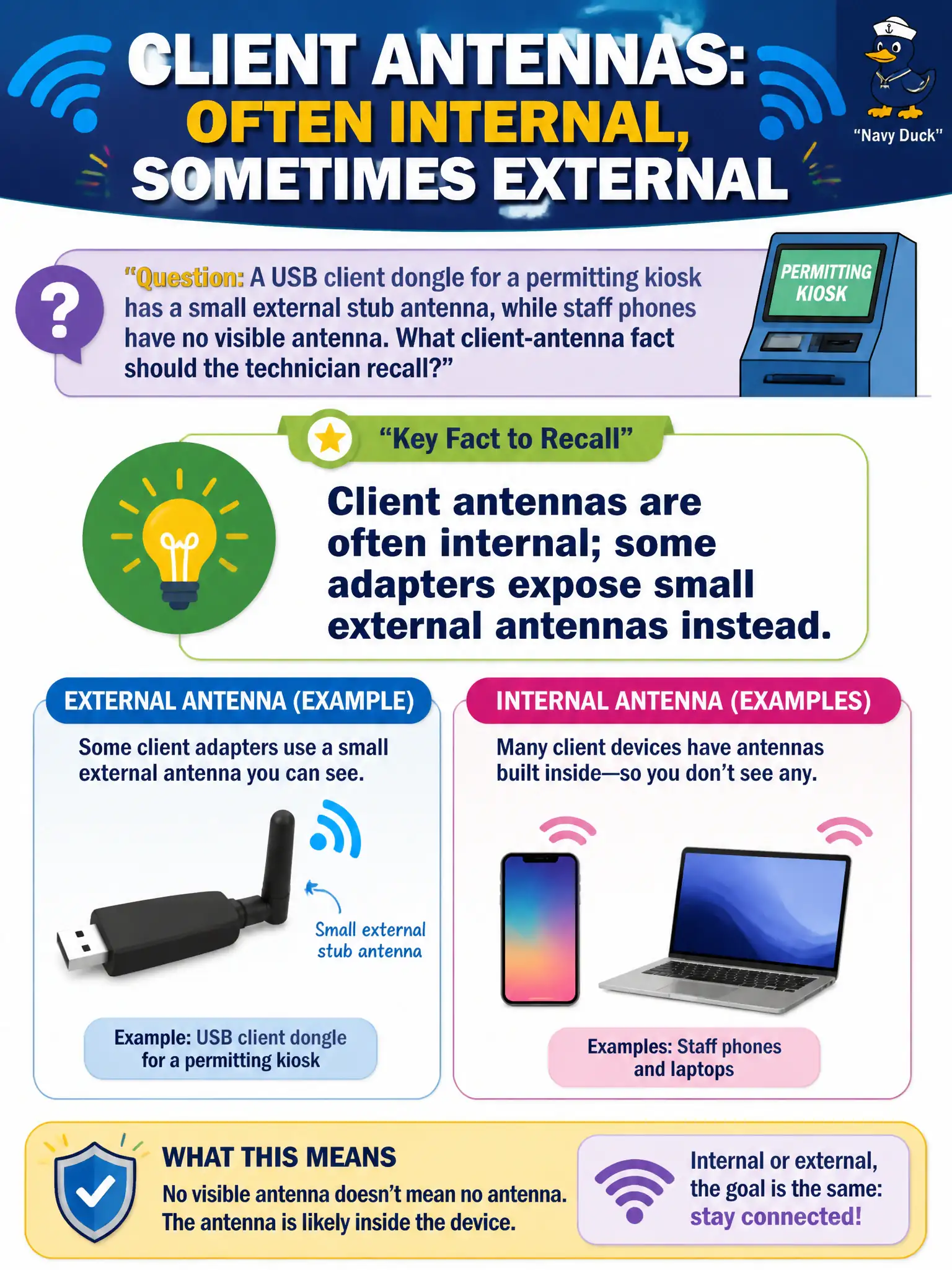
A USB client dongle for a permitting kiosk has a small external stub antenna, while staff phones have no visible antenna. What client-antenna fact should the technician recall?
Select an answer to reveal the explanation.
Short Explanation
Phones hide their antennas; some USB sticks wear a tiny stub on their sleeve. Both can be perfectly normal 802.11 clients. Visible metal is not a band death sentence or a MIMO killer by default.
Full Explanation
Client antennas are often internal; some adapters, such as a USB dongle on a permitting kiosk, expose small external stub antennas instead. Phones without visible antennas still use 802.11 with internal antennas. A visible stub does not confine the device to 900 MHz IoT only, and external client antennas do not outlaw MIMO by themselves. Exam caveat: antenna quality and placement still affect kiosk reliability even when the radio is dual-band. Operational check: seat the USB stub clear of metal drawers, compare phone vs dongle dBm at the counter, and replace damaged stubs rather than blaming the SSID. Note internal-versus-stub client antennas in municipal hardware standards. In municipal WLAN operations, record the rationale in the work order so future on-call staff know which concept applied and which failure modes the rejected options would create for city services. Re-validate after the next maintenance window that the same control still holds under the AP firmware and client mix used by the civic network team. Keep civic notes tied to the approved design document and absolute measurements where RF levels matter. Keep civic notes tied to the approved design document and absolute measurements where RF levels matter.