
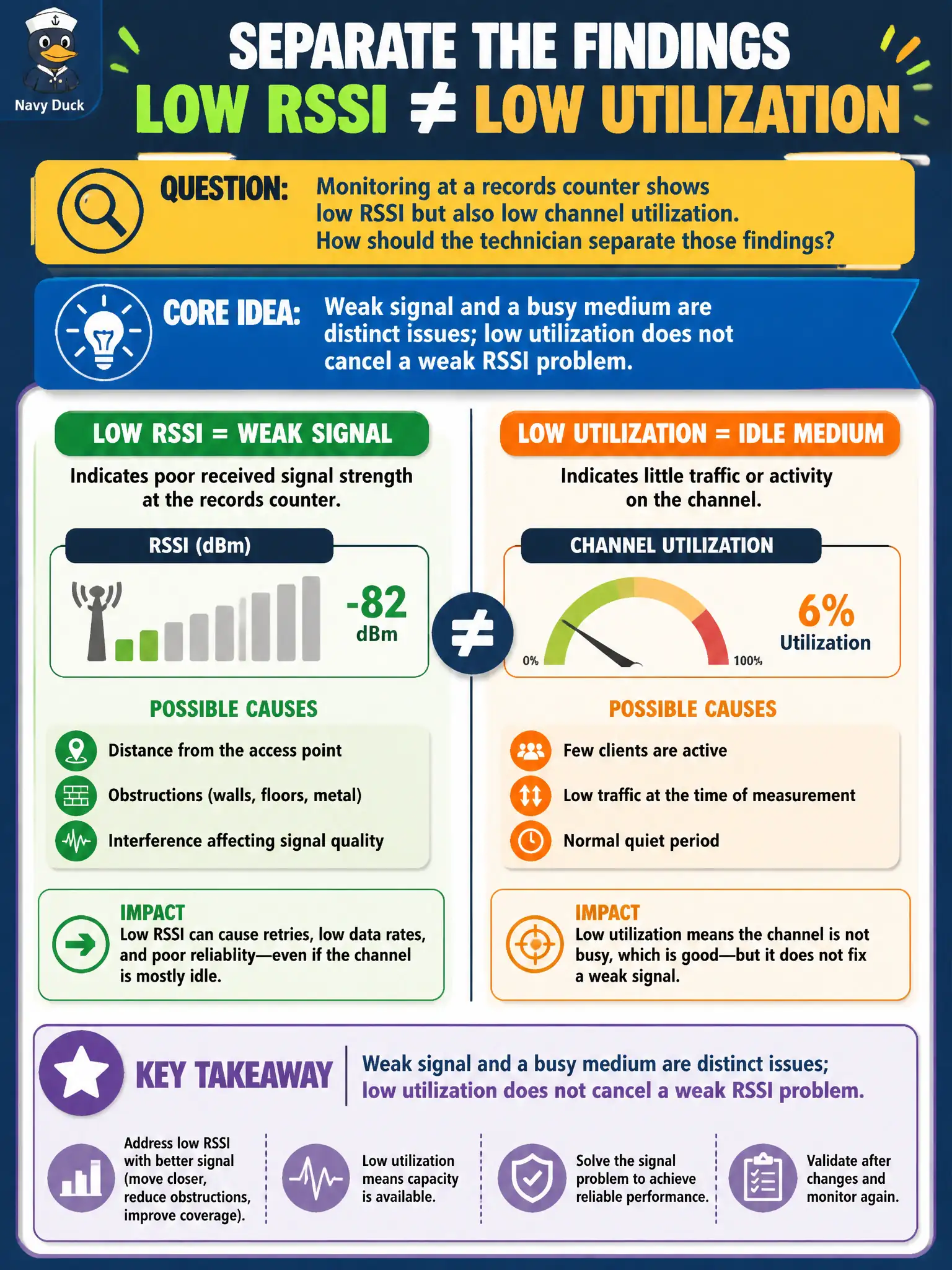
Monitoring at a records counter shows low RSSI but also low channel utilization. How should the technician separate those findings?
Select an answer to reveal the explanation.
Short Explanation
Quiet street, faint radio — those are two different complaints. Low utilization says the channel is not jammed; low RSSI says the client still hears the AP poorly. Fix the weak link without pretending congestion was the villain.
Full Explanation
Monitoring at a records counter that shows low RSSI together with low channel utilization must be read as two separate findings: the client hears the AP weakly, while the medium itself is not busy. Weak signal and a busy medium are distinct issues; low utilization does not cancel a weak RSSI problem or prove coverage is fine. The technician should improve the coverage or path for that counter—placement, antenna, power within design, or escalate an RF hole—without inventing a congestion fix that the utilization counter already shows is unnecessary. Civic tickets close cleanly when each measured axis gets the matching remedy.
Claiming low utilization proves the weak RSSI reading must be a software bug fails by concept: quiet airtime and faint signal commonly coexist far from an AP or behind obstruction. Treating low RSSI and low utilization as the same problem that always share one fix fails because one axis is coverage/path loss and the other is airtime contention. Saying low utilization means the client should ignore RSSI and force 160 MHz widths fails: wider channels can worsen edge performance and interference and do not repair a weak received level.
Exam caveat: fix the axis you measured—coverage, power, or placement for weak RSSI; channel plan, width, or client load for high utilization—do not swap remedies.
Operational check: measure dBm/RSSI and utilization separately at the records counter; improve RSSI via design-aligned AP/client placement or approved power/antenna changes; leave channel width alone unless utilization rises; remeasure both metrics and close the ticket with distinct before/after values.