
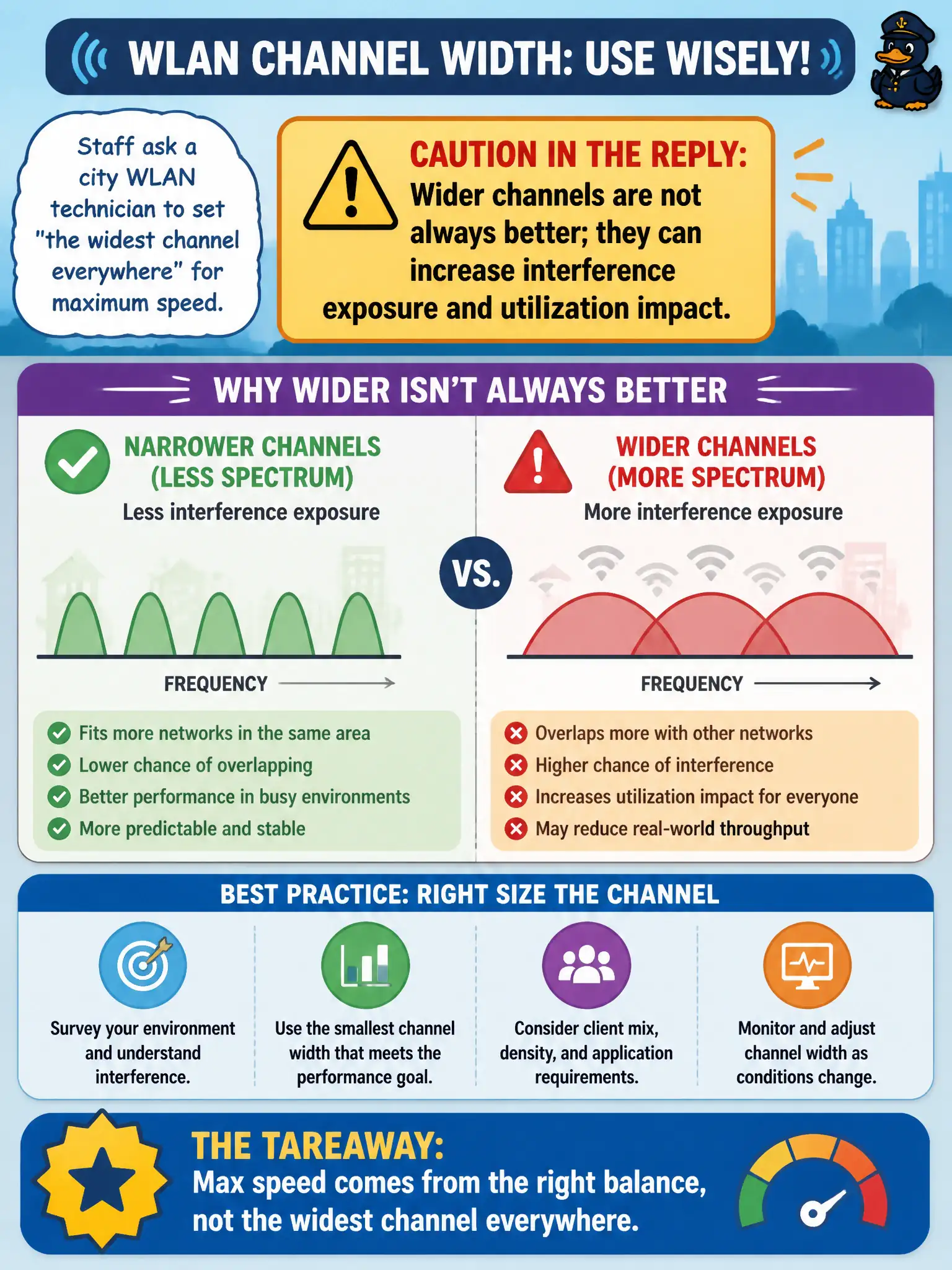
Staff ask a city WLAN technician to set "the widest channel everywhere" for maximum speed. What caution belongs in the reply?
Select an answer to reveal the explanation.
Short Explanation
Widest-channel-everywhere is like driving a wide truck down every alley — sometimes you just scrape more parked cars. More spectrum can mean more neighbors in your lane and a busier meter. Follow the design; speed myths do not rewrite physics.
Full Explanation
Wider channels are not always better for a city WLAN: they can increase interference exposure and utilization impact even when peak PHY rates look attractive. They do not automatically skip busy spectrum, are not limited to Bluetooth-only effects, and do not excuse ignoring the design document’s channel plan. Exam caveat: dense municipal floors often favor narrower widths for coexistence. Operational check: compare 20/40/80 MHz trials against measured utilization and retry rates in the lobby, keep the design’s prescribed width unless a formal change is approved, and educate requesters that “widest everywhere” is not a CWTS best practice. Record width tradeoffs in the civic RF change log. In municipal WLAN operations, record the rationale in the work order so future on-call staff know which concept applied and which failure modes the rejected options would create for city services. Re-validate after the next maintenance window that the same control still holds under the AP firmware and client mix used by the civic network team. Keep civic notes tied to the approved design document and absolute measurements where RF levels matter. Keep civic notes tied to the approved design document and absolute measurements where RF levels matter.