
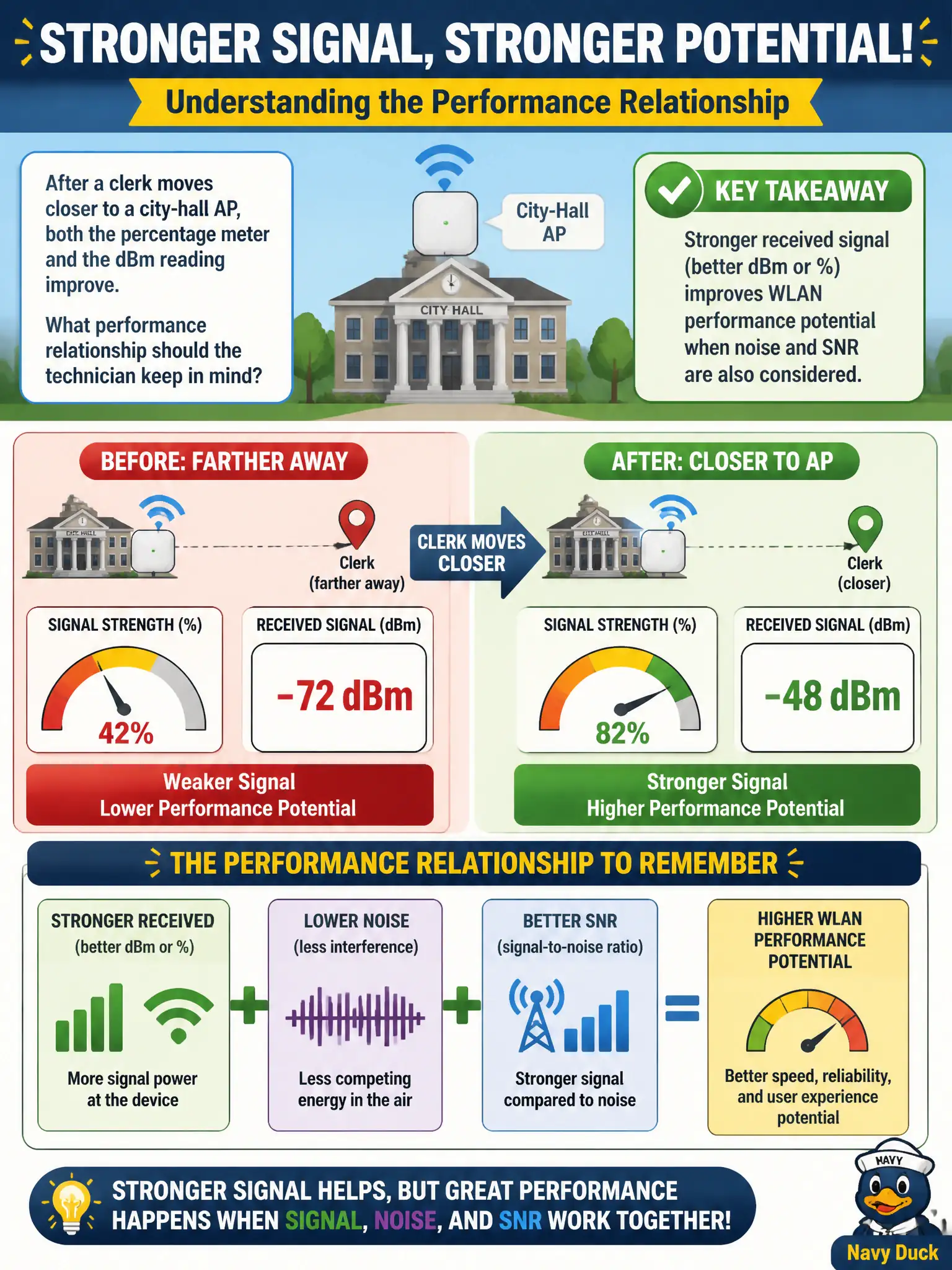
After a clerk moves closer to a city-hall AP, both the percentage meter and the dBm reading improve. What performance relationship should the technician keep in mind?
Select an answer to reveal the explanation.
Short Explanation
Scooting closer usually fattens the received signal — great news, but noise still sits at the other end of the seesaw. Better dBm or percent raises the ceiling; SNR decides whether the link actually sings. Utilization and security type are separate plotlines.
Full Explanation
After a clerk moves closer to a city-hall AP and both percentage and dBm improve, remember that stronger received signal improves WLAN performance potential when noise and SNR are also considered—it does not always guarantee maximum throughput regardless of noise. Improved dBm does not prove channel utilization dropped to zero, and the improvement is not caused only by changing SSID security type. Exam caveat: rate selection still depends on SNR, retries, and airtime competition in busy municipal lobbies. Operational check: measure dBm, noise, SNR, and utilization at the new desk, confirm the move matches coverage intent, and avoid promising “max speed” from strength alone. Record the relationship—better signal helps, SNR/utilization decide experience—in the civic performance guide. In municipal WLAN operations, record the rationale in the work order so future on-call staff know which concept applied and which failure modes the rejected options would create for city services. Re-validate after the next maintenance window that the same control still holds under the AP firmware and client mix used by the civic network team. Keep civic notes tied to the approved design document and absolute measurements where RF levels matter.