
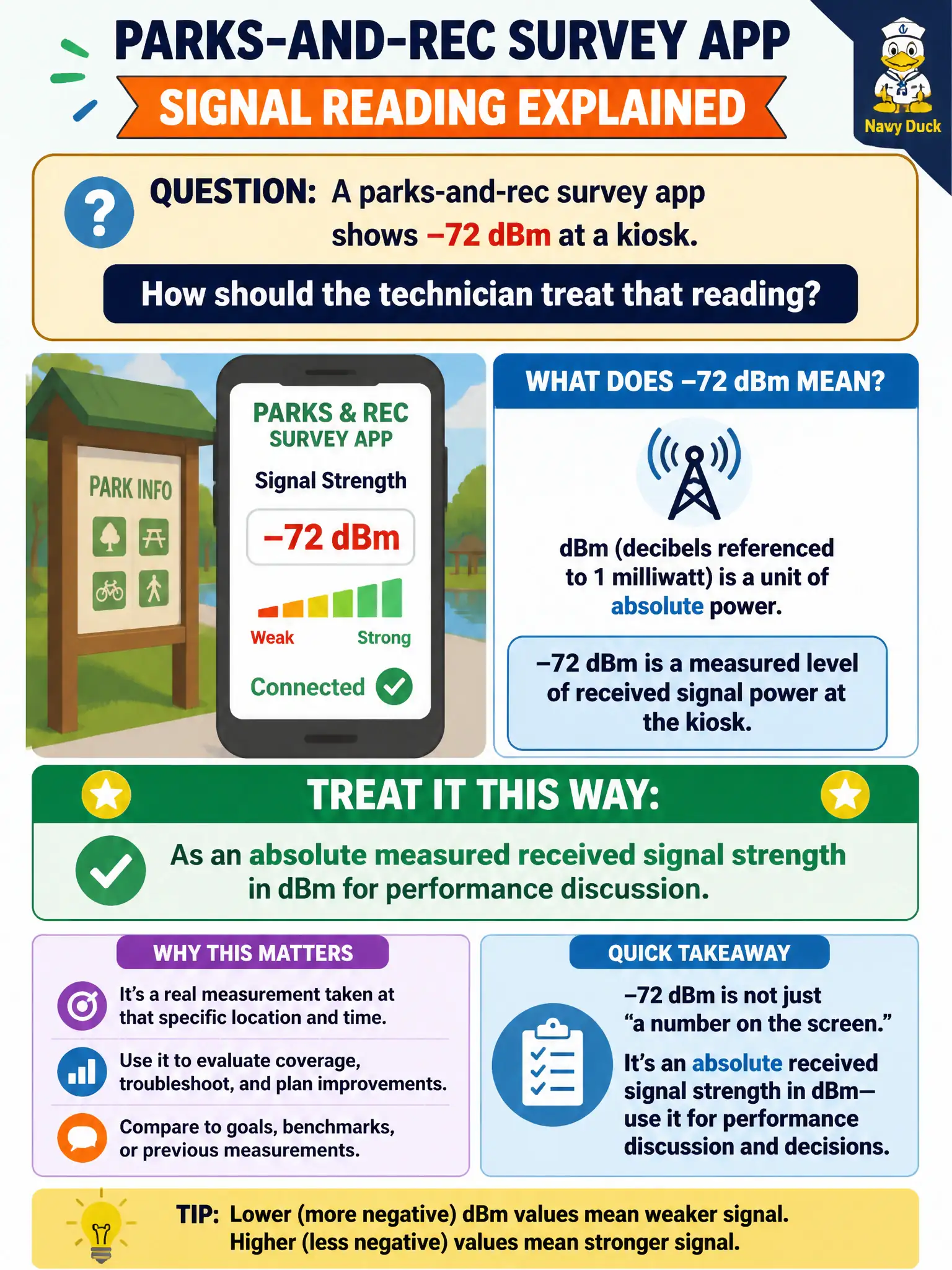
A parks-and-rec survey app shows −72 dBm at a kiosk. How should the technician treat that reading?
Select an answer to reveal the explanation.
Short Explanation
Negative dBm still counts — most Wi-Fi lives below 0 dBm, and −72 is a real absolute level, not a broken meter. Talk performance from that received-strength number, not from a made-up "negatives are dead" rule. Utilization and RSSI codes are different dials.
Full Explanation
A parks-and-rec survey reading of −72 dBm at a kiosk is an absolute measured received signal strength in dBm for performance discussion. It is not merely a relative RSSI code only that app can interpret, not a claim that the medium is 72% busy, and not proof that any negative dBm is unusable—most client Wi-Fi lives below 0 dBm. Exam caveat: whether −72 dBm is “good enough” depends on noise, SNR, rate needs, and design targets, not on the sign alone. Operational check: log −72 dBm with noise/SNR and utilization if available, compare to the parks kiosk SLA in the design, and remediate placement/power/channel per plan if margins are thin. Keep civic tickets in absolute dBm so trends remain meaningful after app upgrades. In municipal WLAN operations, record the rationale in the work order so future on-call staff know which concept applied and which failure modes the rejected options would create for city services. Re-validate after the next maintenance window that the same control still holds under the AP firmware and client mix used by the civic network team. Keep civic notes tied to the approved design document and absolute measurements where RF levels matter. Keep civic notes tied to the approved design document and absolute measurements where RF levels matter.