
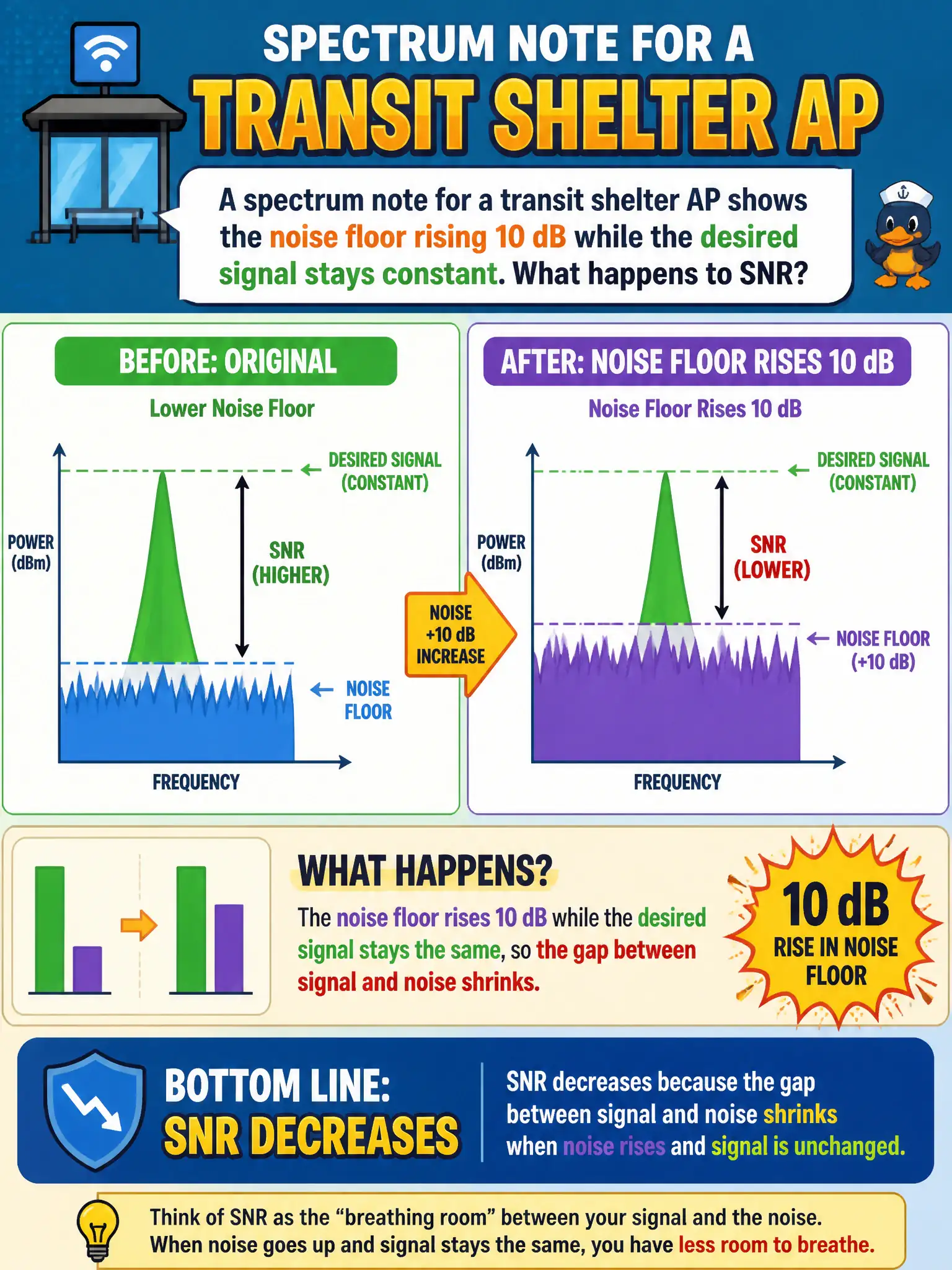
A spectrum note for a transit shelter AP shows the noise floor rising 10 dB while the desired signal stays constant. What happens to SNR?
Select an answer to reveal the explanation.
Short Explanation
Hold the singer's volume steady and crank the crowd noise — the song gets harder to hear. That shrinking gap is SNR getting worse. A 10 dB hotter noise floor with the same signal is bad news for the link, not a free upgrade.
Full Explanation
SNR is the gap between desired signal and noise. If a transit-shelter AP’s noise floor rises 10 dB while the desired signal stays constant, SNR decreases by about that same amount because the gap shrank. SNR does not improve when noise rises, is not undefined merely because dBm units appear, and does not become identical to free-space path loss in that moment. Exam caveat: shelter sites often face rising interference—fix noise and utilization, not only RSSI. Operational check: capture signal, noise, and SNR before/after the noise step, identify interferers on the channel plan, and remediate per municipal RF design. Record that hotter noise with flat signal means worse SNR for rider-facing Wi-Fi performance. In municipal WLAN operations, record the rationale in the work order so future on-call staff know which RF concept applied and which failure modes the rejected options would create for city services. Re-validate after the next maintenance window that the same control still holds under the AP firmware and client mix used by the civic network team. Keep civic survey notes tied to absolute measurements and the approved design document. Keep civic survey notes tied to absolute measurements and the approved design document.