
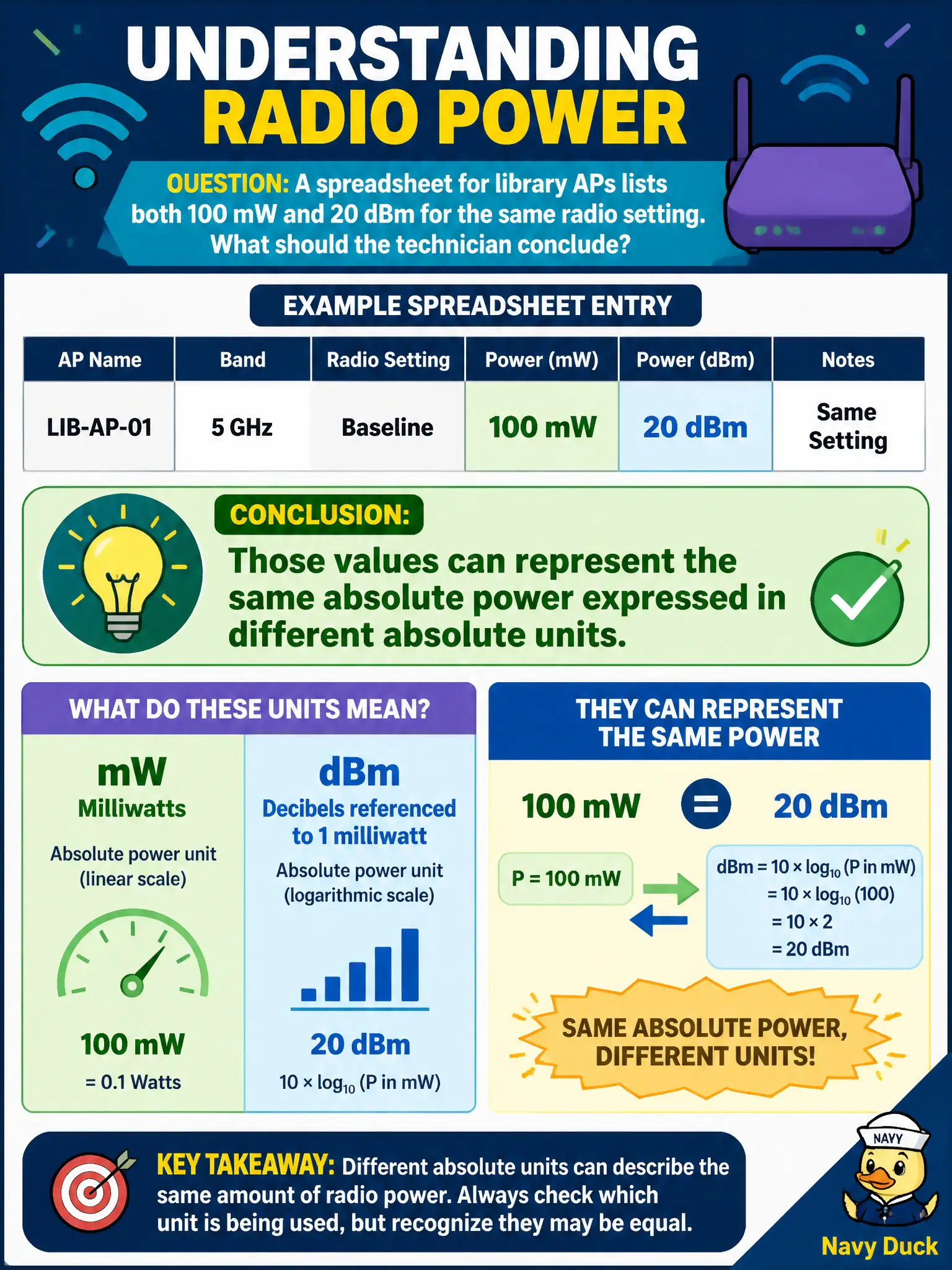
A spreadsheet for library APs lists both 100 mW and 20 dBm for the same radio setting. What should the technician conclude?
Select an answer to reveal the explanation.
Short Explanation
Same tank of gas, two labels on the pump. 100 mW and 20 dBm are a classic matching pair for absolute power — not a fight between relative and absolute, and not a channel ID. Learn the dual labeling and the spreadsheet stops looking broken.
Full Explanation
100 mW and 20 dBm can represent the same absolute power expressed in different absolute units—a classic WLAN pairing. That is not a contradiction, not “100 mW relative vs 20 dBm as a channel number,” and not proof that dBm only measures noise floor. Exam caveat: always confirm which quantity a datasheet means (conducted power vs EIRP) for municipal compliance, but unit pairing itself is standard. Operational check: when library AP spreadsheets list both, verify they match the intended absolute setting, convert if needed, and align controller/UI displays to the design. Document dual-unit absolute power so civic audits do not flag matched mW/dBm pairs as errors. In municipal WLAN operations, record the rationale in the work order so future on-call staff know which RF concept applied and which failure modes the rejected options would create for city services. Re-validate after the next maintenance window that the same control still holds under the AP firmware and client mix used by the civic network team. Keep civic survey notes tied to absolute measurements and the approved design document. Keep civic survey notes tied to absolute measurements and the approved design document. Keep civic survey notes tied to absolute measurements and the approved design document.