
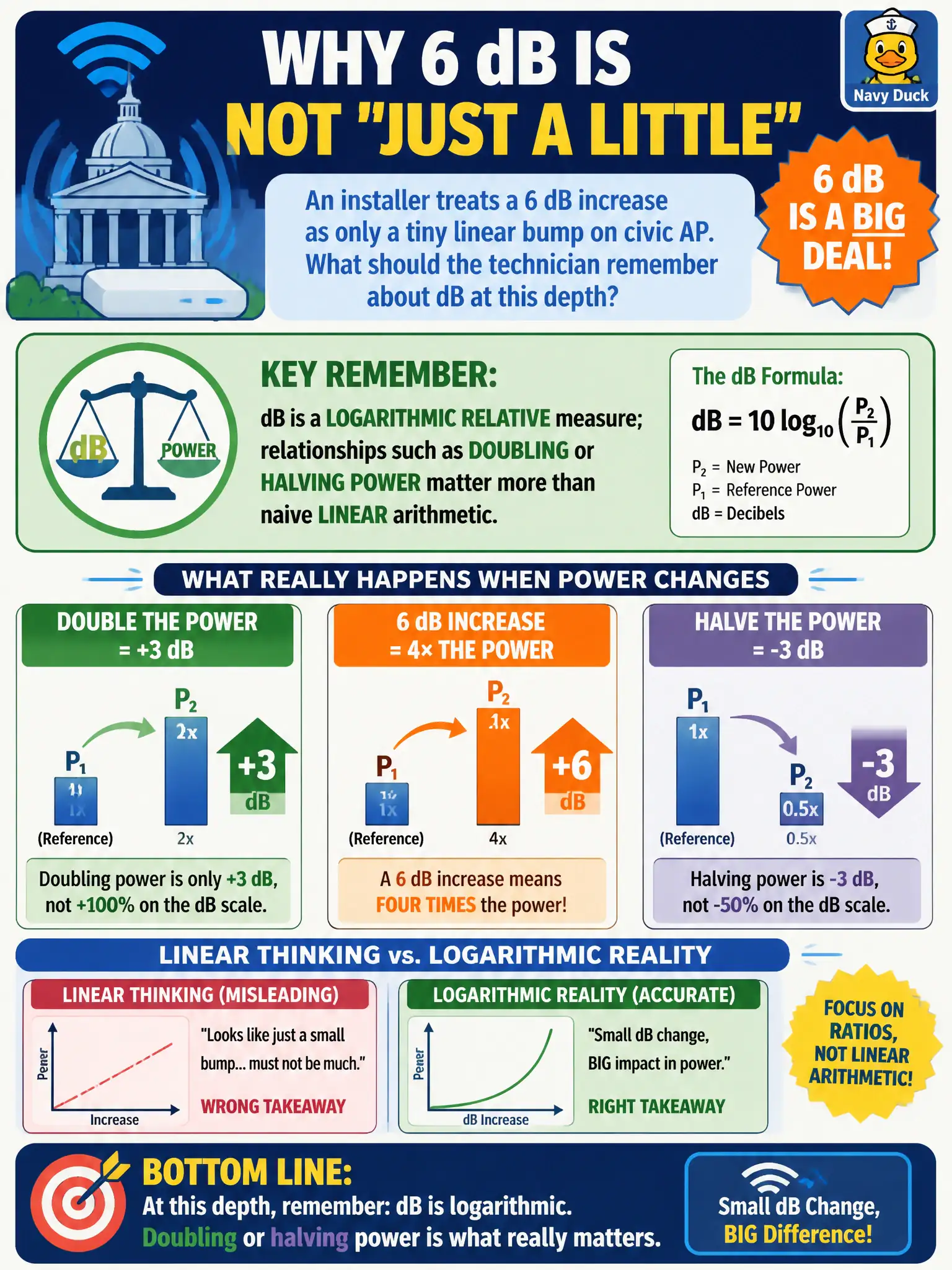
An installer treats a 6 dB increase as only a tiny linear bump on a civic AP. What should the technician remember about dB at this depth?
Select an answer to reveal the explanation.
Short Explanation
Decibels are spicy log math — a handful of dB can mean a double or a much bigger jump depending on the step, not a cute +6 on a bathroom scale. Treat 6 dB like a real gear change in power ratio, not a rounding error.
Full Explanation
dB is a logarithmic relative measure; relationships such as approximate doubling or halving of power (classic 3 dB steps) matter more than treating a 6 dB change as a tiny linear bump of “plus six watts.” dB values do not add like ordinary linear watts without log meaning. A 6 dB change is not always exactly 6 milliwatts regardless of starting power. dB applies to RF ratios, not only Ethernet PoE. Exam caveat: memorize common CWTS-friendly anchors (about 3 dB ≈ 2× power) without claiming false precision on every UI. Operational check: when a civic design changes power by 6 dB, compute the approximate factor relative to the prior absolute level, remeasure clients, and record both dB delta and resulting dBm/mW. Keep municipal change tickets explicit that dB steps are logarithmic ratios. In municipal WLAN operations, record the rationale in the work order so future on-call staff know which RF concept applied and which failure modes the rejected options would create for city services. Re-validate after the next maintenance window that the same control still holds under the AP firmware and client mix used by the civic network team. Keep civic survey notes tied to absolute measurements and the approved design document.