
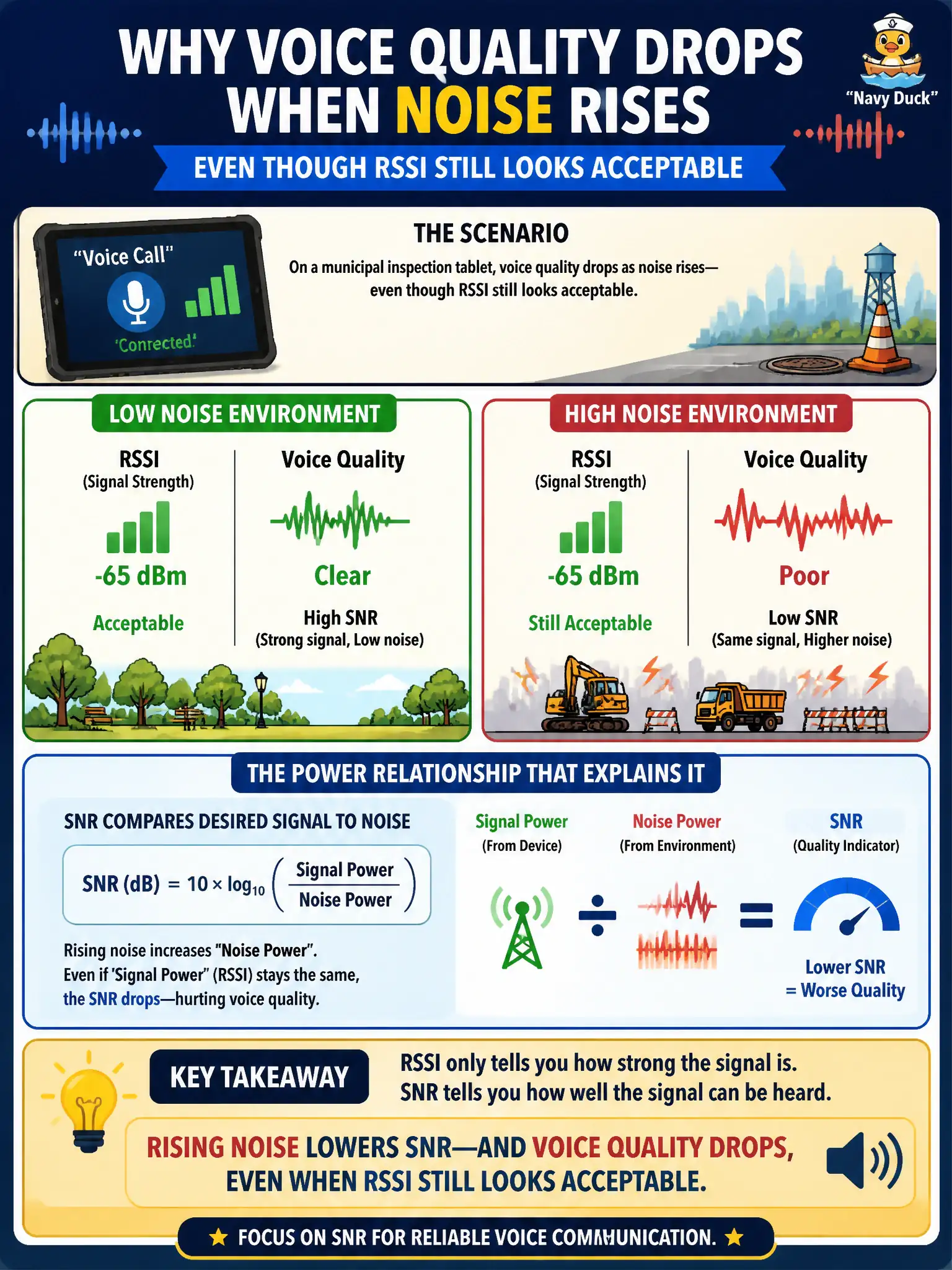
Voice quality on a municipal inspection tablet drops when noise rises even though RSSI still looks acceptable. Which power relationship best explains the problem?
Select an answer to reveal the explanation.
Short Explanation
RSSI can look fine while the room gets noisy — like hearing someone clearly in a quiet library then losing them when a band starts playing. SNR is signal versus that noise. Voice dies when the gap shrinks, not only when the bars disappear.
Full Explanation
SNR compares desired signal power to noise power. On a municipal inspection tablet, rising noise can crush voice quality even when RSSI still looks acceptable because the gap between signal and noise shrank. Wavelength does not shorten merely because an elevator anecdote was offered, and elevators are not required for this SNR concept. Antenna gain is not a QoS feature that intentionally raises the noise floor. dBm and milliwatts remain valid units during voice calls. Exam caveat: “good RSSI, bad experience” tickets should drive noise and utilization checks, not only power increases that may not fix SNR. Operational check: measure signal, noise floor, and SNR at the inspection location, scan for interferers, and follow the city’s channel plan before blaming the tablet codec alone. In municipal WLAN operations, record the rationale in the work order so future on-call staff know which RF concept applied and which failure modes the rejected options would create for city services. Re-validate after the next maintenance window that the same control still holds under the AP firmware and client mix used by the civic network team. Keep civic survey notes tied to absolute measurements and the approved design document.