
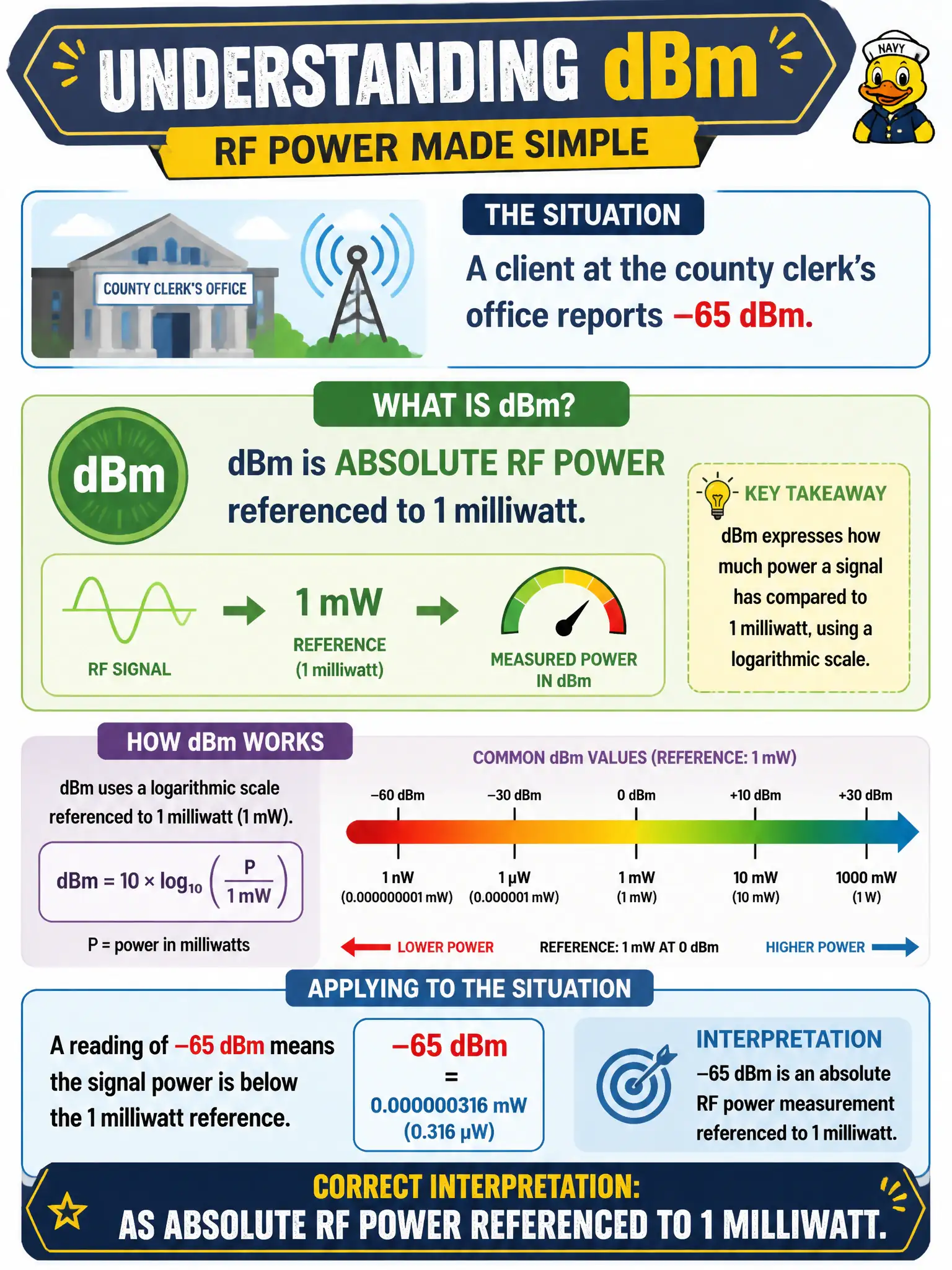
A client at the county clerk's office reports −65 dBm. How should the technician interpret dBm?
Select an answer to reveal the explanation.
Short Explanation
dBm is an absolute fuel gauge tied to one milliwatt as zero on the scale. Negative numbers are normal for received Wi-Fi — you are below that 1 mW reference. It is not a vague 'compared to yesterday' dB without a reference.
Full Explanation
dBm is absolute RF power referenced to 1 milliwatt. A county clerk’s client showing −65 dBm is a normal absolute received-power reading below that 1 mW reference, not a relative-only delta with no anchor. It is not channel utilization percentage and not a spatial-stream count from MIMO negotiation. Exam caveat: negative dBm values are expected for received Wi-Fi; “negative” does not mean invalid. Operational check: log −65 dBm (and noise/SNR if available) in the municipal ticket, compare against design targets for that clerk area, and prefer dBm over proprietary bars when escalating. Teach staff that dBm is absolute power versus 1 mW so civic surveys stay comparable across tools. In municipal WLAN operations, record the rationale in the work order so future on-call staff know which RF concept applied and which failure modes the rejected options would create for city services. Re-validate after the next maintenance window that the same control still holds under the AP firmware and client mix used by the civic network team. Keep civic survey notes tied to absolute measurements and the approved design document. Keep civic survey notes tied to absolute measurements and the approved design document.