
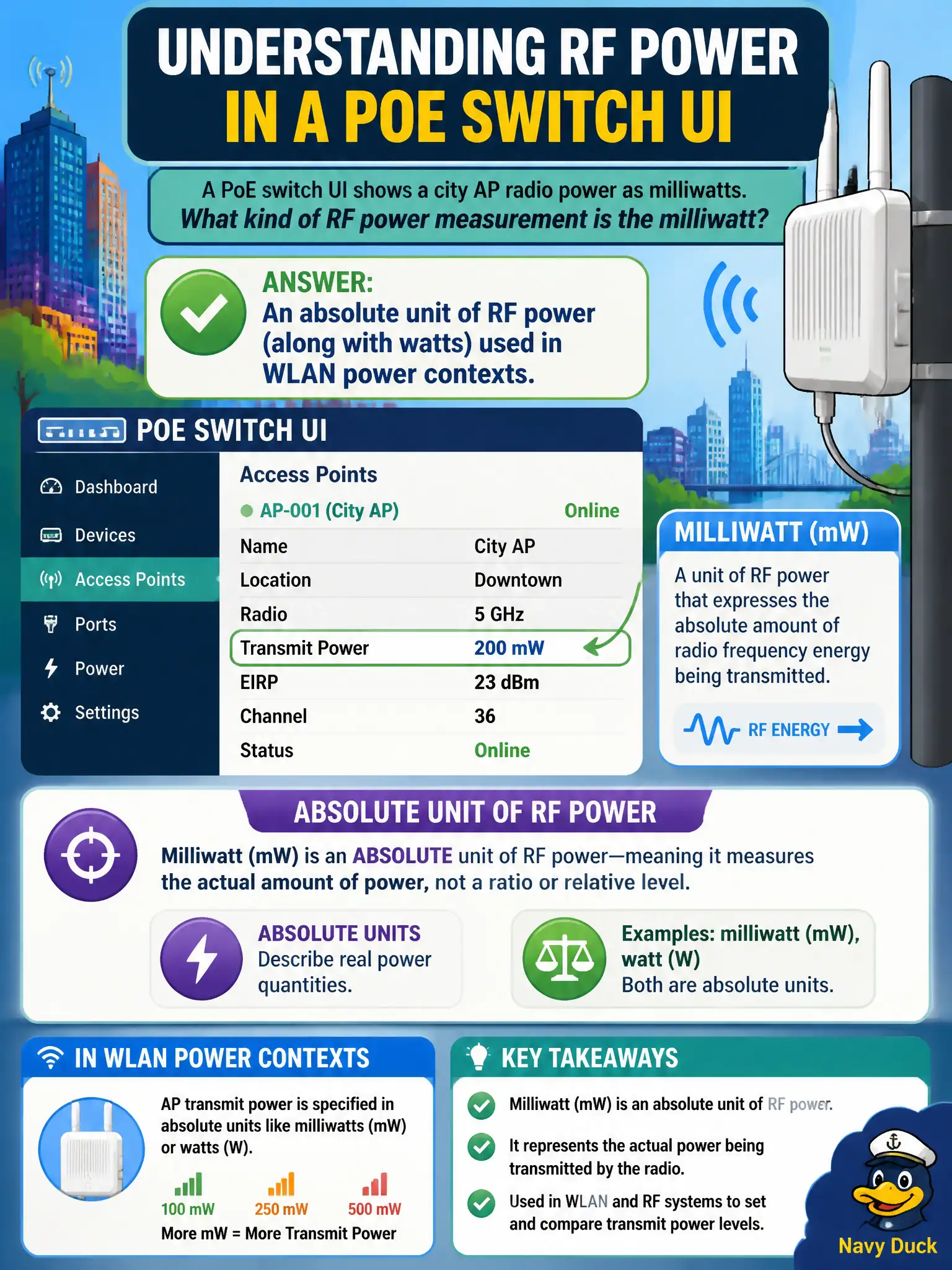
A PoE switch UI shows a city AP radio power as milliwatts. What kind of RF power measurement is the milliwatt?
Select an answer to reveal the explanation.
Short Explanation
Milliwatts are a real amount of power — like saying how many drops of water, not 'twice as much as before.' Absolute units stand on their own. Relative dB talk is the comparison language; mW is the tank level.
Full Explanation
A milliwatt is an absolute unit of RF power (with watts) used in WLAN power contexts—exactly what a PoE switch UI means when it shows a city AP radio power in milliwatts. Absolute units stand alone without needing a second reading to define the quantity. A bare dB change is relative (a ratio between levels), not identical to an absolute milliwatt value. Client RSSI percentage is a vendor UI construct, not the definition of milliwatts. Channel utilization measures airtime congestion on the medium, not transmit power units. Exam caveat: interfaces may display mW or dBm; both can express absolute power, while dB alone expresses relative change. Operational check: when comparing civic AP power settings, convert or match mW and dBm consistently against the design, and do not treat utilization percentages or laptop bars as milliwatt equivalents. In municipal WLAN operations, record the rationale in the work order so future on-call staff know which RF concept applied and which failure modes the rejected options would create for city services. Re-validate after the next maintenance window that the same control still holds under the AP firmware and client mix used by the civic network team.