
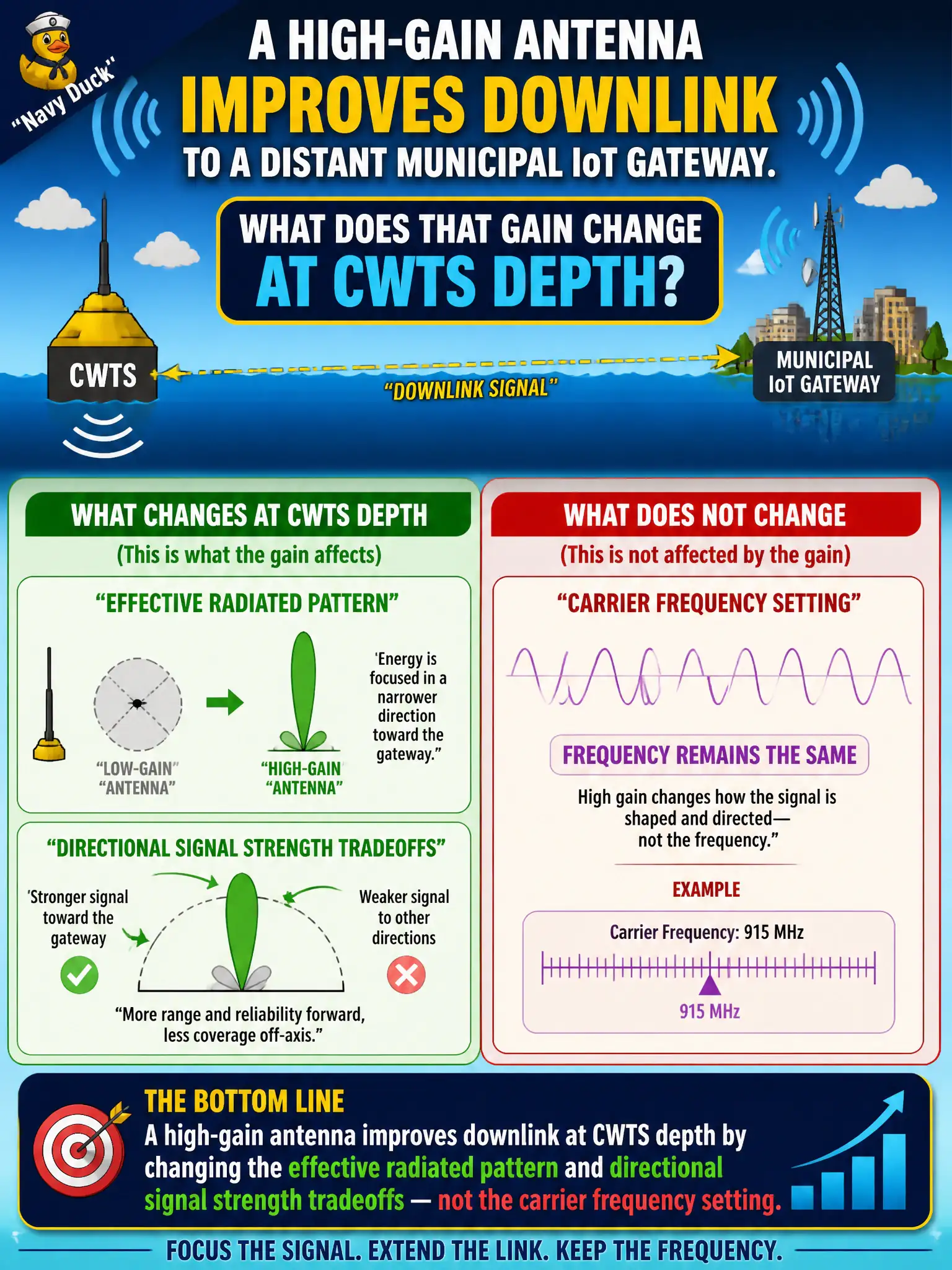
A high-gain antenna improves downlink to a distant municipal IoT gateway. What does that gain change at CWTS depth?
Select an answer to reveal the explanation.
Short Explanation
Cranking antenna gain is aiming the flashlight, not changing the color of the light. You reshape where energy goes; you do not hop the radio to a new frequency band by bolting on a directional antenna. Pattern and strength tradeoffs are the gain story.
Full Explanation
High passive antenna gain reshapes the effective radiated pattern and directional signal-strength tradeoffs toward a distant municipal IoT gateway; it does not change the carrier frequency setting. Regulatory domain codes live in radio/client configuration for legal channels and power, not in bolting on a higher-gain antenna. WPA3 SAE handshake timers are security-protocol behavior, unrelated to antenna gain. Ethernet copper category supports PoE/data cabling and is not what gain alters. Exam caveat: higher gain can raise EIRP in the beam—stay inside the city’s approved antenna and power sheet. Operational check: aim the directional antenna at the IoT gateway, verify connectors and cable loss, measure downlink/uplink levels, and confirm off-axis coverage loss is acceptable for other civic devices. Document gain as pattern focusing for the gateway link, not as a band or security change. In municipal WLAN operations, record the rationale in the work order so future on-call staff know which RF concept applied and which failure modes the rejected options would create for city services. Re-validate after the next maintenance window that the same control still holds under the AP firmware and client mix used by the civic network team.