
An outdoor municipal point-to-point note cites free space path loss as distance increases with no obstacles between radios. What does free space path loss describe?
Select an answer to reveal the explanation.
Short Explanation
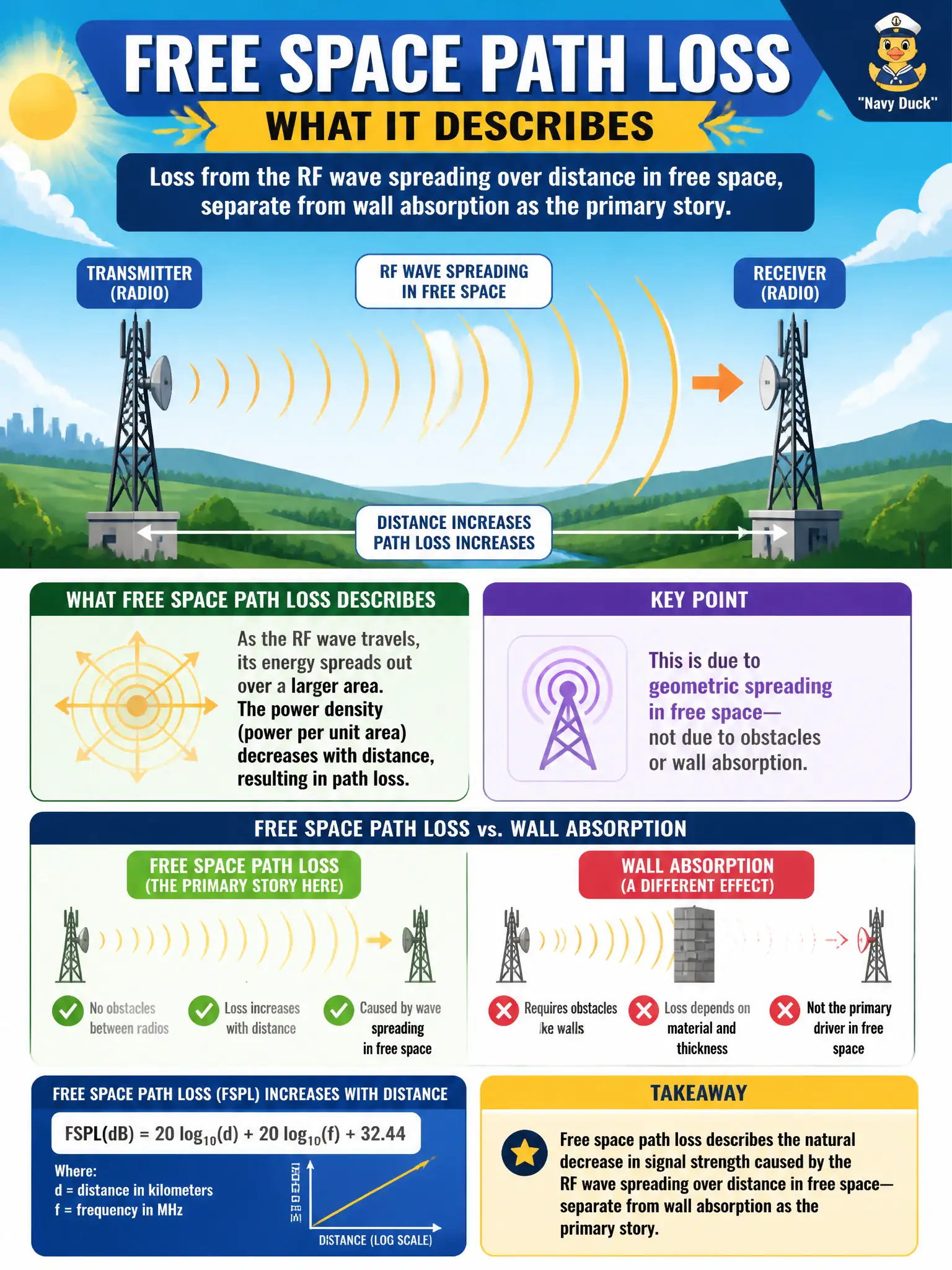
Even in empty air, the wave spreads like a flashlight beam getting dimmer farther from the bulb. That distance dimming is free space path loss. Walls eating energy is a different monster — do not rename every weak link 'FSPL' when you are really staring at concrete.
Full Explanation
Free-space path loss describes RF power density falling as the wave spreads with distance in free space, even with no walls between radios—classic for an outdoor municipal point-to-point note. It is separate from wall absorption as the primary story, though real links can stack both effects. FSPL is not defined as drywall/foil loss indoors, not caused by WPA3 passphrase errors, and not cured by PoE++ injectors, which deliver DC power over Ethernet rather than rewriting propagation physics. Exam caveat: quoting FSPL does not replace measuring the actual path, antenna gain, and connectors on the city’s PTP link. Operational check: for the unobstructed hop, confirm distance and antenna aiming against the design, calculate or review expected levels, measure received power, and separate distance spreading from any unexpected obstruction loss. In municipal WLAN operations, record the rationale in the work order so future on-call staff know which RF concept applied and which failure modes the rejected options would create for city services. Re-validate after the next maintenance window that the same control still holds under the AP firmware and client mix used by the civic network team. Keep civic survey notes tied to absolute measurements and the approved design document.