
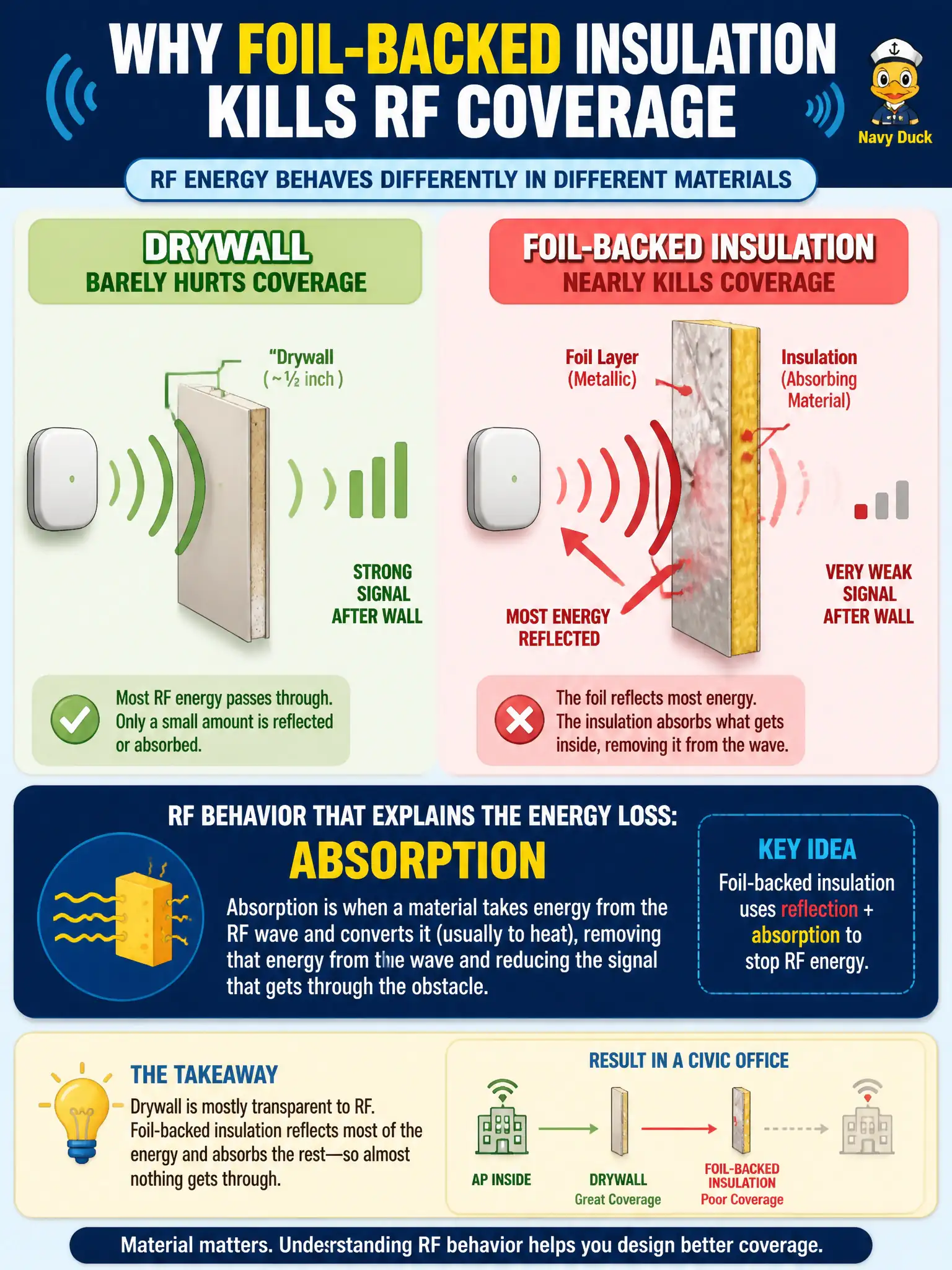
Drywall barely hurts a civic office AP, but a foil-backed insulation wall nearly kills coverage through that wall. Which RF behavior best explains the energy loss in the foil-backed material?
Select an answer to reveal the explanation.
Short Explanation
Some walls are polite; foil-backed ones are hungry. Absorption is the wall eating RF energy so less makes it out the other side. Distance in open air is a different loss story — this one is the material taking a bite.
Full Explanation
Absorption is the RF behavior where materials take energy from the wave and attenuate what continues through the obstacle. Foil-backed insulation in a civic office can nearly kill through-wall coverage compared with ordinary drywall because the material extracts and blocks energy. Free-space path loss is the distance-spreading effect in open space and is not the right primary label for foil-wall attenuation. Phase is not an AP setting that “punches through” foil. Foil does not create extra SSIDs or define channel utilization. Exam caveat: some metals also reflect strongly; foil-backed assemblies are still taught as severe attenuators relative to drywall—do not assume a helpful bounce behind every foil wall. Operational check: identify wall construction on the municipal as-built, place APs so users are not depending on foil-piercing paths, measure both sides of the wall, and adjust AP count or placement per design rather than maxing power as a first resort. In municipal WLAN operations, record the rationale in the work order so future on-call staff know which RF concept applied and which failure modes the rejected options would create for city services. Re-validate after the next maintenance window that the same control still holds under the AP firmware and client mix used by the civic network team.