
A supervisor uses 'air attenuation' and 'free space path loss' interchangeably during a parks wireless review. How should the technician separate the ideas at CWTS depth?
Select an answer to reveal the explanation.
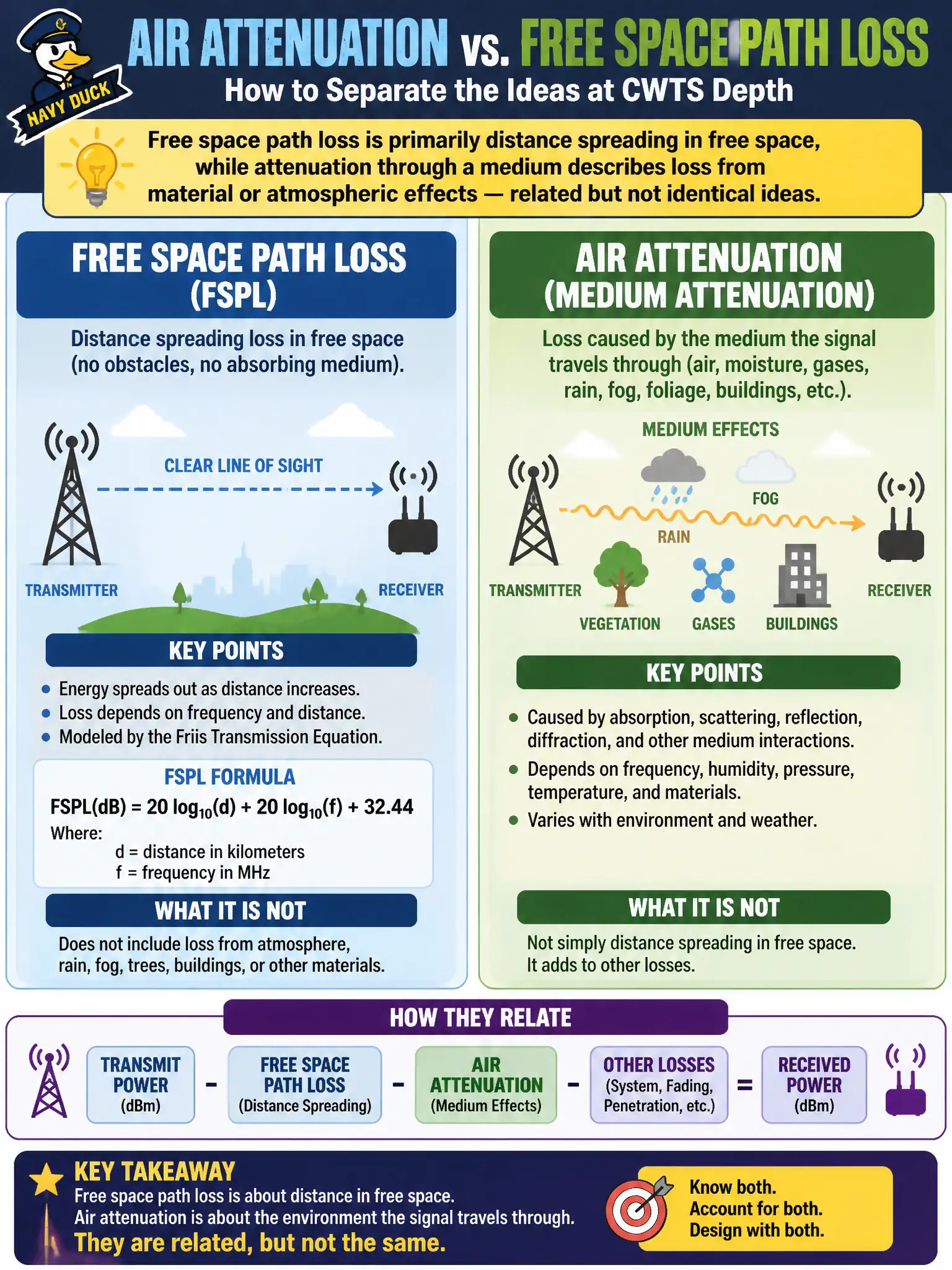
Short Explanation
One idea is the beam getting thinner with pure distance; the other is stuff in the path (air moisture, materials) soaking or impeding energy. Related cousins, not twins. Saying the words as synonyms muddies which fix you even look for.
Full Explanation
At CWTS depth, free-space path loss is primarily geometric spreading with distance in free space, while attenuation through a medium describes loss from material or atmospheric effects—related ideas, not identical synonyms. Using “air attenuation” and “FSPL” interchangeably in a parks wireless review muddies which mechanism you are diagnosing. Neither term means wall absorption only in every sentence, neither is WPA2 encryption overhead, and neither is the AP’s channel-width setting. Exam caveat: exam language may pair FSPL versus attenuation deliberately; matching the mechanism beats memorizing one buzzword for every weak link. Operational check: when a parks link is weak, ask whether the path is mostly open distance (FSPL story) or moisture, foliage, or materials in the path (medium attenuation), then measure and compare to design expectations. In municipal WLAN operations, record the rationale in the work order so future on-call staff know which RF concept applied and which failure modes the rejected options would create for city services. Re-validate after the next maintenance window that the same control still holds under the AP firmware and client mix used by the civic network team.