
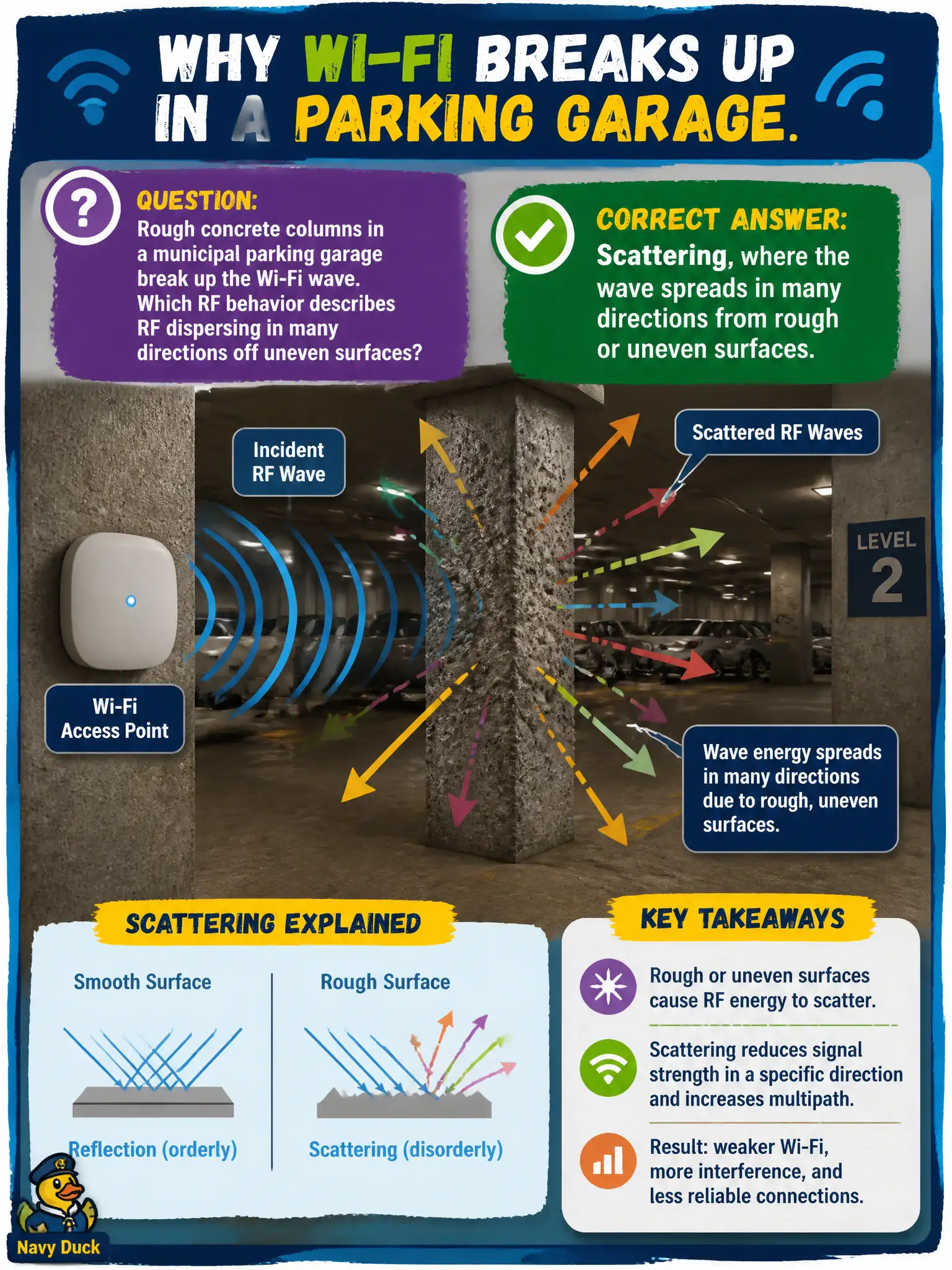
Rough concrete columns in a municipal parking garage break up the Wi-Fi wave. Which RF behavior describes RF dispersing in many directions off uneven surfaces?
Select an answer to reveal the explanation.
Short Explanation
Rough concrete is like throwing a handful of gravel at a wave — energy sprays everywhere instead of one clean bounce. That spray is scattering. One shiny metal door might mirror; crumbly columns shred the wave into many weak paths.
Full Explanation
Scattering disperses RF energy in many directions when the wave hits rough or uneven surfaces such as coarse concrete columns in a municipal parking garage. That shotgun spray differs from a single clean specular reflection off a smooth metal door or polished panel. Concrete does not act as an intentional dish providing passive antenna gain, and garage structure does not raise the assigned carrier frequency. Exam caveat: scattering contributes to multipath fragmentation; remedies are placement, antennas, and band/channel planning per design—not renaming scattering as gain. Operational check: survey mid-garage versus open lanes, expect fragmented paths near rough columns, and validate AP mounting height and antenna pattern against the parking structure drawing. Document scattering as multi-direction dispersal so civic garage tickets distinguish rough-surface spray from mirror-like bounce. In municipal WLAN operations, record the rationale in the work order so future on-call staff know which RF concept applied and which failure modes the rejected options would create for city services. Re-validate after the next maintenance window that the same control still holds under the AP firmware and client mix used by the civic network team.