
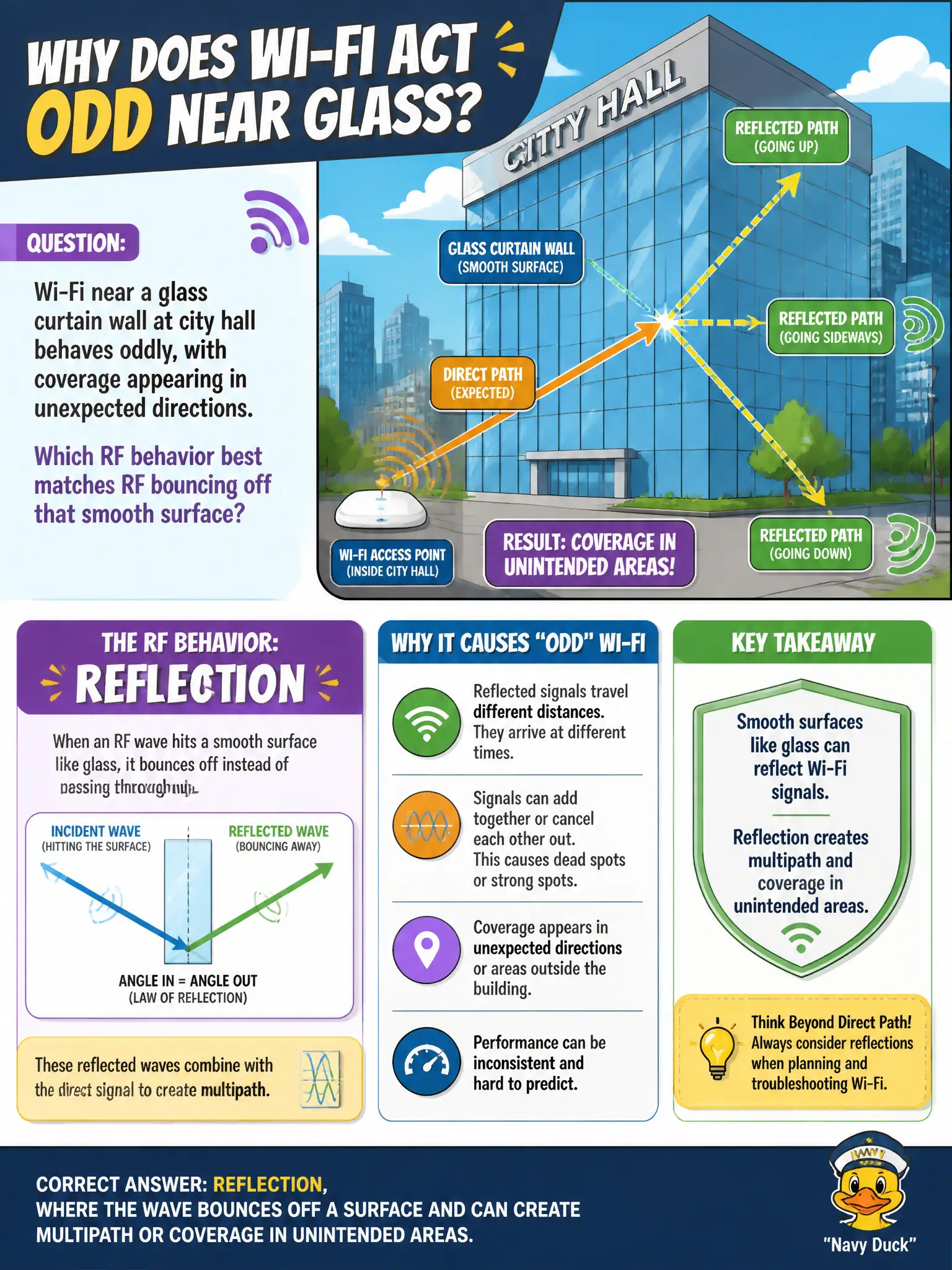
Wi-Fi near a glass curtain wall at city hall behaves oddly, with coverage appearing in unexpected directions. Which RF behavior best matches RF bouncing off that smooth surface?
Select an answer to reveal the explanation.
Short Explanation
Smooth glass can act like a mirror for RF — the wave hits and ricochets. That bounce is reflection, and it is why a client around the corner might hear the AP while someone in the 'obvious' spot sees weird fades. Mirrors redirect; they do not eat the whole meal like heavy absorption would.
Full Explanation
Reflection is the RF behavior where a wave bounces off a surface and can send energy into unexpected directions, creating multipath or odd coverage—exactly the glass curtain-wall story at city hall. Smooth architectural glass is a classic reflector. Absorption converts energy into the material and reduces what continues through; it is not the primary match for bounce-driven odd directions. Free-space path loss is distance spreading without requiring that bounce narrative. Antenna gain is intentional pattern focusing by an antenna, not something that “only occurs when glass is present.” Exam caveat: reflection can help or hurt; do not assume every bounce is usable coverage, and do not ignore absorption through other materials in the same building. Operational check: survey both the intuitive desk and the unexpected hotspot, note multipath symptoms, and compare against the design’s AP placement rather than raising power blindly. In municipal WLAN operations, record the rationale in the work order so future on-call staff know which RF concept applied and which failure modes the rejected options would create for city services. Re-validate after the next maintenance window that the same control still holds under the AP firmware and client mix used by the civic network team.