
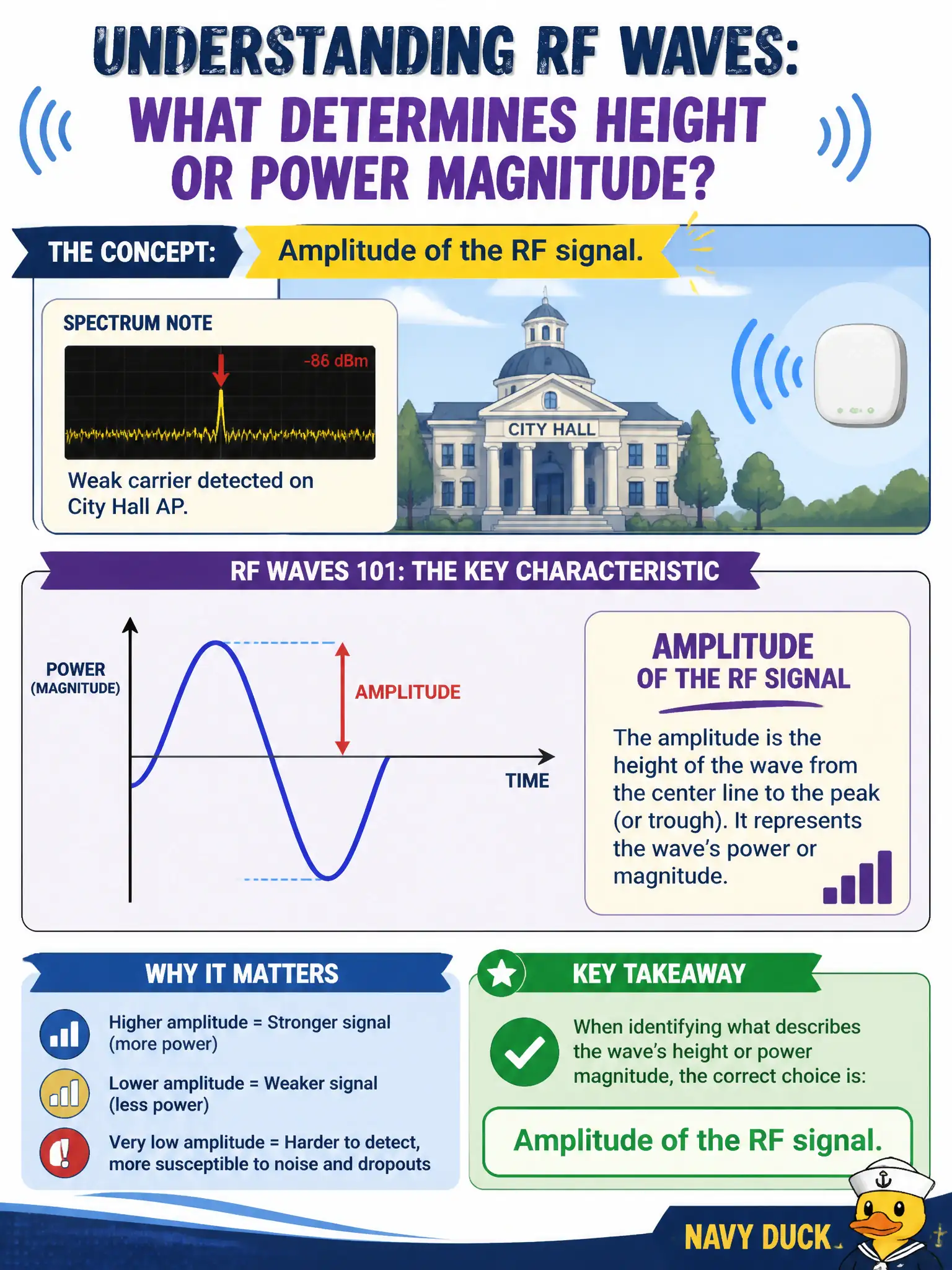
An installer reads a spectrum note about a weak carrier on a city hall AP and must identify which characteristic describes the wave's height or power magnitude. Which choice is correct?
Select an answer to reveal the explanation.
Short Explanation
A weak carrier is a 'short wave' on the strength chart — that is amplitude. The channel can be perfectly correct and the wave still look small. Fixing weakness starts with understanding you are talking about magnitude, not retuning pitch for no reason.
Full Explanation
Amplitude is the characteristic that describes the RF wave’s height or power magnitude—exactly the language a spectrum note uses when a city-hall carrier looks weak. A correctly assigned channel can still show a small amplitude if power, antennas, cabling, or path loss reduce delivered energy. Frequency identifies how fast the carrier oscillates at the assigned center; it is not the primary label for wave height. Phase offset between diversity antennas is a combining topic, not the definition of magnitude. Wavelength is a spatial period measured along the propagation path, not “meters of Cat6” as if Ethernet length redefined RF cycle length. Exam caveat: weak-carrier tickets should drive power, antenna, cable, and obstacle checks—not random frequency hops framed as fixing amplitude. Operational check: confirm configured transmit power and antenna connections against the city-hall design, measure received dBm at the complaint desk, and note whether noise or SNR—not merely “weak looking”—is the real performance limiter. In municipal WLAN operations, record the rationale in the work order so future on-call staff know which RF concept applied and which failure modes the rejected options would create for city services. Re-validate after the next maintenance window that the same control still holds under the AP firmware and client mix used by the civic network team.