
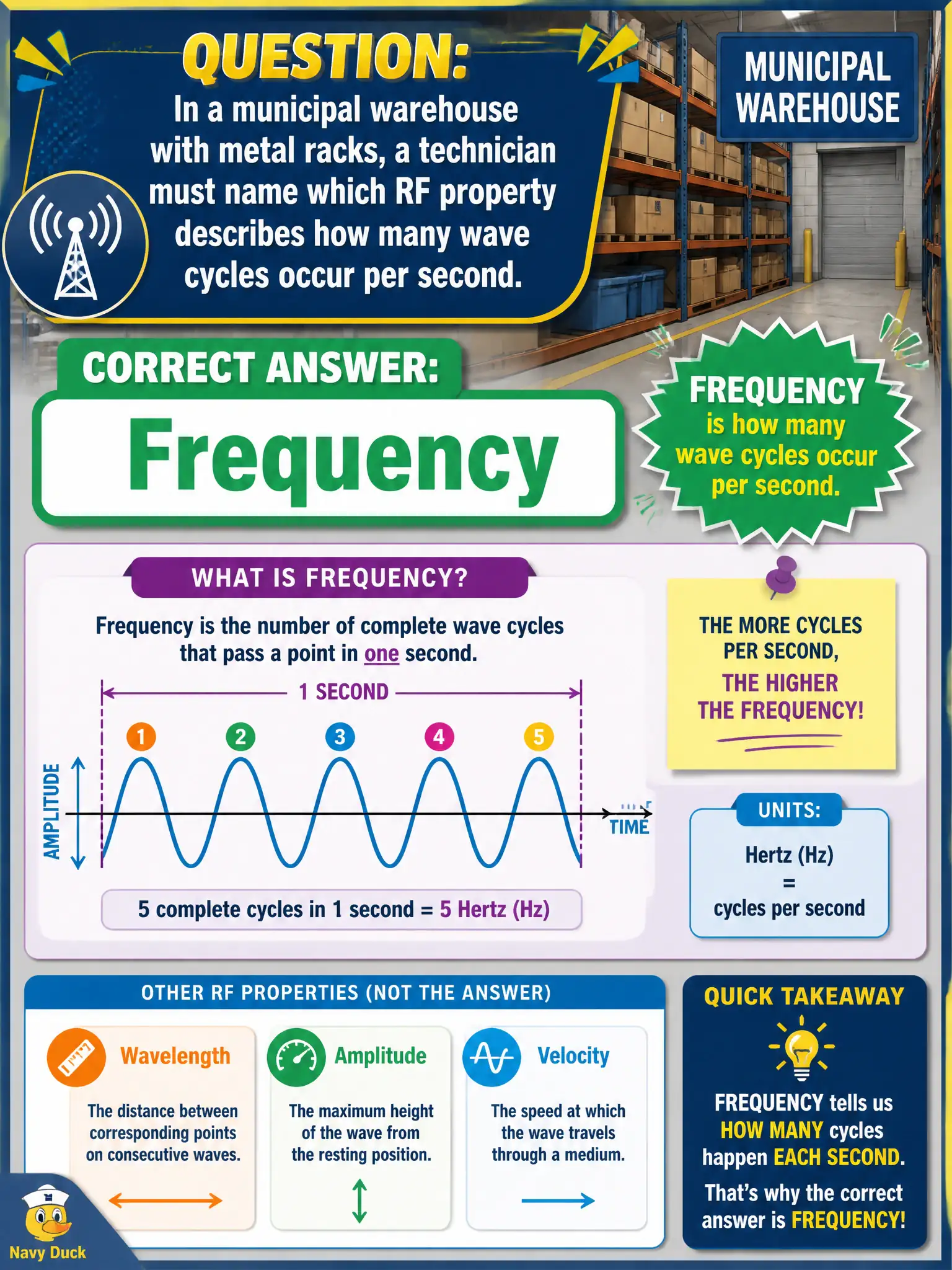
In a municipal warehouse with metal racks, a technician must name which RF property describes how many wave cycles occur per second. Which property is that?
Select an answer to reveal the explanation.
Short Explanation
Cycles per second is the definition of frequency — full stop. Amplitude is how strong, phase is where you are in the cycle, and wavelength is how long one cycle stretches in space. Warehouse metal might bounce signals around, but it does not change that vocabulary.
Full Explanation
Among the four basic RF signal characteristics, frequency is the property that counts how many wave cycles occur per second. In a municipal warehouse full of metal racks, multipath and reflection may complicate coverage, but they do not redefine that vocabulary: cycles per second remain frequency. Amplitude relates to magnitude and signal strength. Phase is relative position in the cycle and affects how multipath copies combine. Wavelength is the physical length of one cycle in space. Naming frequency correctly is foundational before applying warehouse multipath behaviors in later troubleshooting. Exam caveat: warehouse metal can tempt technicians to invent new definitions for familiar terms; keep the four characteristics clean before applying propagation behaviors. Operational check: when labeling spectrum captures or design notes for the civic warehouse, name the carrier’s cycle rate as frequency, log absolute received power separately, and avoid calling channel width or RSSI percentage “frequency.” Confirm the AP’s configured band center against the municipal channel plan so vocabulary and settings stay aligned. In municipal WLAN operations, record the rationale in the work order so future on-call staff know which RF concept applied and which failure modes the rejected options would create for city services. Re-validate after the next maintenance window that the same control still holds under the AP firmware and client mix used by the civic network team.