
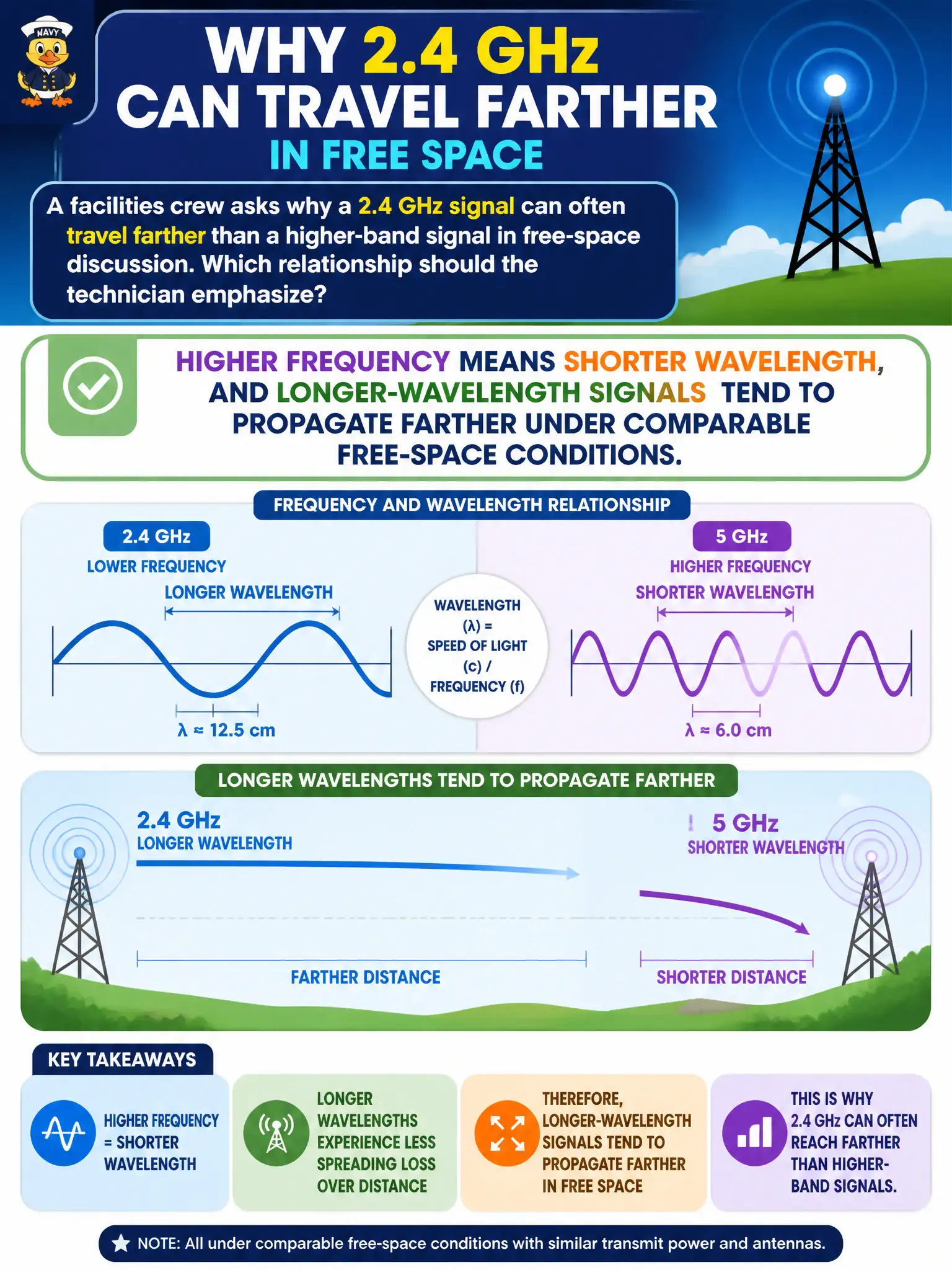
A facilities crew asks why a 2.4 GHz signal can often travel farther than a higher-band signal in free-space discussion. Which relationship should the technician emphasize?
Select an answer to reveal the explanation.
Short Explanation
Think of ocean swells versus tiny ripples. Lower frequency means longer waves, and those long waves usually hang on better over distance in the free-space story. Higher bands are not broken — they just ride shorter wavelengths with different range tradeoffs.
Full Explanation
Frequency and wavelength are inversely related for RF traveling at the speed of light: higher frequency yields shorter wavelength. At technician depth, longer-wavelength signals in the 2.4 GHz class are commonly discussed as propagating farther in free-space comparisons than higher-band signals under comparable conditions—useful when a facilities crew asks why a municipal courtyard still leans on 2.4 GHz for reach. That relationship does not mean higher bands invent less transmit power or cannot cover outdoors; power, antennas, obstacles, and regulatory limits still govern design. Wavelength is not identical to channel width in megahertz, so claiming 2.4 GHz reaches farther only because of 80 MHz channels mixes propagation geometry with bandwidth configuration. Lower frequency does not automatically raise amplitude or eliminate the need for antennas. Exam caveat: free-space teaching comparisons are not a license to ignore the city’s channel plan, client band support, or clutter. Operational check: when explaining range tradeoffs, cite frequency–wavelength pairing from the design brief, confirm actual AP power and antenna type, and survey both bands at the courtyard edge instead of assuming 5/6 GHz is “broken.”