
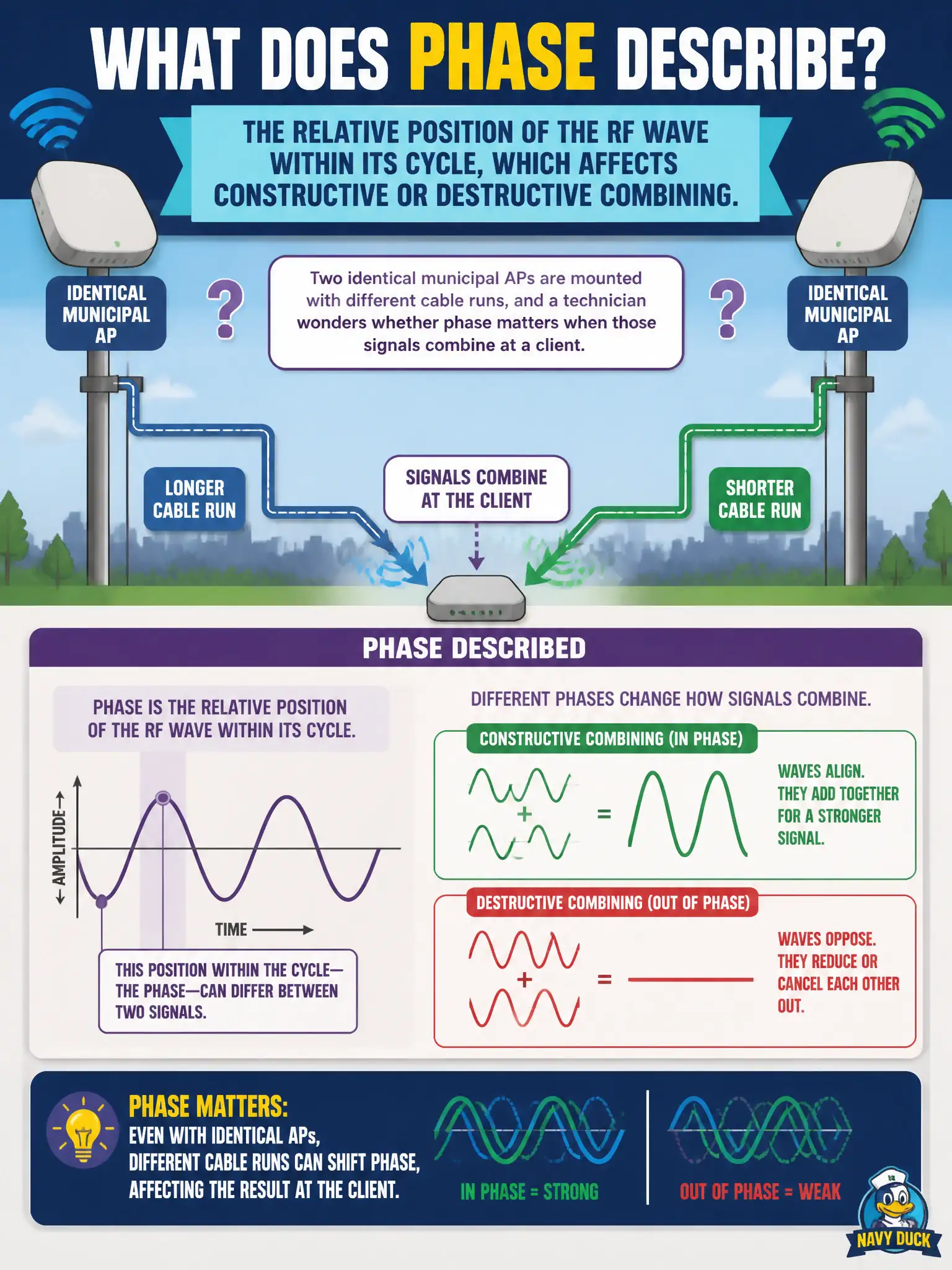
Two identical municipal APs are mounted with different cable runs, and a technician wonders whether phase matters when those signals combine at a client. What does phase describe?
Select an answer to reveal the explanation.
Short Explanation
Picture two kids jumping on a trampoline — if they land together, you get a bigger bounce; if they land opposite, it cancels. Phase is where each wave is in its cycle when they meet. Cable delay can shift that timing so the client sees help or a hole.
Full Explanation
Phase describes the relative position of an RF wave within its oscillatory cycle. When two municipal APs or multipath copies arrive at a client with different cable or path delays, that phase relationship decides constructive or destructive combining at the receiver—help or a coverage hole. Absolute power in milliwatts is amplitude/power territory, not phase. Configured channel width in megahertz is a spectrum-occupancy choice, unrelated to cycle position. SSID beacon interval is a management-frame timer, not an RF wave-phase property. Exam caveat: CWTS-level phase is a physics idea about combining waves; typical AP GUIs do not offer a routine “set phase” checkbox for day-two fixes, so do not invent one. Operational check: when identical civic APs use unequal coax runs to antennas or when clients report spotty combining in a lobby, treat cable length and multipath delay as phase-shift contributors, verify antenna and cable plant against the design, and measure with survey tools rather than hunting a nonexistent phase menu. In municipal WLAN operations, record the rationale in the work order so future on-call staff know which RF concept applied and which failure modes the rejected options would create for city services. Re-validate after the next maintenance window that the same control still holds under the AP firmware and client mix used by the civic network team.