
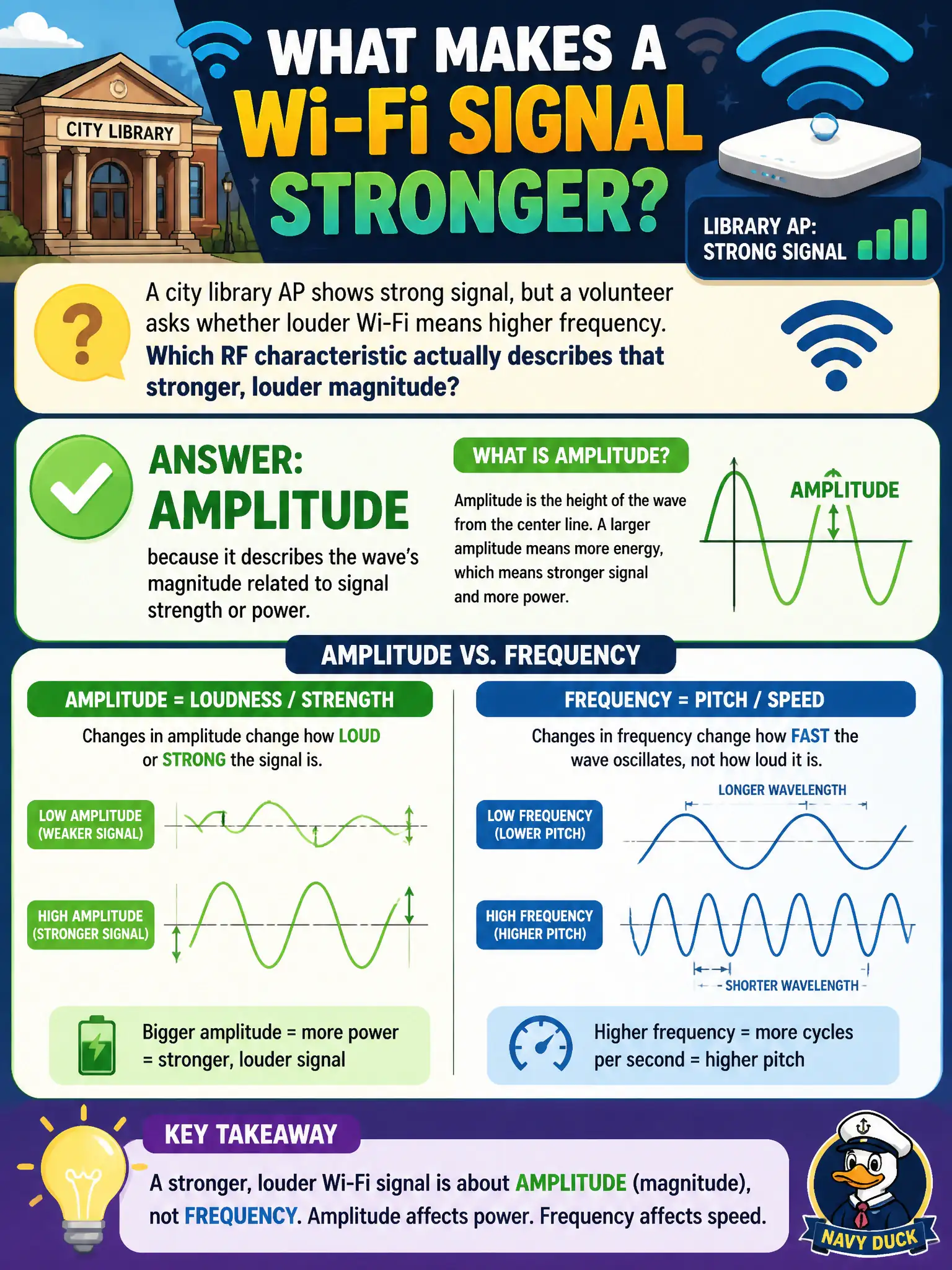
A city library AP shows strong signal, but a volunteer asks whether louder Wi-Fi means higher frequency. Which RF characteristic actually describes that stronger, louder magnitude?
Select an answer to reveal the explanation.
Short Explanation
Louder is about how tall the wave looks on a scope, not how fast it wiggles. Amplitude is that height — the strength side of the story. Frequency is the wiggle rate; mixing them up is like confusing volume with pitch.
Full Explanation
Amplitude is the RF characteristic that describes the wave’s magnitude and therefore the strength or power impression volunteers hear as “louder” Wi-Fi at the city library. A strong received signal can reflect higher amplitude-related power without any change in how fast the carrier oscillates. Frequency is oscillation rate; it does not automatically rise because coverage looks stronger, so claiming louder signal means a higher band is a category error. Wavelength is the spatial length of one cycle and does not stretch simply because the signal appears louder. Phase is relative position within the RF cycle and governs combining behavior, not a rule that louder arrivals always come earlier. Exam caveat: library help scripts often mix “bars,” loudness, and band names—keep amplitude (strength) distinct from frequency (rate) and from UI percentages that are not absolute power. Operational check: at the same desk, capture dBm (or a calibrated survey reading), note noise and SNR, and verify the AP’s configured band and power against the municipal design rather than retuning frequency because someone described the signal as loud. In municipal WLAN operations, record the rationale in the work order so future on-call staff know which RF concept applied and which failure modes the rejected options would create for city services. Re-validate after the next maintenance window that the same control still holds under the AP firmware and client mix used by the civic network team.