
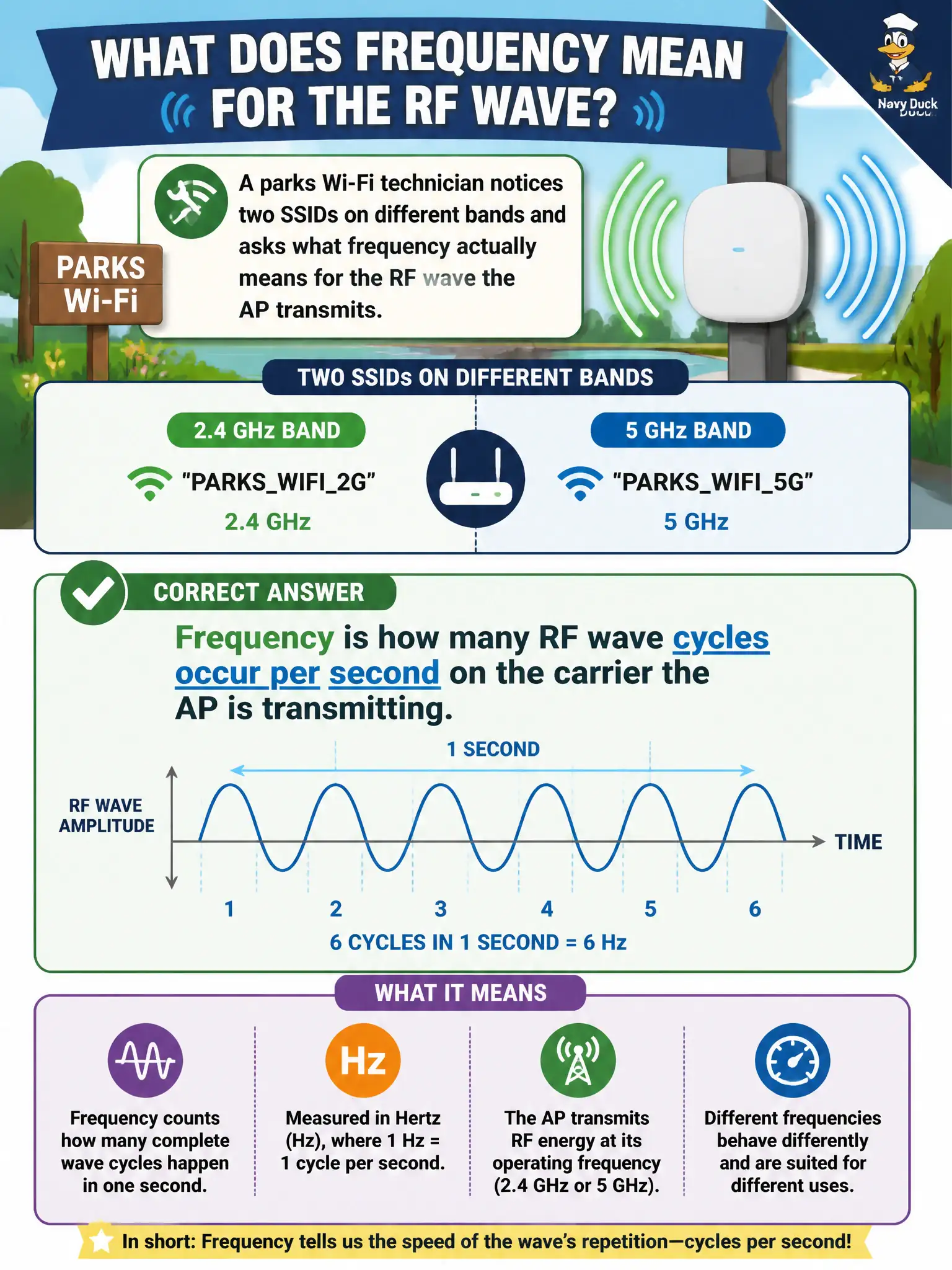
A parks Wi-Fi technician notices two SSIDs on different bands and asks what frequency actually means for the RF wave the AP transmits. Which statement is correct?
Select an answer to reveal the explanation.
Short Explanation
Think of the RF carrier like a metronome ticking in the air. Frequency is how fast that metronome clicks each second — not how loud it is, and not the length of one tick. Different bands just use different click rates.
Full Explanation
Frequency is the count of RF wave cycles per second on the carrier the municipal AP transmits, expressed in hertz (for example, the 2.4 GHz or 5 GHz class bands parks Wi-Fi uses). That rate is a fundamental RF characteristic of the electromagnetic wave itself, separate from how the technician labels channels in a design sheet. Channel numbers are planning aliases that map to center frequencies; they are not a substitute definition of frequency, so treating the sticker channel as unrelated to the carrier confuses label with physics. Amplitude describes wave magnitude related to power or strength, not a synonym for frequency—louder coverage does not mean the AP jumped to a higher cycle rate. Wavelength is the physical length of one full cycle in space, the inverse geometric partner of frequency, not the definition of cycles-per-second. Exam caveat: CWTS depth expects clean vocabulary among frequency, amplitude, phase, and wavelength before later multipath or band-tradeoff questions. Operational check: on a parks survey, note the band and center frequency (or channel mapped to that frequency) for each SSID, confirm the design document’s band plan, and record absolute received levels in dBm rather than arguing that a strong courtyard signal somehow changed the carrier’s cycle rate.