
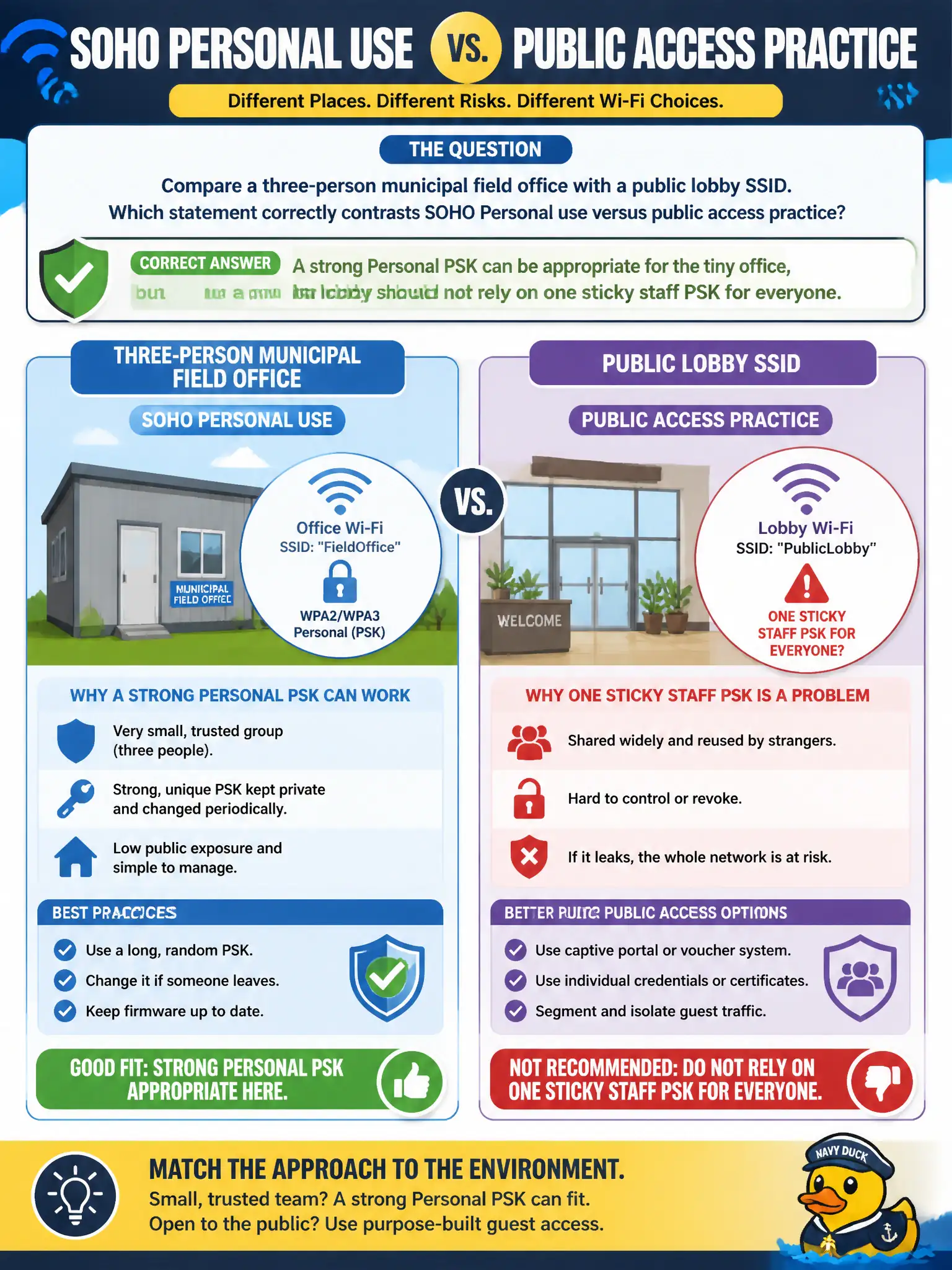
Compare a three-person municipal field office with a public lobby SSID. Which statement correctly contrasts SOHO Personal use versus public access practice?
Select an answer to reveal the explanation.
Short Explanation
Tiny office? A strong Personal passphrase can be fine. Public lobby? Do not make the whole city share one sticky staff PSK. Different audiences, different controls.
Full Explanation
Comparing a three-person municipal field office with a public lobby SSID, a strong Personal PSK can be appropriate for the tiny office, but a public lobby should not rely on one sticky staff PSK for everyone. Audience and threat model differ: SOHO Personal security fits a small known staff set, while public access needs portal/OWE/segmentation patterns that do not publish departmental secrets to walk-ins.
Saying public lobbies should always use the same departmental staff PSK posted at reception fails by collapsing public and staff trust and advertising the key. Claiming SOHO offices must never use WPA2/WPA3-Personal and may only use open SSIDs fails by concept: Personal with a strong passphrase is valid SOHO practice. Saying public and SOHO SSIDs should both place AP management and guest traffic on one flat VLAN fails segmentation and management-plane hygiene for both contexts.
Exam caveat: CWTS contrasts SOHO Personal appropriateness with public-use controls. One sticky PSK is not a universal civic Wi-Fi pattern.
Operational check: keep the field office on WPA2/WPA3-Personal with a strong unique passphrase; configure lobby with portal/OWE and separate VLAN; verify the staff PSK is not printed for visitors; confirm management interfaces are not on the public SSID.