
A parks department small office asks how WPA3-Personal differs from WPA2-Personal when both use a passphrase. Which contrast should the technician highlight?
Select an answer to reveal the explanation.
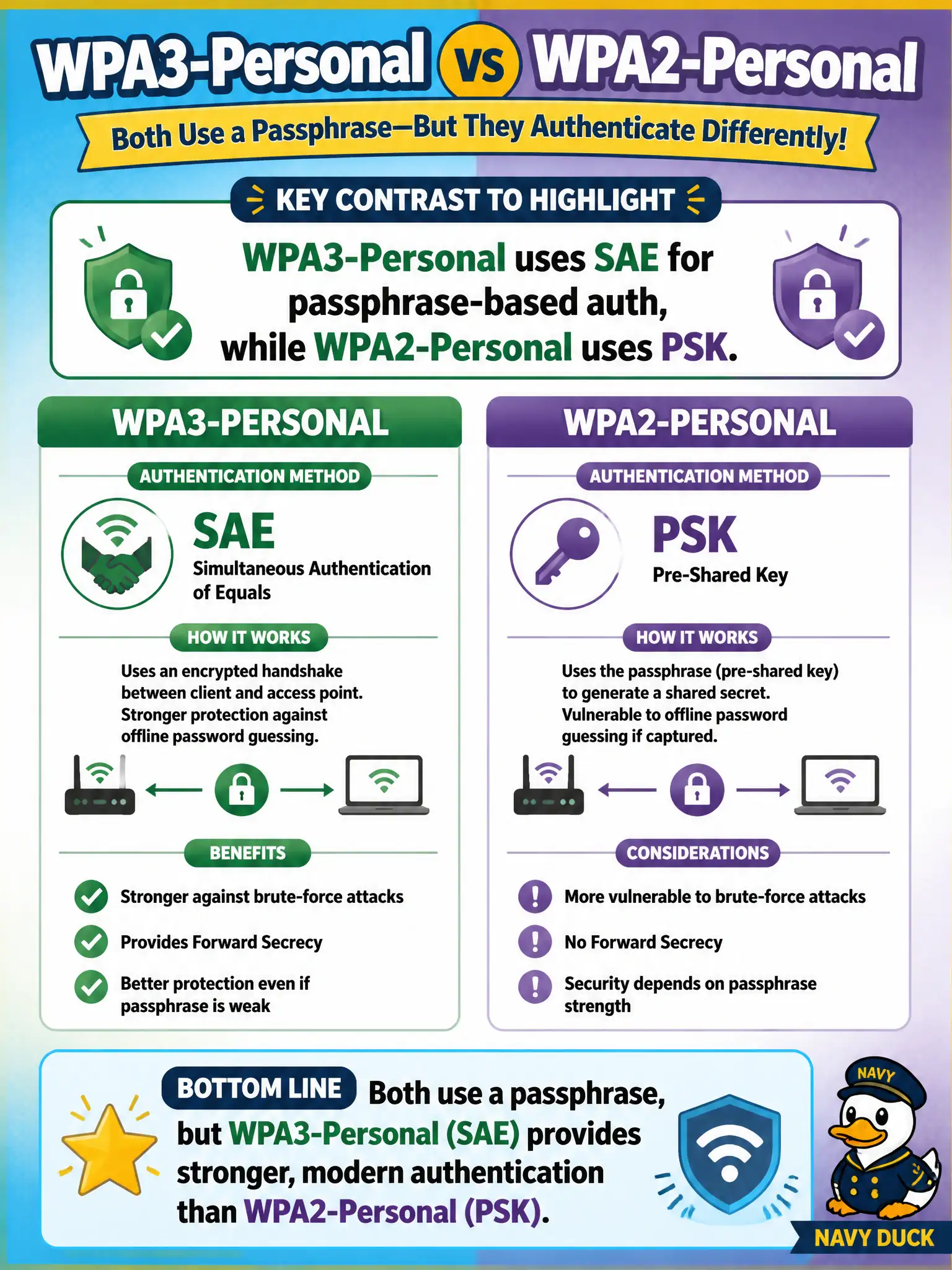
Short Explanation
Same idea of a shared secret, different handshake. WPA3-Personal brings SAE to the party; WPA2-Personal is still classic PSK. Neither one magically becomes RADIUS Enterprise just because the label says “Personal.”
Full Explanation
For a parks-department small office comparing passphrase-based modes, the technician should highlight that WPA3-Personal uses Simultaneous Authentication of Equals (SAE) for passphrase-based authentication, while WPA2-Personal uses the older PSK construct. Both can use a shared secret for SOHO-style civic offices, but the handshake and resistance properties differ: SAE is the modern Personal replacement path, not merely a marketing rename of classic PSK.
Claiming WPA3-Personal still uses the same PSK four-way handshake weaknesses as WPA2 with no protocol change fails because WPA3-Personal replaces that PSK handshake model with SAE. Saying WPA3-Personal requires a full RADIUS server while WPA2-Personal never uses a passphrase fails by concept: Personal modes are passphrase-based without RADIUS; Enterprise is the RADIUS/EAP path. Claiming WPA2-Personal encrypts with OWE while WPA3-Personal only hides the SSID fails because OWE is encrypted-open technology and SSID hiding is not the defining WPA3-Personal control.
Exam caveat: map Personal versus Enterprise correctly. WPA3-Personal = SAE; WPA2-Personal = PSK; neither becomes Enterprise just because a strong passphrase is used.
Operational check: on a parks SOHO AP that supports WPA3, set Personal mode and confirm the UI or docs reference SAE/WPA3-Personal; on a WPA2-only AP, expect PSK; do not configure RADIUS for a Personal SSID unless the design actually calls for Enterprise.