
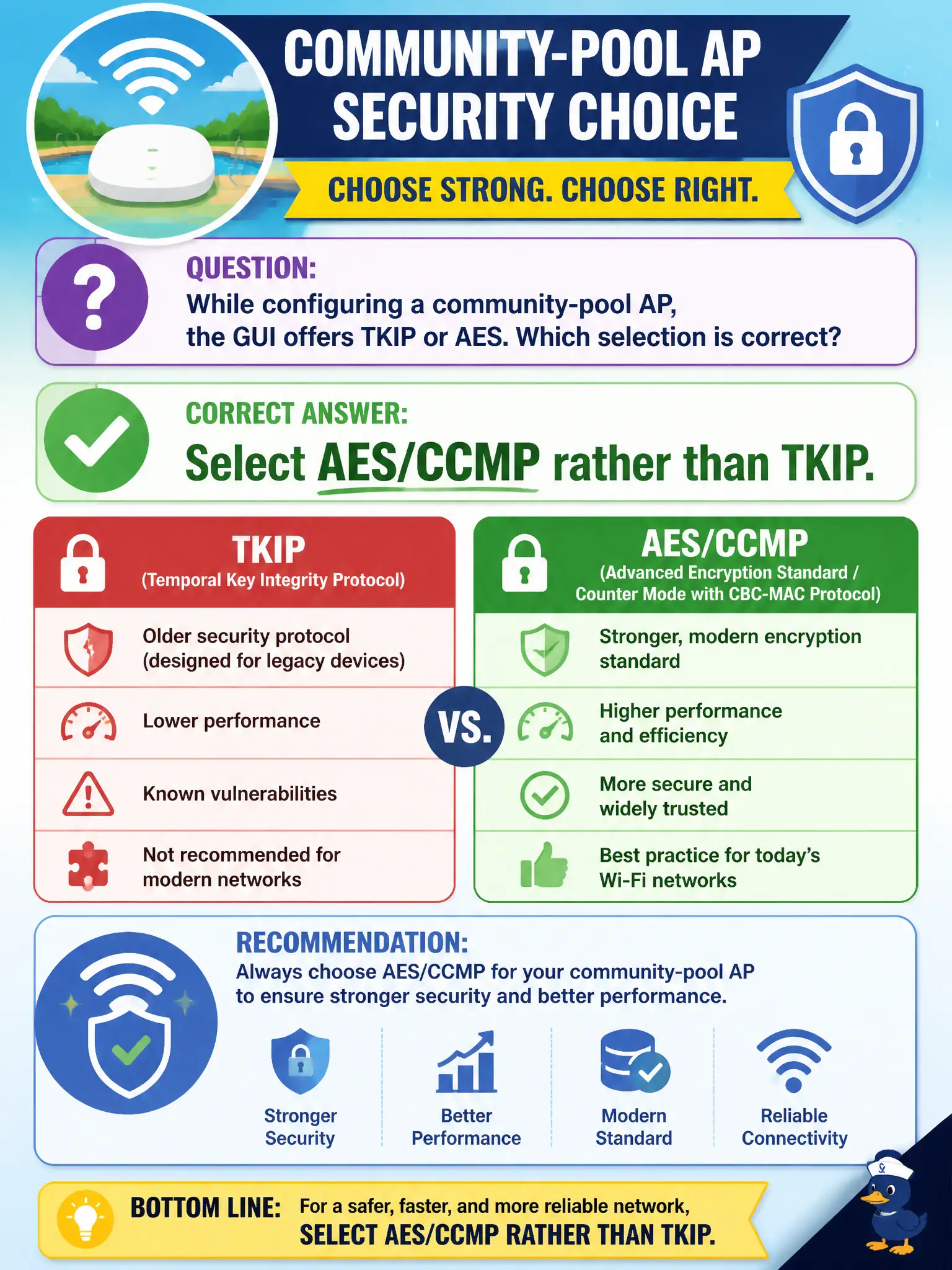
While configuring a community-pool AP, the GUI offers TKIP or AES. Which selection is correct?
Select an answer to reveal the explanation.
Short Explanation
When the menu is TKIP versus AES, take AES/CCMP every time. Compatibility stories and mixed random picks are how old ciphers stay alive on a pool-house AP.
Full Explanation
While configuring a community-pool AP, when the GUI offers TKIP or AES, the correct selection is AES/CCMP rather than TKIP. AES/CCMP is the modern cipher suite; TKIP is deprecated. Pool and recreation SSIDs still require contemporary cryptography even when the environment feels informal or IoT-heavy.
Selecting TKIP for better compatibility with all IoT pool sensors freezes a weak cipher instead of planning supported modern clients or alternate connectivity. Selecting both TKIP and AES and letting each client pick randomly keeps TKIP available and recreates mixed-mode risk. Selecting TKIP on 2.4 GHz and AES only if the radio is outdoor-rated invents an irrelevant outdoor-rating dependency.
Exam caveat: given TKIP versus AES in a GUI, choose AES/CCMP every time on CWTS security items.
Operational check: select AES/CCMP on the pool AP, confirm TKIP is not also enabled, test staff and kiosk devices, and record the cipher choice in the recreation department WLAN baseline. Municipal technicians document the verified setting in the as-built packet so the next shift inherits a known-good civic configuration rather than tribal knowledge. Municipal technicians document the verified setting in the as-built packet so the next shift inherits a known-good civic configuration rather than tribal knowledge.