
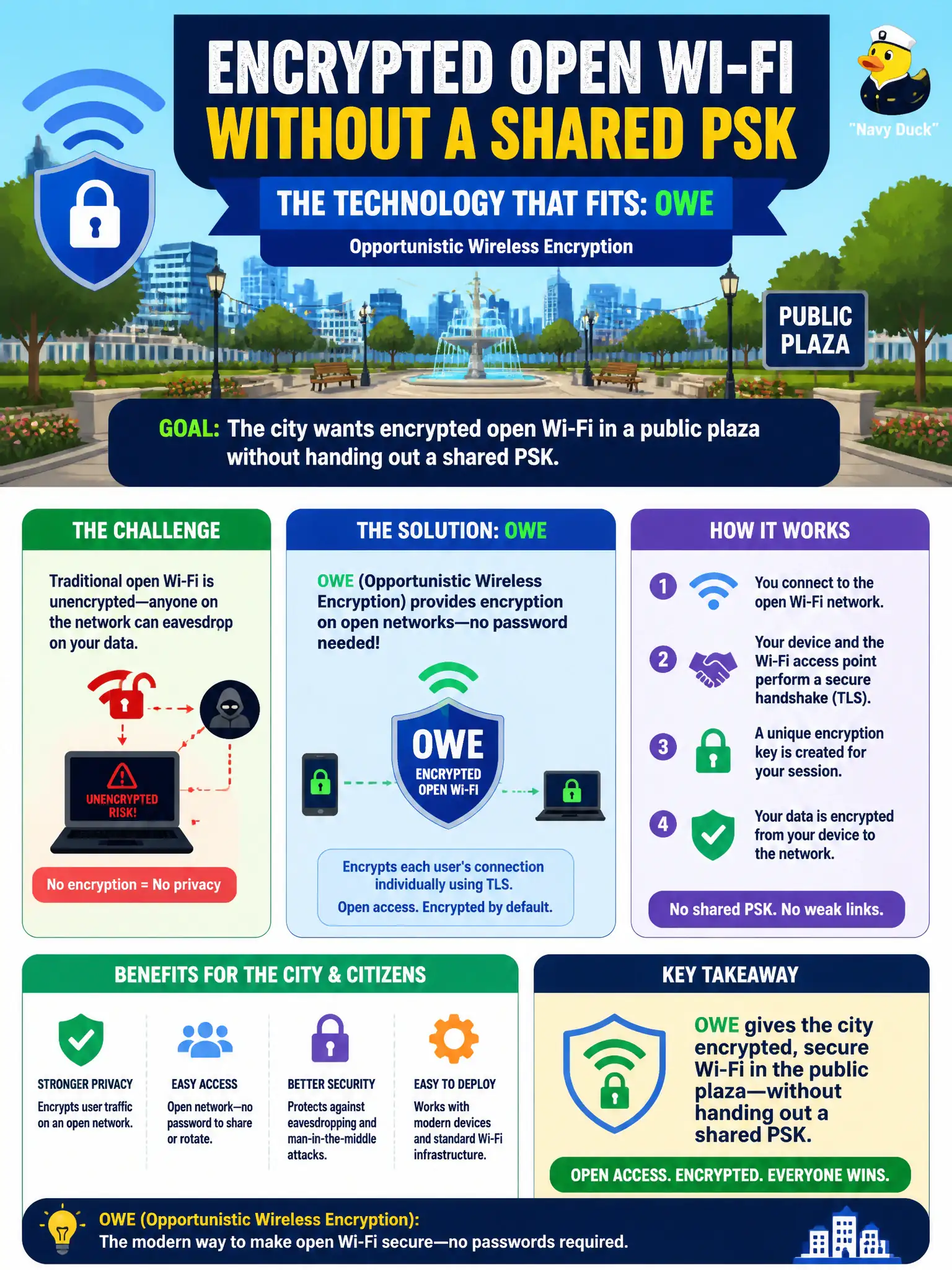
The city wants encrypted open Wi-Fi in a public plaza without handing out a shared PSK. Which technology fits?
Select an answer to reveal the explanation.
Short Explanation
Public plaza Wi-Fi can still wrap the traffic without a shared password poster. That pattern is OWE—Opportunistic Wireless Encryption—not WEP signs, hide-SSID open nets, or table-tent PSKs.
Full Explanation
Cities wanting encrypted open Wi-Fi in a public plaza without handing out a shared PSK are describing OWE—Opportunistic Wireless Encryption—for encrypted open networks without a traditional PSK. OWE provides encryption for open-style onboarding while avoiding a printed passphrase on every bench. It fits certain civic guest designs that still want air confidentiality without Personal-mode PSK distribution.
WEP open authentication with a well-known static key on a kiosk sign is broken crypto with a published secret. Hidden SSID Open System so passersby cannot see the name provides neither reliable hiding nor encryption. WPA2-Personal with the passphrase printed on every cafe table tent is a shared PSK the scenario wanted to avoid.
Exam caveat: encrypted open without a traditional PSK maps to OWE—not WEP, cloaking, or table-tent PSKs.
Operational check: confirm APs and target clients support OWE, enable OWE on the plaza SSID per design, verify encryption without distributing a PSK, and post clear resident guidance that this differs from WPA3-Personal SAE networks. Municipal technicians document the verified setting in the as-built packet so the next shift inherits a known-good civic configuration rather than tribal knowledge.