
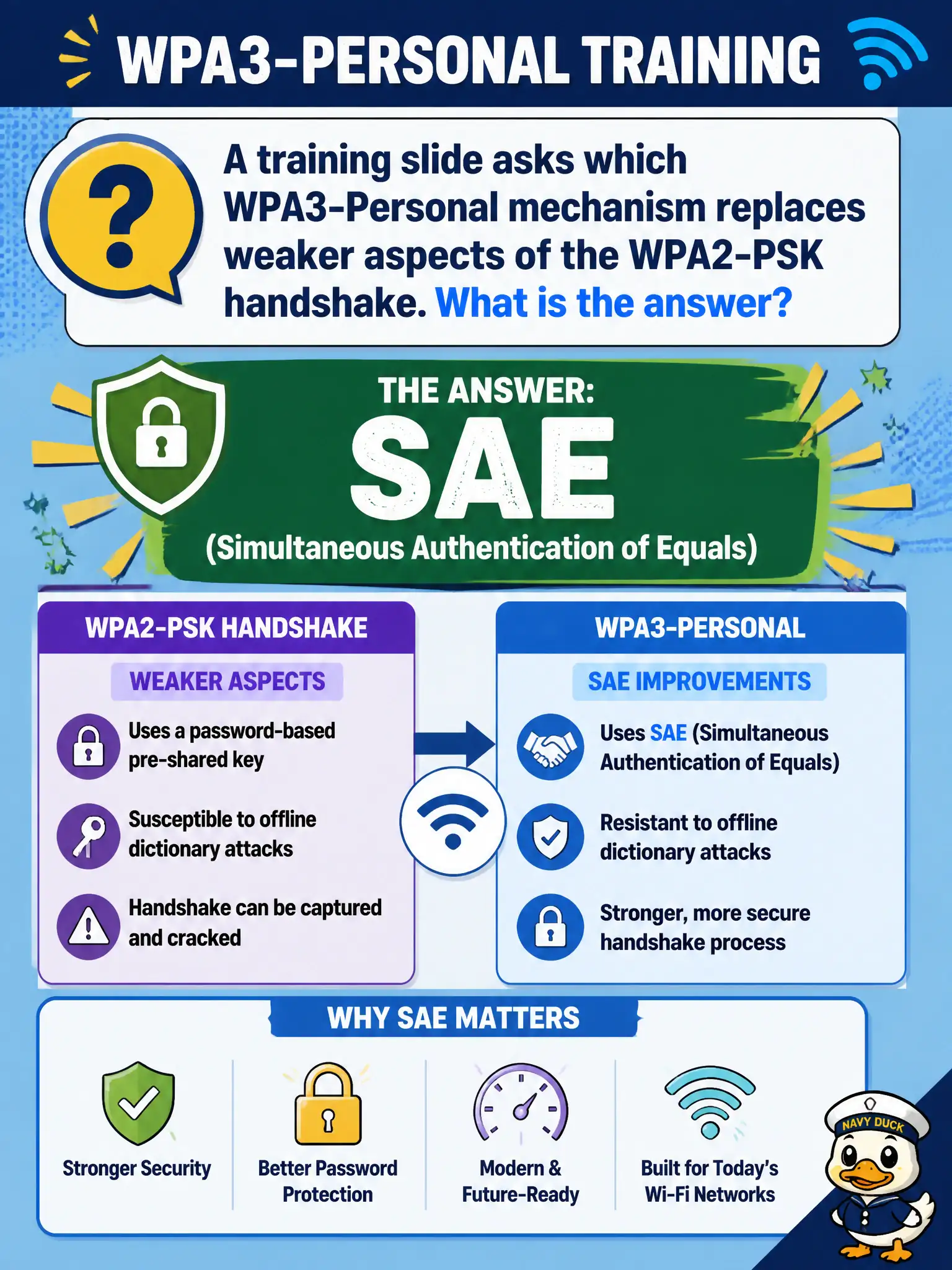
A training slide asks which WPA3-Personal mechanism replaces weaker aspects of the WPA2-PSK handshake. What is the answer?
Select an answer to reveal the explanation.
Short Explanation
WPA3-Personal's big handshake upgrade is SAE—Simultaneous Authentication of Equals. It is the modern stand-in for the weaker corners of old PSK behavior, not Shared Key Auth, WEP packing, or a MAC list.
Full Explanation
Training slides asking which WPA3-Personal mechanism replaces weaker aspects of the WPA2-PSK handshake are looking for SAE—Simultaneous Authentication of Equals. SAE is the password-authenticated key exchange used by WPA3-Personal to improve resistance relative to WPA2-PSK’s handshake weaknesses. Municipal technicians should recognize SAE by name when configuring or validating WPA3-Personal on civic APs.
Shared Key Authentication reused from early 802.11 is a legacy auth mode, not WPA3-Personal’s replacement handshake. Static WEP key packing inside the RSN information element is nonsensical legacy thinking. MAC allow-listing before the four-way handshake does not replace PSK handshake cryptography.
Exam caveat: WPA3-Personal’s distinctive mechanism versus WPA2-PSK is SAE—not Shared Key, WEP, or MAC filtering.
Operational check: when enabling WPA3-Personal, confirm the UI or docs show SAE, validate a client associates with a WPA3-Personal profile, and ensure training materials spell out Simultaneous Authentication of Equals for staff. Municipal technicians document the verified setting in the as-built packet so the next shift inherits a known-good civic configuration rather than tribal knowledge.