
A recreation-center AP is set to "WPA/WPA2 mixed," which keeps TKIP options alive. What should the technician recommend?
Select an answer to reveal the explanation.
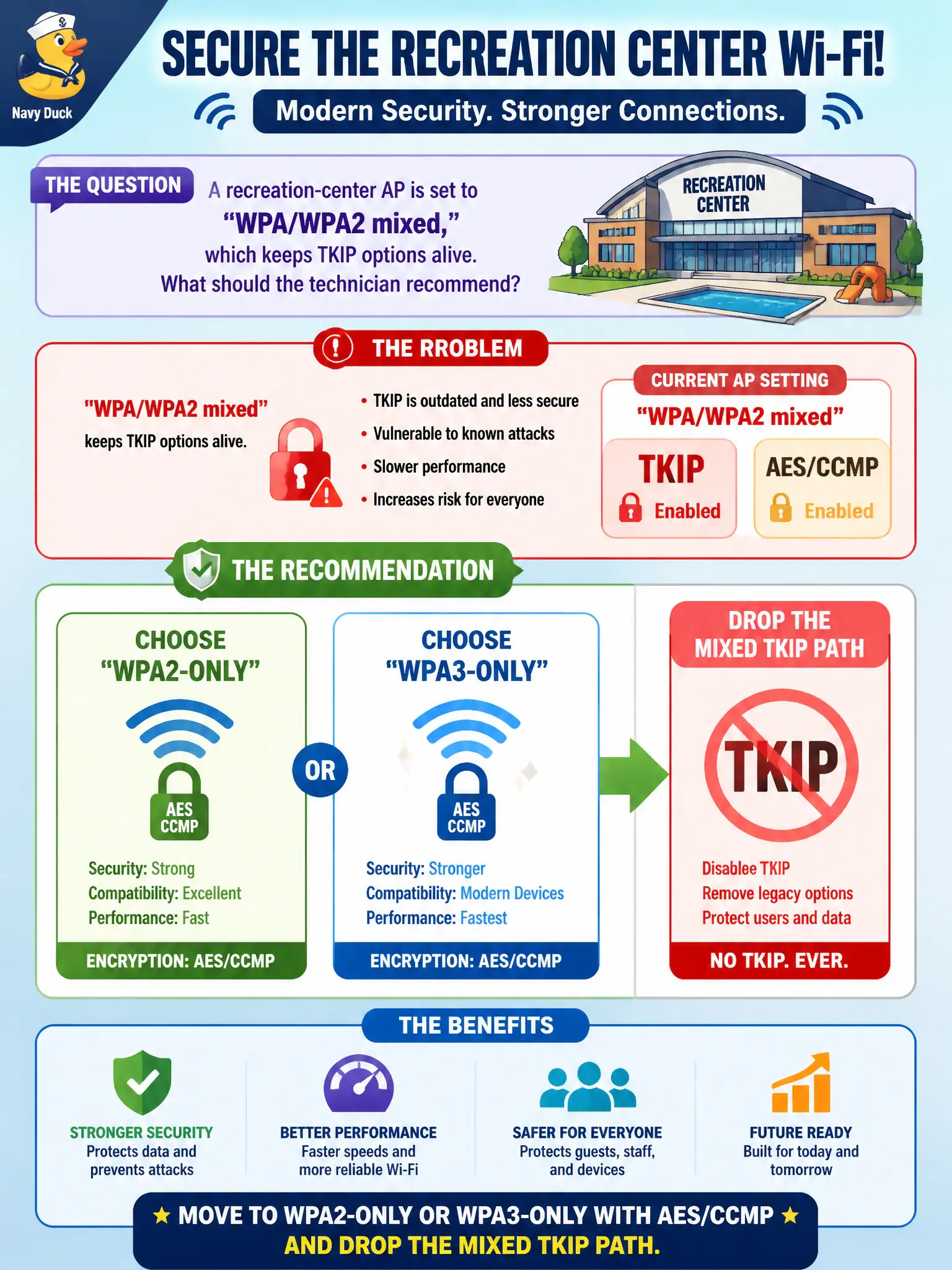
Short Explanation
Mixed mode is a museum wing still open to visitors. Close the WPA/TKIP side, run WPA2-only or WPA3-only with AES/CCMP, and stop letting the old cipher hitch a ride on the recreation SSID.
Full Explanation
A recreation-center AP set to “WPA/WPA2 mixed” keeps TKIP options alive and should be tightened. The technician should recommend moving to WPA2-only or WPA3-only with AES/CCMP and dropping the mixed TKIP path. Mixed modes exist for transitional compatibility but perpetuate deprecated ciphers on civic SSIDs that evening classes and staff devices share.
Leaving mixed mode so WPA1 clients can roam during evening classes prioritizes legacy weakness over baseline security. Preferring mixed mode because it automatically upgrades every client to SAE misunderstands mixed mode—it does not magically force SAE. Using mixed mode with longer group key rotation to offset TKIP risk leaves TKIP exposure in place.
Exam caveat: mixed WPA/WPA2 with TKIP is a transition trap; prefer WPA2-only or WPA3-only with AES/CCMP on municipal APs.
Operational check: change the recreation-center SSID to WPA2-only or WPA3-only with AES/CCMP, verify TKIP is absent, retest class devices, and update the center’s WLAN security profile. Municipal technicians document the verified setting in the as-built packet so the next shift inherits a known-good civic configuration rather than tribal knowledge. Municipal technicians document the verified setting in the as-built packet so the next shift inherits a known-good civic configuration rather than tribal knowledge.