
A security questionnaire asks why the city must retire TKIP and original WPA-Personal. Which rationale is correct?
Select an answer to reveal the explanation.
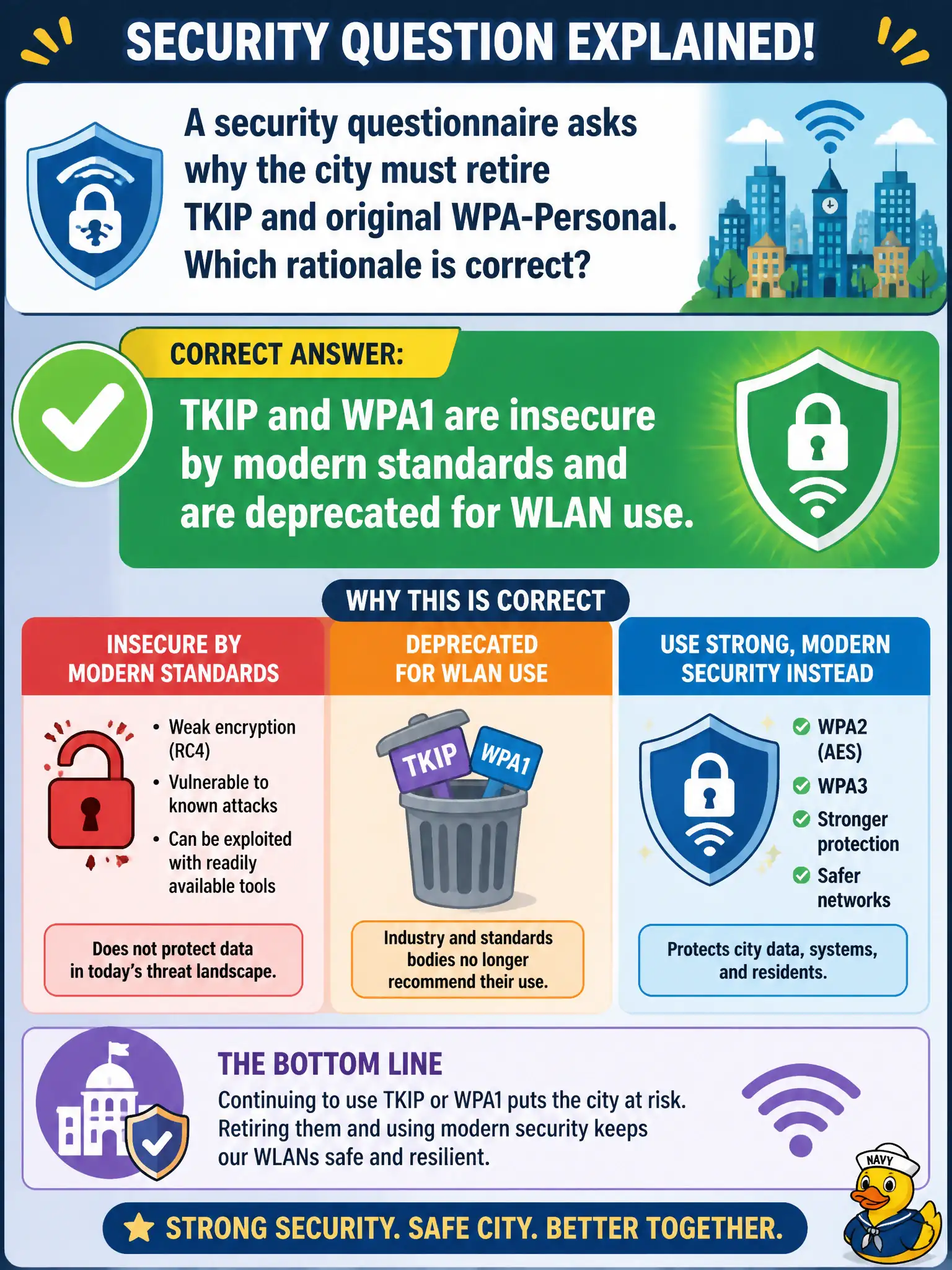
Short Explanation
The why is simple: the crypto and handshake did not age well. TKIP and original WPA-Personal are insecure by today's bar, so the questionnaire answer is deprecation for security—not signage, captive portals, or wired-only myths.
Full Explanation
Security questionnaires asking why the city must retire TKIP and original WPA-Personal are answered by stating that TKIP and WPA1 are insecure by modern standards and are deprecated for WLAN use. Cities retire them to meet contemporary security baselines, not for cosmetic reasons. Remaining on those suites exposes municipal traffic to known weaknesses.
Saying they are deprecated only because SSIDs using them cannot be printed on signage invents a frivolous reason. Claiming they remain fully approved and that deprecation applies only to wired 802.1X switches is false. Claiming they fail solely because they cannot support captive-portal redirect URLs ignores the cryptographic deprecation basis.
Exam caveat: deprecation of TKIP/WPA1 is about insecurity—not signage, wired-only myths, or portal URL support.
Operational check: cite the modern baseline in the questionnaire response, confirm city SSIDs use WPA2/WPA3 with AES/CCMP, and schedule any remaining TKIP/WPA1 networks for immediate remediation. Municipal technicians document the verified setting in the as-built packet so the next shift inherits a known-good civic configuration rather than tribal knowledge. Municipal technicians document the verified setting in the as-built packet so the next shift inherits a known-good civic configuration rather than tribal knowledge.