
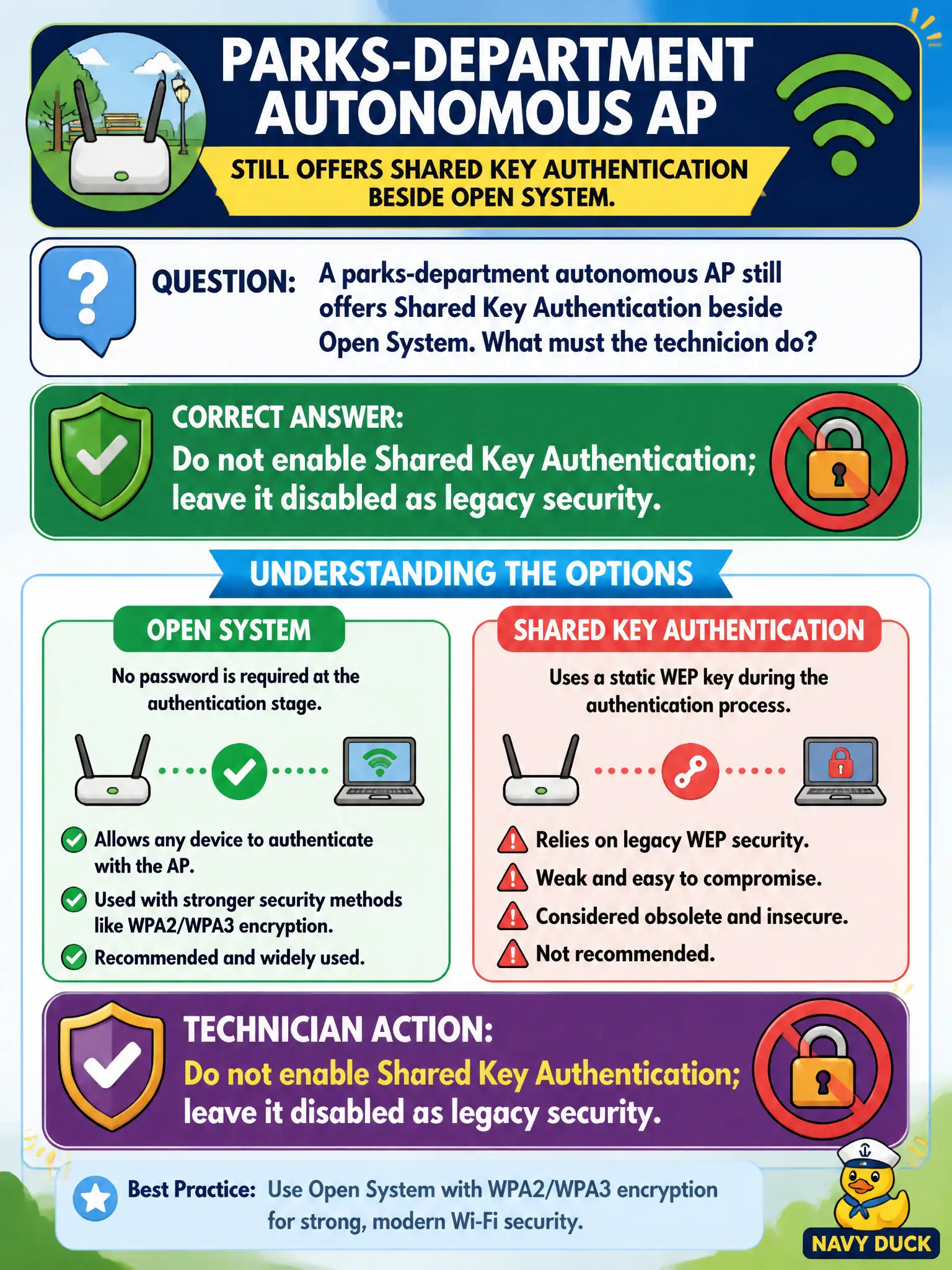
A parks-department autonomous AP still offers Shared Key Authentication beside Open System. What must the technician do?
Select an answer to reveal the explanation.
Short Explanation
Shared Key Authentication is the old handshake that leaked WEP key material—leave it off. Think of it as posting the combination while checking IDs: it looks stricter and actually makes things worse, so keep that legacy mode disabled.
Full Explanation
Parks-department autonomous APs that still offer Shared Key Authentication beside Open System require the technician to leave Shared Key disabled as legacy security. Shared Key Authentication is not a harmless compatibility toggle; it is a discouraged legacy mode associated with weak historical practices. Municipal APs should use Open System authentication with modern WPA2/WPA3 RSN suites as designed.
Preferring Shared Key because it proves the client already knows the WEP key embraces the wrong era of WLAN security. Enabling both Shared Key and Open System for older handheld fallback during events keeps the insecure option live. Disabling Open System entirely and forcing Shared Key for every municipal SSID maximizes legacy risk.
Exam caveat: do not enable Shared Key Authentication—disable it. Compatibility narratives do not override that CWTS stance.
Operational check: verify Shared Key Authentication is disabled on the parks AP, confirm Open System plus modern encryption per design, test event handhelds on the approved suite, and screenshot the auth mode page for compliance files. Municipal technicians document the verified setting in the as-built packet so the next shift inherits a known-good civic configuration rather than tribal knowledge.