
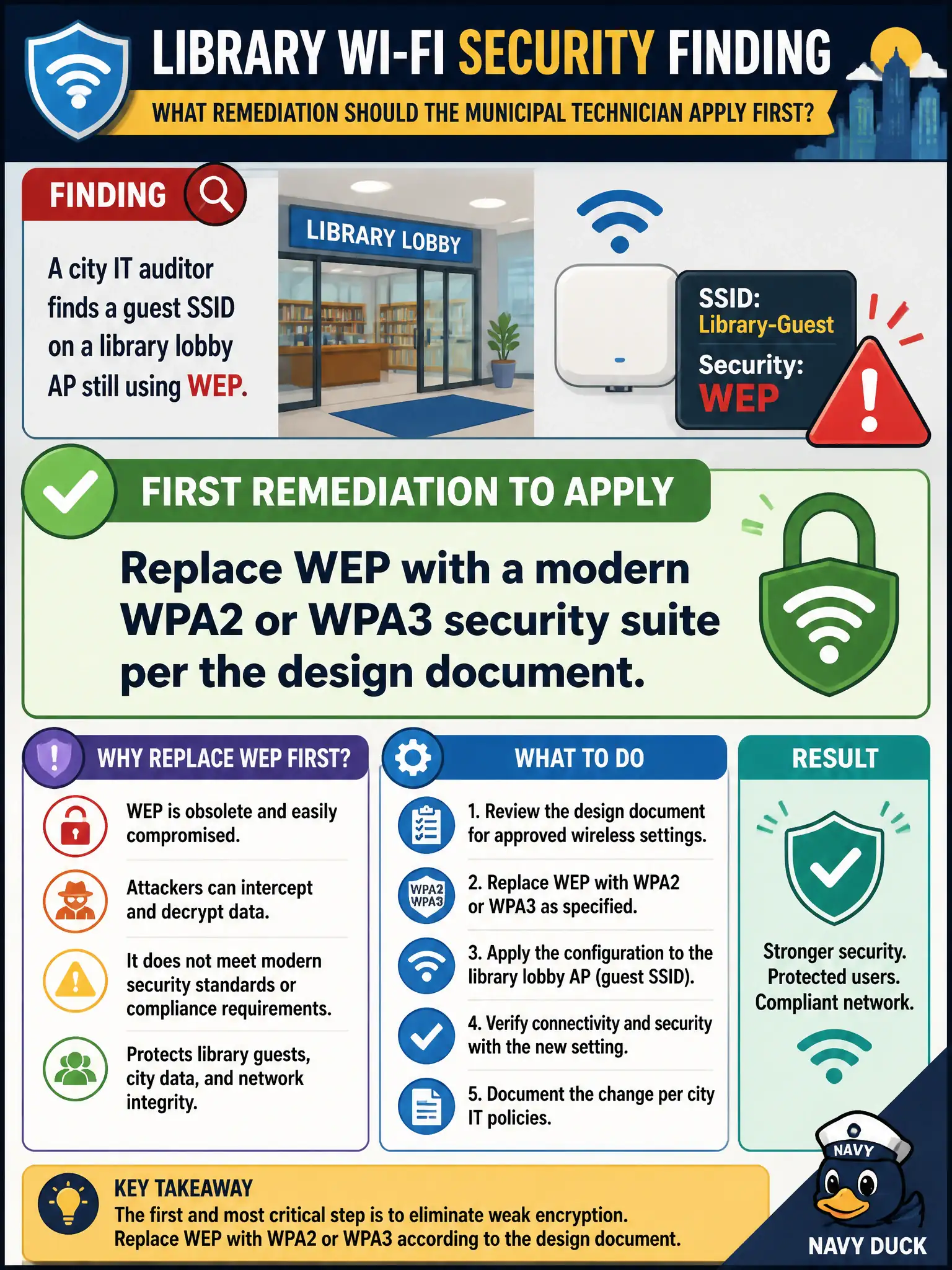
A city IT auditor finds a guest SSID on a library lobby AP still using WEP. What remediation should the municipal technician apply first?
Select an answer to reveal the explanation.
Short Explanation
WEP is a cracked antique, not a guest welcome mat. Treat the auditor finding like a broken lock on the lobby door: swap it for a modern WPA2 or WPA3 suite instead of stacking hide-SSID or MAC tricks on top of WEP.
Full Explanation
When a city IT auditor finds a guest SSID on a library lobby AP still using WEP, the first remediation is to replace WEP with a modern WPA2 or WPA3 security suite per the design document. Library guests still deserve confidentiality against casual eavesdropping, and auditors correctly flag WEP as unacceptable on civic guest airtime. Prompt cipher replacement is the technician’s priority.
Leaving WEP enabled and hiding the SSID so visitors cannot see the name stacks obscurity on broken crypto. Adding a MAC allow-list of library tablets while keeping WEP for older scanners preserves the vulnerable cipher. Enabling Shared Key Authentication so weak WEP keys “rotate more often” worsens the legacy posture.
Exam caveat: remediation for discovered WEP is modern WPA2/WPA3 per design—not hiding, MAC lists, or Shared Key.
Operational check: change the library guest SSID to the approved WPA2/WPA3 mode and passphrase or portal design, verify guest access still works, confirm WEP is gone from the cipher list, and file closure evidence with the auditor. Municipal technicians document the verified setting in the as-built packet so the next shift inherits a known-good civic configuration rather than tribal knowledge.