
Why must a municipal WLAN retire WEP rather than keep it for 'simple devices'?
Select an answer to reveal the explanation.
Short Explanation
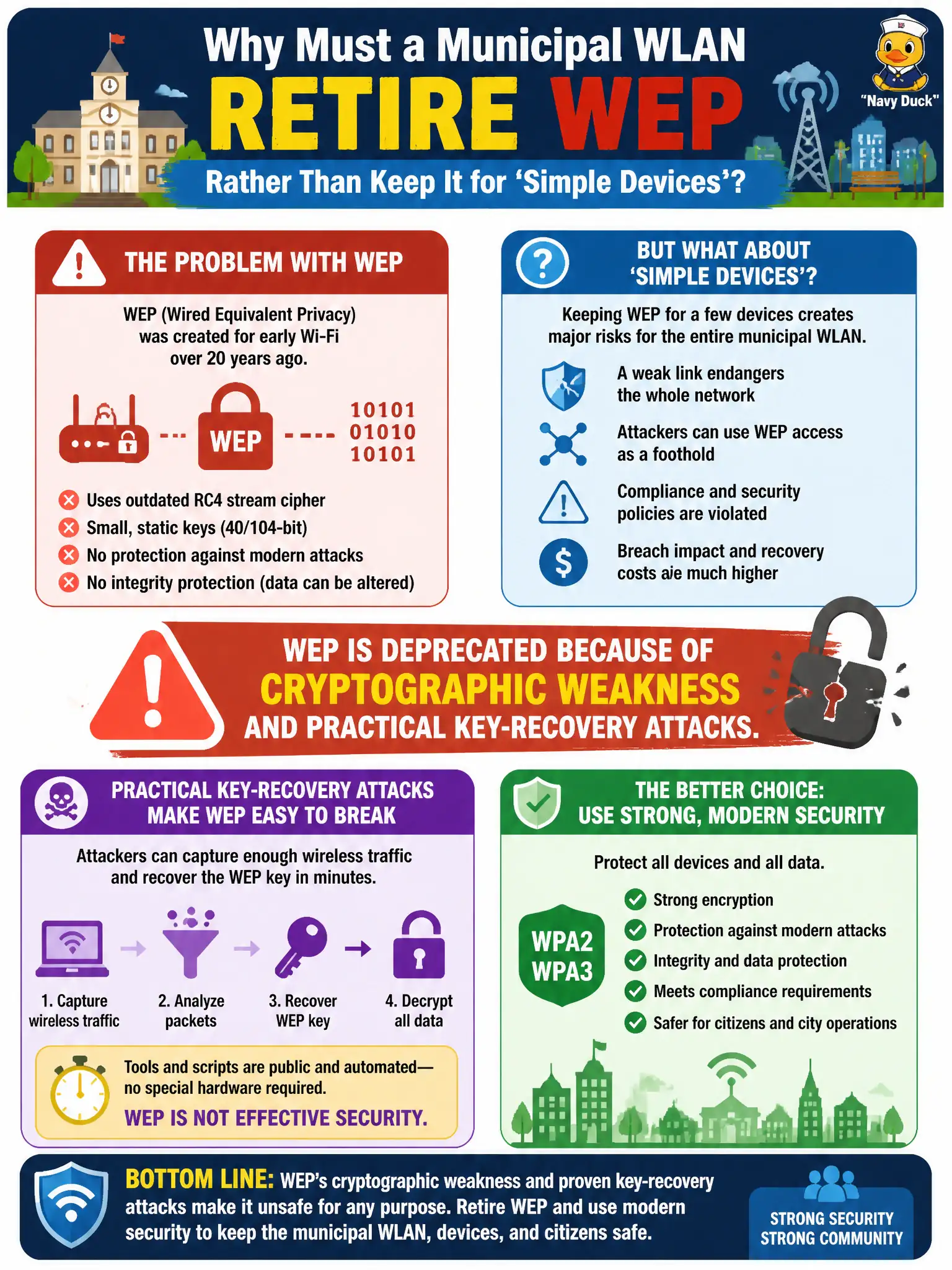
WEP did not age out because typing keys was annoying—it fell to real crypto attacks that recover keys. That is why municipal networks must retire it instead of babysitting 'simple devices' on broken security. Weak cryptography, not splash-page drama, is the deprecation reason.
Full Explanation
Municipal WLANs must retire WEP rather than keep it for “simple devices” because WEP is deprecated due to cryptographic weakness and practical key-recovery attacks. Simple devices do not get a pass to expose city traffic or adjacent segments. Modern WPA2/WPA3 suites—or wired alternatives for truly incapable endpoints—are the responsible civic paths.
Claiming WEP keys rotate automatically forever so attacks are impossible misstates WEP’s failure mode. Saying WEP is deprecated only because SSIDs cannot be hidden with it invents a false deprecation reason. Claiming WEP fails solely because it cannot support captive-portal redirects ignores the cryptographic basis for retirement.
Exam caveat: the reason to retire WEP is crypto weakness and attacks—not signage, portals, or hiding limitations.
Operational check: inventory any remaining WEP SSIDs, migrate or isolate simple devices onto approved modern security or wired ports, disable WEP ciphers on APs, and retain evidence for the municipal security audit. Municipal technicians document the verified setting in the as-built packet so the next shift inherits a known-good civic configuration rather than tribal knowledge. Municipal technicians document the verified setting in the as-built packet so the next shift inherits a known-good civic configuration rather than tribal knowledge.