
A city-owned visitor lodge must choose a guest Wi-Fi credential model. How should the WLAN security designer decide between per-room credentials and open+OWE?
Select an answer to reveal the explanation.
Short Explanation
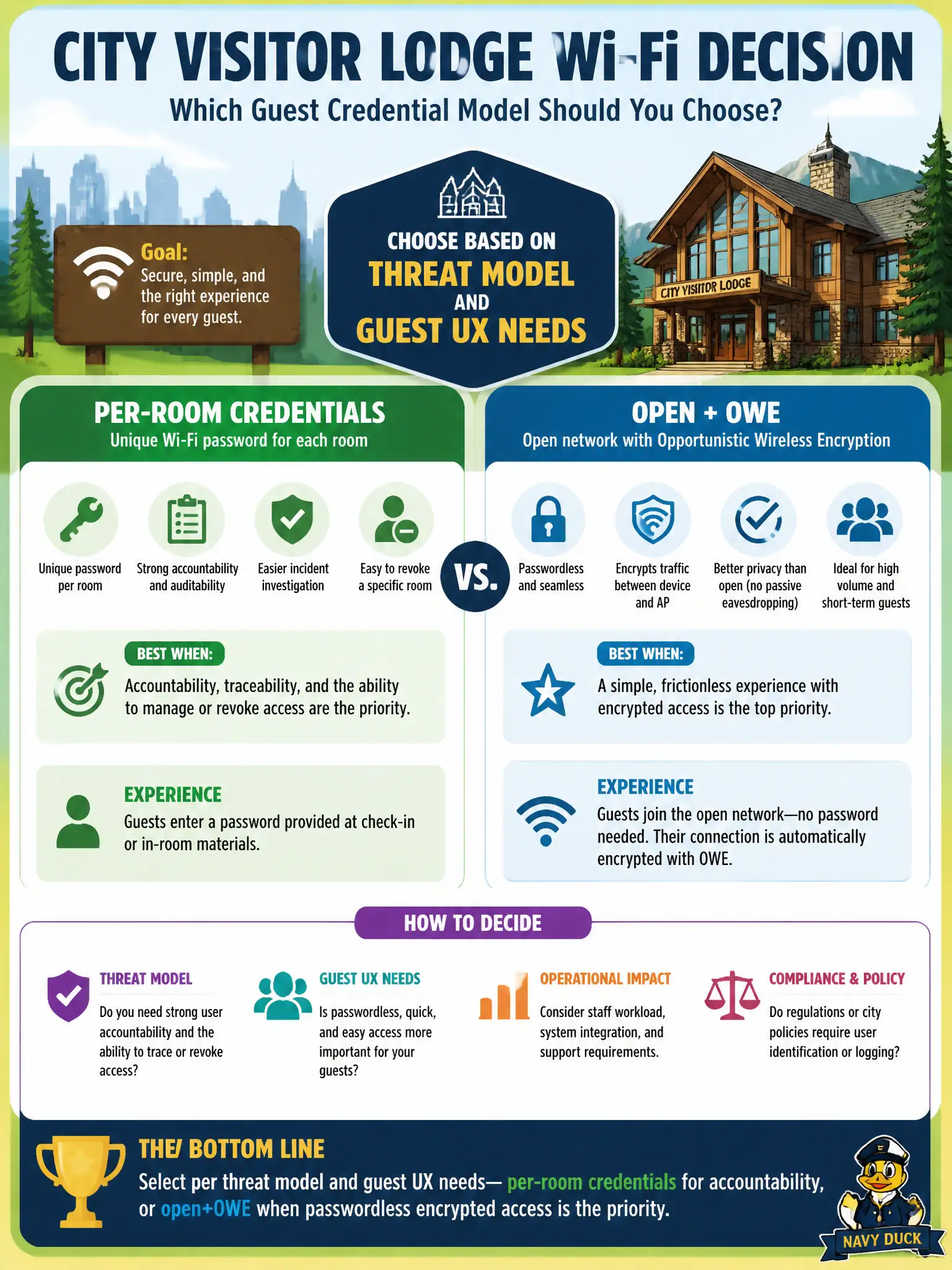
Guest Wi-Fi is a menu, not a single recipe: per-room codes help you know who is on which session; open+OWE feels like a lobby door with a privacy curtain and no code to type. Pick from risk and UX—not a one-size staff PSK.
Full Explanation
Choosing between per-room credentials and open+OWE for a city-owned visitor lodge requires balancing security threat models and guest user experience (UX). Per-room credentials provide accountability by uniquely identifying users per room, enabling tracking and access control tailored to occupants. This approach is suitable when guest identification and auditing are priorities. In contrast, open+OWE offers passwordless encrypted access, simplifying connectivity while protecting data confidentiality against passive eavesdropping. This model enhances UX by removing credential management but sacrifices individual accountability. Always using a global staff PSK for every guest room simplifies support but severely weakens security and accountability, as all users share the same key. Leaving the SSID open without OWE or portals maximizes speed but exposes users to interception and abuse. Requiring EAP-TLS on every tourist phone before check-in is impractical due to device compatibility and user inconvenience. The caveat is that per-room credentials require infrastructure to manage and distribute keys securely, while open+OWE depends on client device support. Operational verification involves confirming that per-room credentials authenticate distinct users or that open+OWE encrypts traffic without requiring passwords, matching the chosen security-UX balance.