
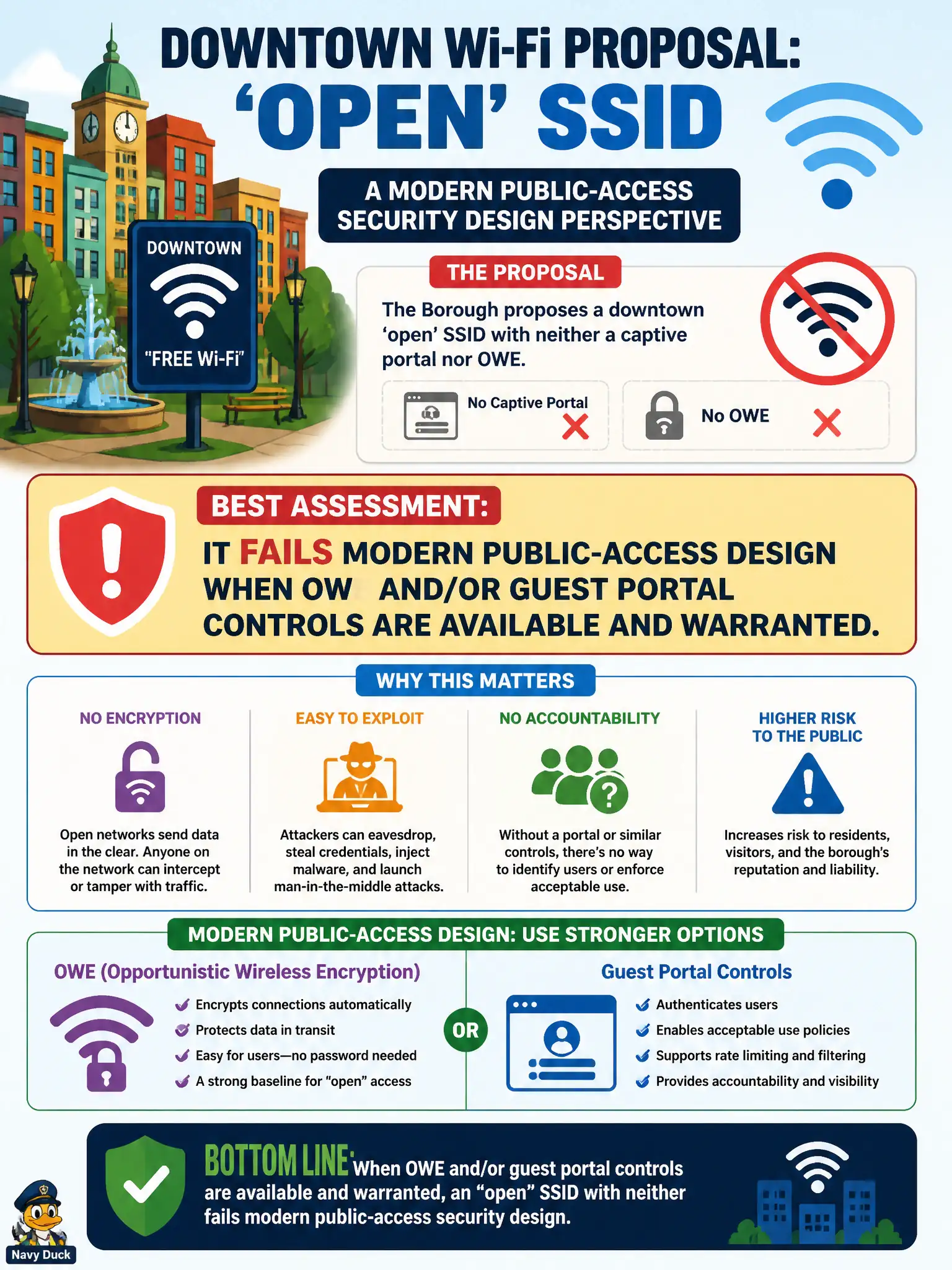
A borough proposes a downtown ‘open’ SSID with neither a captive portal nor OWE. From a modern public-access security design view, what is the best assessment?
Select an answer to reveal the explanation.
Short Explanation
Open with nothing else is shouting city business across the sidewalk with no curtain and no door. If OWE or a guest portal is on the table, skipping both is yesterday’s ‘convenience’ excuse, not a security design.
Full Explanation
A downtown 'open' SSID with neither a captive portal nor Opportunistic Wireless Encryption (OWE) fails to meet modern public-access Wi-Fi security design standards. Without OWE, the wireless link is unencrypted, exposing users to passive eavesdropping and potential data theft. The absence of a captive portal removes the ability to enforce Acceptable Use Policies or present terms of service, which are important for legal and operational reasons. Modern designs favor at least OWE to encrypt traffic and captive portals to manage user access and compliance. The belief that plaintext open Wi-Fi maximizes convenience ignores the significant security risks and liability concerns. Including the word 'Secure' in the SSID name is superficial and does not provide any actual security or user protection. Preferring open SSIDs over Passpoint because profiles are slower misunderstands that Passpoint enables seamless, automatic authentication and improved security, often enhancing user experience despite initial setup. The scope limit is that some very low-risk environments might tolerate open Wi-Fi, but municipal deployments should prioritize user protection. Operationally, test that the SSID encrypts traffic with OWE and redirects users to a portal before granting Internet access to align with best practices.